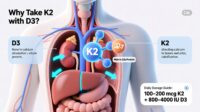
On the surface, D3 and K2 sound like a simple pairing—vitamin D3 helps the body absorb calcium, and vitamin K2 is often described as the “traffic controller” that guides calcium toward bones instead of soft tissue. Yet the question lingers in patient conversations and online searches: Can D3 and K2 cause blood clots? The truth is more nuanced than a yes-or-no answer. It depends on biology, dose, medical context, and how these nutrients interact with coagulation pathways.
To make sense of the rumor, it helps to separate three ideas: (1) what the nutrients are designed to do, (2) what “clotting risk” actually means, and (3) when supplementation could become problematic—particularly in people with underlying disorders or concurrent medications.
Understanding Blood Clots: What “Risk” Really Refers To
A blood clot, or thrombosis, is not a single condition. It’s a process involving platelets, clotting factors, blood vessel integrity, and blood flow dynamics. Some clots form deep in veins (deep vein thrombosis), others occur in the lungs (pulmonary embolism), and still others involve arterial blockage, which is clotting in a higher-pressure system.
When people ask whether vitamin supplements “cause” clots, they often mean one of two things. Either the supplement directly promotes coagulation, or it indirectly increases risk by nudging calcium handling, inflammation, or vascular biology. The body is rarely so obedient that one nutrient simply flips a “clot switch.” Instead, risk is usually a tapestry of factors: genetics, immobility, smoking, surgery, hormone therapy, kidney disease, and sometimes medication interactions.
With that framing, D3 and K2 should be evaluated as pieces of physiology—not as isolated villains.
What Vitamin D3 Actually Does in the Body
Vitamin D3 (cholecalciferol) is converted in the liver and kidneys into active metabolites that influence gene expression. One of its best-known roles is supporting calcium and phosphate absorption in the gut. It also contributes to immune regulation and cell differentiation—subtle actions that can shift inflammatory tone over time.
Because D3 affects calcium availability, some people assume it must also increase clotting. After all, calcium is a cofactor in several steps of the coagulation cascade. Yet “calcium being present” is not the same as “calcium being mismanaged.” In healthy physiology, adequate calcium helps maintain vascular and skeletal function. Problems arise when calcium balance becomes dysregulated—either through disease states, inappropriate dosing, or drug interactions.
In most individuals, standard D3 supplementation is not considered a direct clot inducer. Still, extremes matter. Very high doses can lead to hypercalcemia, and elevated calcium can have downstream vascular effects. Those vascular effects can include impaired endothelial function and changes in smooth muscle behavior—conditions that may, in some people, create a more clot-prone environment.
Short version: D3 can become risky when it overshoots biological targets, especially in predisposed individuals.
What Vitamin K2 Does: The Calcium “Routing” System
Vitamin K2’s reputation as a safeguard against calcification stems from its role in activating vitamin K-dependent proteins, including matrix Gla protein (MGP) and osteocalcin. These proteins influence where calcium ends up. Osteocalcin supports bone mineralization, while MGP helps inhibit abnormal calcification in soft tissues.
That sounds like anti-clot logic at first, but calcium handling connects to multiple pathways. Vascular calcification and thrombosis can co-travel in chronic disease, yet they are not identical processes. Calcification is a longer-term structural shift; clotting is an acute or subacute event.
Because K2 generally promotes healthier calcium distribution, it is more plausible that K2 reduces a broad risk landscape related to calcification. However, health outcomes depend on whether someone is correcting a deficiency, improving a metabolic imbalance, or merely stacking supplements without need.
So, rather than acting as a clot trigger, K2 is more accurately described as a regulator that helps calibrate calcium choreography—provided the rest of the system is stable.
Where the Controversy Comes From: Warfarin, “Vitamin K,” and Misunderstandings
The most important clot-related caveat is not about D3 or K2 acting like pro-thrombotic agents. Instead, it’s about medication interactions—especially with vitamin K antagonists such as warfarin.
Warfarin works by interfering with vitamin K recycling, reducing the activation of clotting factors. If someone on warfarin abruptly adds K2, anticoagulation can weaken, and clot risk can rise. This is not a generic “vitamin K2 causes clots” conclusion. It is a specific pharmacological tug-of-war.
Even consistent, carefully monitored vitamin K intake can matter. The key variable is whether dosing remains stable and whether the prescriber adjusts the INR targets accordingly. For those on anticoagulants, any supplement that contains meaningful vitamin K activity should be treated like a medication, not a casual add-on.
In short: the danger often lies in how K2 interacts with anticoagulants, not in K2 creating clotting biology by itself.
D3 Supplementation and Clot Risk: Dose, Duration, and Underlying Conditions
To understand whether D3 can be associated with clotting, look at the “if conditions” list.
First, consider dose. Large, unmonitored doses can raise serum calcium. Hypercalcemia can provoke multiple physiological irritations: dehydration risk, kidney stress, altered vascular behavior, and potentially pro-thrombotic tendencies in susceptible individuals.
Second, consider duration. Short-term use is less likely to cause dramatic calcium disruptions than chronic high-dose supplementation. Yet chronic elevation can accumulate subtle harms.
Third, consider the preexisting landscape. People with granulomatous diseases (like sarcoidosis), certain lymphomas, hyperparathyroidism, advanced kidney disease, or a history of vascular events may process vitamin D differently. In these contexts, “standard” doses can become nonstandard risks.
Finally, consider testing. Measuring 25(OH)D and, when appropriate, checking calcium and kidney markers can prevent a silent drift into excess. The body rarely signals “warning” in a dramatic way; it drifts.
Therefore, D3 is not inherently a clot promoter, but it can become problematic when doses exceed individual tolerance or when monitoring is neglected.
Can Taking D3 and K2 Together Change the Equation?
Pairing D3 with K2 is often framed as synergistic: D3 increases calcium availability; K2 supports proper routing. In theory, this combination should improve calcium distribution rather than disrupt it.
Still, synergy is not a free pass. If D3 is far above what a person requires, K2 may not fully neutralize the consequences of excess calcium. Conversely, if someone is deficient in K2, supplementation could improve calcification inhibition—yet this doesn’t automatically mean it will affect acute clotting events.
Also, quality matters. K2 comes in different forms (commonly MK-7 and MK-4), and their bioavailability and dosing equivalence are not identical. Some products vary in potency and transparency. A “high number on the label” does not guarantee the same pharmacodynamics across brands.
So, taken appropriately, D3 + K2 is more likely to be a rational regimen than a clot factory. Taken without assessment, it becomes a gamble.
What Types of Readers Should Expect: Practical Scenarios and Content Paths
This topic can branch into several reader journeys.
Readers on anticoagulants: They need clarity about vitamin K antagonists, stable dosing, and INR monitoring. The central theme here is coordination with clinicians, not fear of supplements in isolation.
Readers with a clot history: They often need risk stratification. A prior clot suggests that clot-prevention strategies should be individualized—supplements may be secondary to anticoagulation plans, mobility strategies, and metabolic control.
Readers with bone health goals: They usually want to know whether D3 + K2 supports skeletal mineralization without increasing vascular risk. This audience benefits from discussions on labs, dosing range, and safe progression.
Readers drawn to holistic wellness: They may prefer narrative guidance—how to supplement thoughtfully, how to avoid dosing theatrics, and how to recognize red flags that require medical review.
Readers who prefer evidence-grounded summaries: They’ll want definitions, plausible mechanisms, and “what to measure” checklists rather than generalized reassurance.
Across these groups, the consistent throughline is careful context. Blood clot risk is rarely a solo variable problem.
Visual Context: How Everyday Learning Can Help (and When It Misleads)
Supplements can appear in many lifestyle images—bright, aesthetic, and comforting. But decorative visuals are not clinical data. A more useful approach is to treat packaging and imagery as an entry point, then translate it into lab measurements and medication compatibility checks.
For example, colorful cat art may brighten a room, but it cannot indicate whether a regimen is safe for a specific clotting risk profile. Similarly, a “pretty” health claim should not replace personalized medical guidance.


Use visuals for inspiration if you like—but use testing, dosing discipline, and clinician collaboration for safety.
Bottom Line: The Truth About D3, K2, and Clots
D3 and K2 are not typically considered direct causes of blood clots in healthy people when used in appropriate doses. The bigger risks come from overshooting dosing targets, underlying conditions affecting calcium metabolism, and—most critically—interactions with anticoagulant medications such as warfarin.
If you’re considering D3 and K2, the most responsible path is to align supplementation with your physiology: review current medications, consider relevant lab work, and choose doses that match real need rather than internet averages. Short sentences and clear decisions reduce uncertainty. Long-term wellness is rarely built on a single capsule; it’s built on steady calibration.
When doubt remains, the safest answer is not panic. It’s an evidence-informed conversation with a qualified clinician—especially if you have a clotting history, kidney disease, or you take anticoagulants.