For years, hip fractures have been treated like an unfortunate accident—one sudden fall that changes everything. But the more carefully researchers look at bone health, the more a different story emerges. It isn’t only about falls; it’s also about the body’s readiness to withstand them. Vitamin D and calcium sit at the center of that readiness, quietly shaping bone remodeling, muscle performance, and even the fine-tuned chemistry that governs balance. Once you see them as conductors rather than mere nutrients, the link between them and hip fracture reduction begins to feel less like coincidence and more like a design.
Reframing the “Accident”: From Falls to Fragility
Hip fractures rarely arrive without warning. Even when a fall seems sudden, fragility is usually years in the making. Think of bone like an ongoing construction project: osteoclasts tear down old material, and osteoblasts rebuild stronger scaffolding. When this remodeling becomes lopsided—when breakdown outruns repair—bones lose density and structure, particularly in the femoral neck and surrounding areas.
Vitamin D and calcium influence that construction cycle. Calcium is the literal building block, providing the mineral framework that gives bone its rigidity. Vitamin D, meanwhile, acts as the logistics manager. Without sufficient vitamin D, calcium absorption in the gut declines, and the body may compensate by pulling calcium from the skeleton. That compensation sounds efficient in the short term, but it’s a slow erosion in the long term.
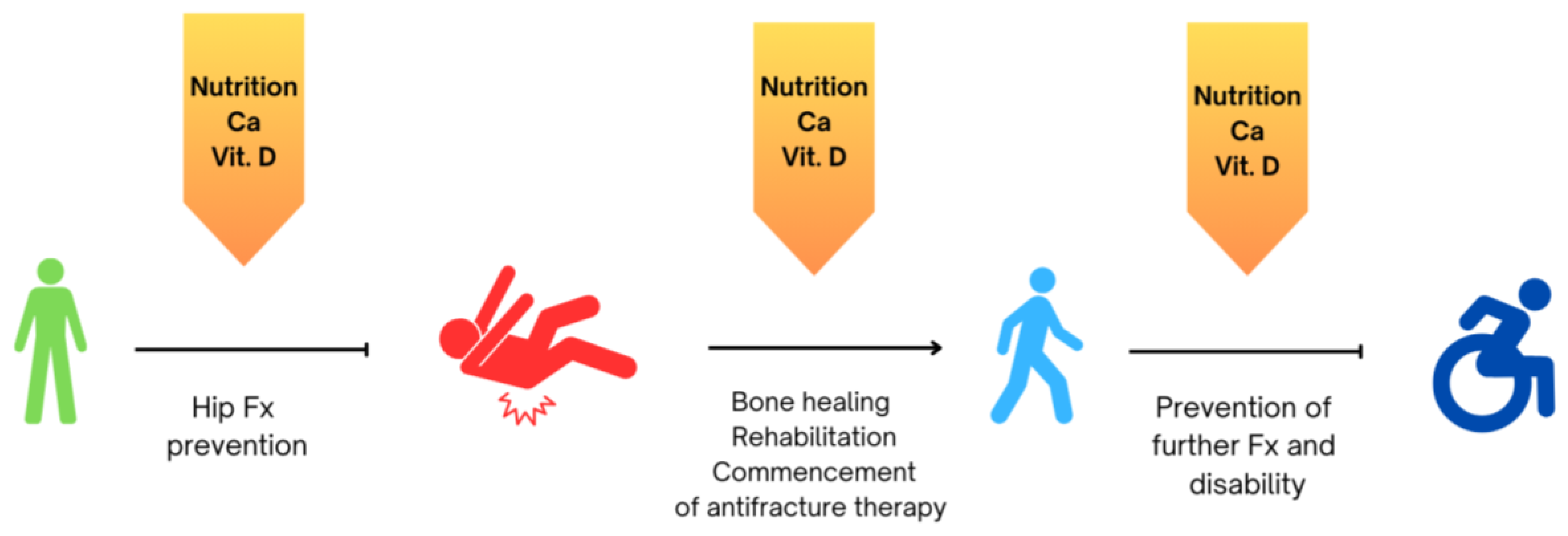
This is the pivot in perspective: hip fracture reduction is not only about preventing falls; it’s also about preventing the internal conditions that make a fall catastrophic.
Calcium: The Structural Backbone of Bone
Calcium’s role is easy to describe and harder to replace. Bone isn’t simply “stored” calcium—it’s constantly being reconstituted. Adequate dietary calcium supports osteogenesis, helping maintain bone mineral density and the microarchitecture that resists cracking.
However, calcium doesn’t work in isolation. The body can only use what it absorbs, and absorption depends heavily on vitamin D status. When calcium intake is low, the body may treat bones like a convenient reserve. Over time, that reserve can become depleted, turning routine impacts into fractures.
There is also a practical nuance: older adults often struggle with reduced appetite, dietary constraints, and occasional gastrointestinal limitations. These factors can quietly shrink calcium intake without anyone realizing the magnitude of the shift.
Vitamin D: The Absorption Switch and More
Vitamin D is frequently introduced as a “helpful vitamin,” but it functions more like a hormone with a multi-system reach. Its best-known job is enabling intestinal absorption of calcium and phosphate. When vitamin D levels fall, calcium absorption can drop sharply—sometimes even before obvious bone changes appear on imaging.
Yet vitamin D’s influence extends beyond the gut. It intersects with neuromuscular function, affecting how muscles generate force and how the nervous system coordinates movement. That matters because hip fractures often follow a loss of balance. A person who moves with slightly reduced stability is more likely to trip, stumble, or fail to recover from a near-miss.
In other words, vitamin D doesn’t merely fortify bones. It helps the body move with steadiness, reducing the probability that a destabilizing event ends in a break.
The Quiet Chemistry: How Bone Remodeling Becomes Slanted
Bone health isn’t static; it is dynamic. Vitamin D helps regulate the environment in which remodeling occurs. When vitamin D is insufficient, mineralization may become less efficient, and bone quality can deteriorate even if density changes are subtle at first.
Calcium availability feeds into that process. If calcium is consistently insufficient, bone formation may not reach its full potential. The result can be a less resilient skeleton—one that absorbs stress poorly and fractures under forces that healthier bone would withstand.
Importantly, fracture risk is not solely about “how much bone” a person has, but also about “how well the bone is assembled.” Vitamin D and calcium contribute to both mineral content and mineralization quality.
Muscle, Balance, and the Fall-Chain Effect
Picture a chain reaction: diminished balance increases fall risk; falls impose impact forces; weak bone turns impact into fracture. Vitamin D may interrupt this chain at multiple points. Through effects on muscle strength, fiber function, and coordination, adequate vitamin D status can support better lower-extremity performance.
Even small improvements can matter. A fractionally better ability to stand from a chair, a slightly more responsive recovery after a stumble—these can determine whether a person catches themselves or hits the ground.
Calcium contributes indirectly by supporting bone strength, which influences the outcome once a fall happens. Vitamin D contributes directly to both muscle function and bone mineral dynamics. Together, they create a two-pronged defense: fewer dangerous moments and better structural survival when moments occur.
Why Older Adults Are Especially Vulnerable
With age, several changes converge. Skin produces less vitamin D in response to sunlight. Diet may shift away from calcium-rich foods. Kidney function and metabolic activation of vitamin D can also decline. Meanwhile, hormonal transitions and chronic inflammation can accelerate bone loss.
What emerges is a predictable pattern: vitamin D insufficiency and low calcium intake become common, and bone density decreases. The consequence is a skeleton that is both less dense and potentially less robust in micro-level structure.
This vulnerability is not inevitable, but it is common. The encouraging implication is that nutritional and lifestyle adjustments can become a lever to alter trajectories—not with dramatic overnight transformations, but with steady, cumulative effects.
What “Reduction” Really Means: Risk, Not Certainty
The phrase “hip fracture reduction” can sound like a guarantee, yet biology rarely offers absolutes. Instead, reduction refers to lowering risk across populations—meaning fewer fractures occur when adequate vitamin D and calcium support bone health.
Risk reduction can take time. Bone remodeling is slow, and improvements in mineralization typically require sustained nutritional sufficiency. Likewise, balance and muscle function respond gradually, reflecting neurophysiological adaptations rather than immediate change.
So the promise is not that every person will avoid a fracture forever. The promise is that the likelihood can shift in a healthier direction—especially for those starting from inadequate vitamin D or calcium status.
Promises, But With Strategy: Supplementation vs. Foundations
For some people, increasing calcium through diet is feasible: dairy products, fortified alternatives, leafy greens, and certain mineral-rich foods can help. For others, diet alone may be insufficient due to absorption issues, intolerance, limited appetite, or lifestyle barriers.
Supplementation can fill that gap, but the most effective approach is strategic. Too little support yields inadequate mineral availability; too much can be problematic for specific individuals, especially those with certain kidney conditions or other contraindications.
The best mental model is balance: adequate vitamin D to enable absorption, adequate calcium to supply the building material, and consistent follow-through to allow bone remodeling processes to catch up.
A Curiosity Question: How Much is Enough?
If vitamin D and calcium are so influential, a natural question follows: what levels matter? The answer is rarely a single number for every person. Skin exposure, dietary habits, body composition, medications, and baseline bone density all play roles.
That uncertainty can be unsettling, but it can also be empowering. It suggests that care should be personalized—guided by clinical evaluation and, when appropriate, measurements of vitamin D status. The goal is sufficiency, not excess.
When a person moves from deficiency to adequacy, the body gains the capacity to absorb calcium and maintain bone mineral integrity. This is where the link to fracture prevention becomes tangible.
Looking Beyond Nutrients: The Synergy With Lifestyle and Care
Vitamin D and calcium do not replace strength training, fall-proofing, vision checks, medication review, or home safety improvements. They complement those interventions. Bone strength grows better when muscles can load it safely and regularly. Balance improves with targeted physical therapy and practice.
In the same way that architecture benefits from both materials and engineering, fracture prevention benefits from both nutrition and biomechanics. Nutrients provide the raw capacity; movement and environmental adjustments determine how that capacity is used.
When care is cohesive, the promise becomes stronger: bones are better built, muscles are better coordinated, and the home is less likely to produce a lethal misstep.
Conclusion: The Link That Feels Like Design
Vitamin D and calcium connect to hip fracture reduction through a chain of influence: improved calcium absorption, supported bone remodeling, and bolstered muscle and balance function. The story is not only about minerals and blood levels—it is about resilience. Once you shift perspective from “a fall happened” to “the body was prepared to resist,” the relationship begins to feel inevitable rather than mysterious.
That’s the real invitation: to treat bone health as an ongoing system, where small biochemical adjustments can yield meaningful real-world outcomes. A hip fracture may still be a dramatic event, but fragility does not have to be the default setting.