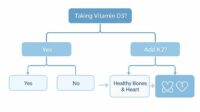

Calcium is the celebrated building block of bones—its reputation is as sturdy as a well-laid foundation. Yet even foundations need daylight. Without vitamin D, calcium can arrive at the doorstep but fail to move through the house efficiently, lingering like an unopened package while your body quietly struggles. So, can you take calcium without vitamin D? Yes, but for many people it becomes a half-finish—less “investment” and more “waste of money.”

Calcium’s Role: A Strong Ingredient, Not a Complete Recipe
Calcium is not merely a mineral stored in bone; it is also a biochemical messenger. It participates in muscle contraction, nerve signaling, blood clotting, and cellular communications. Think of calcium as the scaffolding that allows the body to assemble structure and function.
But scaffolding without the crew is still just metal. Calcium’s benefits depend on absorption and utilization—processes that do not occur in isolation. Your gut can’t simply pour calcium into circulation like water from a faucet. It needs the right conditions to “unlock” the mineral and move it inward.
That unlocking is where vitamin D enters the story, acting less like a garnish and more like the key that turns the lock.
Vitamin D’s Job: The “Unlocking” Mechanism for Absorption
Vitamin D is often described as a vitamin, but it behaves more like a hormone-like regulator. Its crucial task is to increase the intestinal absorption of calcium. In plain terms: vitamin D helps your body absorb calcium from the food you eat and the supplements you swallow.
Without vitamin D, calcium absorption can drop significantly. This doesn’t always mean “zero,” but it does often mean less than you expect—like trying to fill a bucket with a slow leak. You may still pour in calcium, yet the amount that actually stays where it matters is smaller than advertised.
When absorption is reduced, the body may compensate by drawing calcium from bone stores, or by failing to maintain optimal calcium balance. Over time, this can undermine skeletal resilience.
The Waste-of-Money Question: When Supplements Become Misdirection
Buying calcium alone can feel sensible—especially if you’ve heard bones need it. But think of it as purchasing building materials without ordering the contractor. A bag of cement is not inherently wrong; it’s just incomplete if the rest of the plan is missing.
For people who are already vitamin D replete—often those with sufficient sunlight exposure and normal blood levels—calcium supplementation may still provide benefit. However, many individuals are vitamin D insufficient due to indoor lifestyles, limited sun exposure, darker skin pigmentation, older age, or living at higher latitudes.
In those cases, taking calcium without vitamin D becomes a marketing illusion: you’re paying for a mineral that may not be fully utilized. The money is real, but the return on investment is smaller.
Who Might Be Able to Take Calcium Without Vitamin D?
Not everyone needs vitamin D in the same way. Some people may have adequate vitamin D status already, which means their calcium absorption machinery is already humming. If your blood tests show sufficient 25-hydroxyvitamin D, your body can typically process calcium more effectively, even if your supplement includes only calcium.
Also, if your diet is rich in vitamin D—fatty fish, fortified foods—or if you get regular, appropriate sunlight, the “vitamin D gap” may already be covered. In these scenarios, calcium alone may not be a total bust.
Still, certainty matters. Without checking vitamin D status or at least discussing risk factors with a clinician, deciding to supplement only calcium is often guessing in the dark.
Why “More” Calcium Isn’t Always Better
Calcium supplementation is not infinitely scalable. When the body can’t absorb a large fraction of what you take, the unabsorbed portion simply doesn’t serve your bones. It may pass through and contribute to gastrointestinal discomfort in some people, and excessive intake can raise the risk of kidney stones in susceptible individuals.
There’s a subtle psychological trap here: the belief that doubling down will create doubling benefits. Physiologically, that’s not how absorption works. It’s more like trying to accelerate a train by adding more fuel while ignoring the tracks’ condition.
When vitamin D is low, your “track condition” is compromised. Extra calcium doesn’t repair the underlying logistics.
Food vs. Supplements: The More Natural Route
Calcium from food has a steadier presence in the digestive environment. Dairy products, leafy greens, fortified plant milks, and certain fish can contribute meaningful calcium while accompanying nutrients may support overall metabolic health.
However, vitamin D from food is often limited, and sunlight exposure varies widely. That’s why dietary calcium may still be insufficient if vitamin D is also lacking.
In an ideal world, you consider calcium intake and vitamin D status as a two-part symphony. Calcium provides the notes; vitamin D helps your body hear them clearly.
Bone Health and the Long Game: From Short-Term Uptake to Long-Term Outcomes
Bones are living tissue. They continually remodel—old bone is replaced by new bone through a balance between osteoblasts (bone builders) and osteoclasts (bone resorbers). Vitamin D influences this system, supporting mineralization and maintaining healthier calcium balance.
Taking calcium without vitamin D may provide some benefit, but the long-term architecture may not strengthen as effectively. It’s comparable to installing insulation without heating: the structure feels protected, yet comfort and performance remain constrained.
Over months and years, those constraints matter. Reduced absorption and altered calcium handling can erode the intended gains of supplementation.
Common Signs of Low Vitamin D (and Why They Matter)
Low vitamin D can be subtle. Some people experience fatigue, muscle aches, or generalized discomfort. Others notice slower recovery after physical strain or reduced muscle strength.
But symptoms are notoriously unreliable. Many individuals have low vitamin D without clear warning signals. That’s why blood testing—particularly 25-hydroxyvitamin D—often provides a more accurate map than guesswork.
If you’re contemplating calcium supplementation, evaluating vitamin D status is a practical step toward making the effort count.
Safety Considerations: Side Effects and Interaction Awareness
Calcium supplements can cause constipation, bloating, or nausea in some people. Splitting doses may improve tolerance. Taking calcium with meals can also help absorption for certain forms.
Vitamin D supplementation is often well-tolerated, but dosing matters. Too much vitamin D can lead to elevated calcium levels in the blood, which may cause symptoms such as nausea, weakness, or confusion. This is why individualized guidance is preferable to generic megadosing.
Furthermore, calcium can interfere with absorption of certain medications, including some thyroid treatments and antibiotics. Timing the doses can reduce interference.
A Clearer Strategy: Pair Calcium with Vitamin D—or Confirm You Don’t Need To
If your goal is to support bones, the most rational approach is either to pair calcium with vitamin D or confirm that your vitamin D status is already sufficient. Otherwise, you risk buying a partial solution.
Imagine calcium as bricks and vitamin D as the mortar. You can stack bricks without mortar, but the structure will be weaker. For many people, that weakness shows up quietly—until it doesn’t.
For those with high risk of low vitamin D—limited sun exposure, older age, certain health conditions, or darker skin—vitamin D becomes less optional and more essential.
Visual Summary: The “Key and Lock” Concept
To make the relationship memorable, picture your intestines as a door. Calcium is the package you bring. Vitamin D is the key that allows the package to pass through. Without the key, the package may remain at the threshold.

This global variation matters: where you live and how much daylight you receive can influence vitamin D production, which in turn affects whether calcium supplementation becomes truly effective.
The Bottom Line: Calcium Alone May Be a Half-Step
Can you take calcium without vitamin D? Yes, technically. But for many people it’s a half-step that can become a waste of money—because calcium’s full value depends on vitamin D-enabled absorption and balanced calcium metabolism.
If you want your supplement plan to feel less like guesswork and more like engineering, treat vitamin D as a partner, not an afterthought. Your bones deserve the complete blueprint, not just one ingredient.