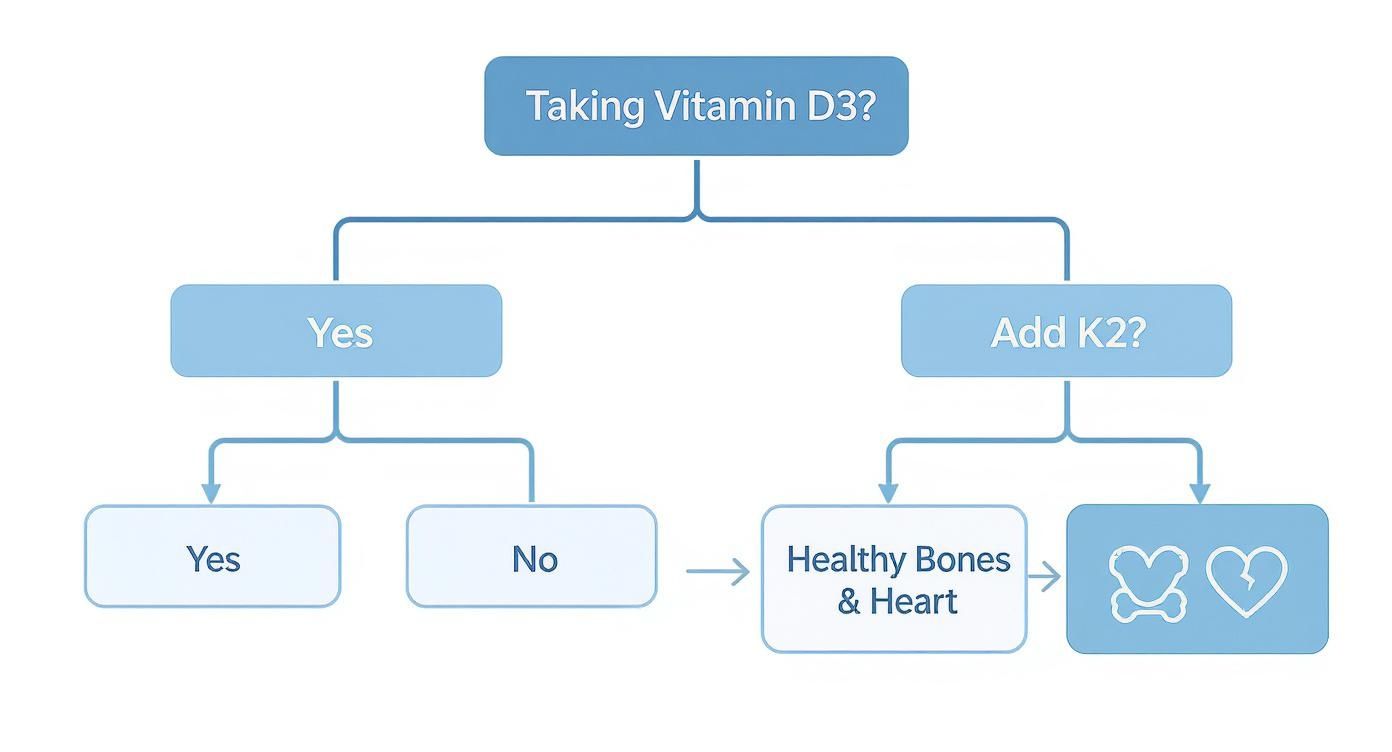

You can be diligent with your multivitamin and still miss a quiet biochemical handshake: the pairing of vitamin D3 with vitamin K2. It’s a common observation—many people take a multivitamin for “bone health” and feel confident they’re covered—yet somehow the K2 piece can be thin, inconsistent, or simply absent. That mismatch isn’t just a labeling quirk. It hints at deeper reasons why fascination with D3 is easy, while K2 often remains a background character in the supplement narrative.

Why D3 Gets the Spotlight (and K2 Often Doesn’t)
Vitamin D3 is famous for its role in calcium absorption and immune modulation. It’s been studied for decades, discussed in wellness circles, and frequently measured on labs. When something becomes measurable and recognizable, it tends to become the default choice. K2, by contrast, is more nuanced—less talked about, less routinely tested, and often misunderstood.
Many multivitamin formulas prioritize ingredients that are widely perceived as “must-haves.” D3 fits neatly into that category. K2 does not always follow, even when the product promises support for bones, muscles, or healthy aging. The result is a fascinating paradox: you can take enough D3 to increase calcium demand, while not providing the K2 required to guide calcium toward bone rather than settling into the wrong tissues.
The “Calcium Transit System” Isn’t Automatic
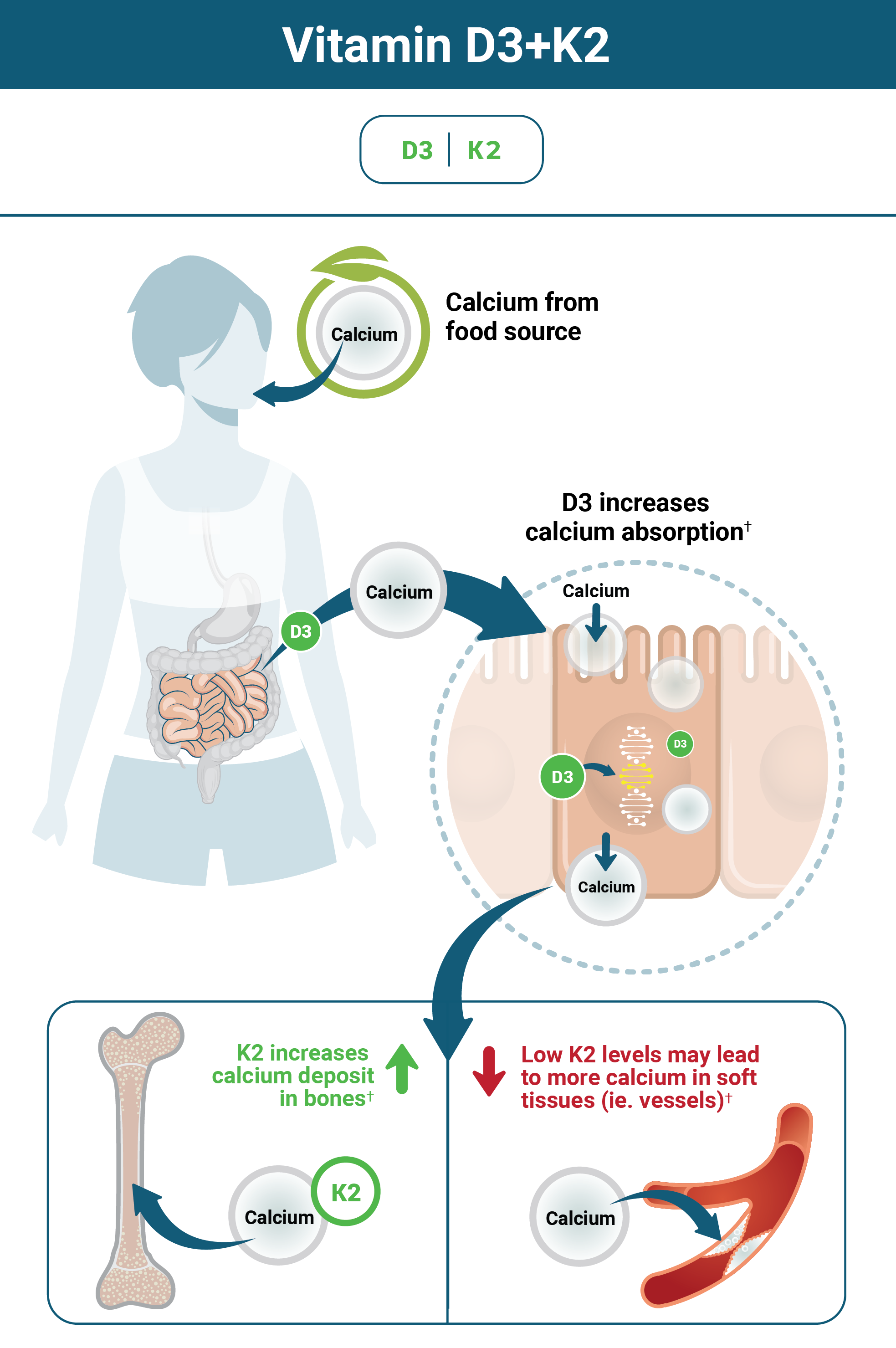
Your body doesn’t simply absorb calcium and hope for the best. There’s a transportation process with specific regulators. Vitamin D3 helps raise calcium availability. Vitamin K2 helps activate proteins involved in directing calcium to appropriate places—especially those associated with skeletal mineralization.
When K2 is under-dosed, the calcium transit system can become less efficient. Think of D3 as increasing the supply, while K2 is needed for correct routing. Without sufficient K2, some of that calcium may be more prone to misdirection, a concern that becomes more relevant with age, metabolic stress, or existing cardiovascular risk factors.
This isn’t meant to trigger alarm. It’s a reminder that wellness is rarely about one vitamin working alone; it’s about coordinated biochemistry with timing, dosage, and compatibility.
Dosage Differences: “Present” vs. “Meaningful” K2
Not all K2 is created equal, and not all K2 included in multivitamins is included in meaningful amounts. A label might list K2, but the quantity could be minimal—suitable for appearance rather than physiological impact.
Some products use smaller doses because of cost, tablet size constraints, or a desire to keep formulas simple. Others may assume that average diets supply enough K2 from fermented foods. Yet dietary reality varies widely. If your intake of fermented sources (like natched foods, certain cheeses, or specific traditions) is inconsistent, the multivitamin’s K2 contribution may be too modest to bridge the gap created by higher D3 intake.
So the key question becomes less “Does it contain K2?” and more “Does it contain enough K2 to match the D3 effect you’re creating?”
MK-4 vs. MK-7: The Form Can Change the Experience
Vitamin K2 is often discussed as a single nutrient, but it comes in different forms, commonly MK-4 and MK-7. The body’s interaction and the duration of action can differ by form, which affects whether a product feels “therapeutic” or merely “token.”
Some multivitamins lean toward one form without considering how that aligns with D3 supplementation habits. If you’re taking D3 separately—or if your D3 status is low—your need for K2 may not match what a multivitamin provides.
This creates another layer of fascination: the same word “K2” can conceal distinct pharmacokinetic behavior. Labels can be accurate, yet still incomplete in how they communicate real-world support.
Absorption, Food Matrix, and the Quiet Role of Fat
D3 is fat-soluble. That means absorption can be influenced by whether you take it with a meal containing dietary fat. K2 is also fat-soluble, and its absorption can be similarly affected by the food matrix.
Even if your multivitamin lists both nutrients, they may be consumed in conditions that reduce absorption efficiency—like taking the pill on an empty stomach or inconsistently with meals. In practice, supplement synergy depends on more than ingredients; it depends on timing and gastrointestinal context.
So the problem may not be “missing K2” so much as “misaligned absorption.” A formula can be theoretically supportive and still underperform due to how it’s actually taken.
Age, Hormonal Shifts, and the Rising Importance of Guidance
As people age, calcium handling can become more delicate. Bone remodeling changes; vascular and tissue environments can shift; and the body may become less forgiving when supplements aren’t balanced.
In younger years, the system may compensate. Later, compensation becomes costlier. That’s when the absence of adequate K2 becomes more noticeable—not because D3 is suddenly harmful, but because the “rules of routing” matter more.
In this sense, multivitamin formulas that once seemed sufficient may begin to feel inadequate. It’s not a failure of personal discipline. It’s a biological reminder that your nutritional needs can evolve.
Common “Bone Health” Marketing vs. Biochemical Reality
Many multivitamins market “bone health,” “calcium support,” or “skeletal strength.” Marketing language can be broad, optimistic, or simplified for consumer clarity. The biochemical reality is more specific: D3 and K2 participate in interconnected pathways that must be considered together.
If a product emphasizes D3 without a robust K2 component, it may create a directional bias—supporting calcium availability without equally supporting calcium destination. This is like turning up a heating system without ensuring the thermostat is calibrated.
The deeper reason this becomes confusing is that wellness culture often celebrates single-nutrient stories. Biochemistry prefers duet choreography.
Dietary Patterns: When You Need More Than What Food Provides
Some people consume K2-rich foods regularly, especially fermented options or traditional diets that include them. Others—particularly those who avoid certain dairy types, don’t eat fermented foods, or have dietary restrictions—may not reliably obtain K2 from meals.
If your food pattern is low in K2, the multivitamin becomes your main source. But even then, the multivitamin’s K2 dose might not scale to your needs. The fascination here is subtle: nutritional adequacy isn’t a yes/no proposition. It’s a balance between what you ingest and what your physiology requires at that moment.

How to Spot the Gap Before It Becomes a Guess
Instead of relying on reassurance from a broad “bone support” claim, scan the facts. Look for whether K2 is actually present in a meaningful quantity. Check which form is used. Consider whether you take the multivitamin with food. And think about your D3 intake—both from supplements and sunlight exposure.
Some people assume they’re fine because their multivitamin contains D3 at a standard dose. Yet “standard” doesn’t always match their personal context—especially if they supplement extra D3 seasonally. When D3 rises, K2 needs may rise too, creating a mismatch that can go unnoticed for months.
This is where curiosity becomes practical. A few label details can transform uncertainty into a more intentional health strategy.
Putting It All Together: A More Coordinated Supplement Philosophy
The core idea isn’t that multivitamins are useless. It’s that they are frequently generalist products. K2 is a specialist nutrient, and its role becomes most relevant when D3 is active and calcium dynamics are in motion.
When D3 and K2 are treated as separate concerns, the body may receive the “signal” to use calcium without receiving enough “instructions” about where that calcium should go. When they’re treated as a duet, the entire rhythm can feel more coherent.
If you’ve been taking a multivitamin and wondering why results feel muted, or why you keep reading about K2, your curiosity is pointing somewhere real: toward biochemical coordination, not just supplement consumption.
A Final Thought Worth Sitting With
Multivitamins can be a helpful foundation, but they’re not always tailored to the quiet choreography that bones and blood vessels require. If you’ve noticed K2 feels mysteriously optional, you’re not imagining things. It’s often underemphasized because it’s less marketed, more form-dependent, and harder to summarize in a single headline.
Yet the fascination persists for a reason: when D3 and K2 are appropriately aligned, calcium handling becomes less of a gamble and more of a guided process. That shift—from hoping to understanding—is where better supplement decisions start.