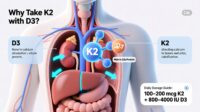
When people talk about vitamin D and vitamin K, they often describe them as separate “helpers” in the body. Yet a subtler pattern emerges when you take D3 and K2 together: the story stops being about isolated nutrients and starts resembling a coordinated biochemical choreography. The pairing feels almost inevitable once you understand what each vitamin is doing—one acting like a gate-opener for calcium, the other like a meticulous courier that helps decide where calcium should—and should not—go. And if you’ve ever wondered why some routines seem to “click” while others feel flat, the answer may be hiding in that coordinated design.
First, the common observation: “I already take vitamin D” (so why K2?)
A frequent observation is straightforward: many people begin with vitamin D3 because deficiency is widely discussed. Later, someone mentions K2, and the reaction is often skeptical. After all, vitamin D is already “about bones,” right? The confusion is understandable. Vitamin D3 supports calcium absorption in the gut, and calcium is undeniably relevant to skeletal integrity.
But here’s the twist—calcium absorption is only the opening move. The body then has to route that calcium responsibly. Without K2, the calcium may still increase in circulation, but the distribution and utilization can become less discerning. K2 helps govern the destinations by activating proteins involved in mineralization and tissue regulation. In other words: vitamin D3 may raise the supply; K2 influences how the supply is allocated. It’s less like buying two products and more like aligning two stages of a system.
D3’s role: increasing calcium availability through calcium “readiness”
Vitamin D3 (cholecalciferol) is often described as a bone vitamin, but its mechanism is more elegant than that. D3 is converted into active forms that influence gene expression and metabolic signaling. The result is improved calcium absorption—particularly in the small intestine—along with better regulation of phosphorus handling. This makes calcium “available” not only in amount, but also in biochemical readiness.
Picture calcium as a substance that can’t perform its job until it receives the right permissions. Vitamin D3 helps provide those permissions. This is why people with low vitamin D status may feel like they’re doing “everything right” nutritionally but still not seeing the outcomes they expected. The bottleneck often isn’t calcium itself; it’s the body’s ability to utilize calcium efficiently.
K2’s role: directing calcium toward bone and away from inappropriate targets
Vitamin K2 is associated with a different kind of competence. Instead of focusing on absorption, K2 is involved in activation of vitamin K–dependent proteins—molecular tools that help guide calcium’s fate. Some of these proteins support bone mineralization, while others help limit calcium deposition in soft tissues.
That “routing” function is a key reason the D3 + K2 combination sparks fascination. Calcium doesn’t simply float into bones by intention; it must be organized at the cellular level. Without adequate K2 activity, the system may still deliver calcium due to D3, but the finishing work—where and how mineralization happens—can be less precise.
The synergy: why together they feel more “complete” than alone
Synergy doesn’t mean magic; it means compatibility. D3 increases the body’s capacity to absorb and use calcium. K2 ensures that calcium-related proteins are appropriately activated for proper mineralization and regulation. When both are present, the body’s “calcium workflow” becomes less fragmented.
Short version: D3 helps you get calcium. K2 helps you use it wisely. Longer version: the coordination reduces the likelihood that calcium will end up in less favorable places—an outcome that becomes more relevant as calcium handling demands rise with age, hormonal transitions, and metabolic stress.
This is also where the deeper fascination lives. The pairing suggests the body was never designed for single-nutrient thinking. Instead, it was built for orchestration—multiple molecular actors responding to each other’s roles.
Bone health: mineralization, density, and the “quality” of support
Bone health is often discussed in terms of density, but quality is more nuanced. Mineralization is not just about depositing material; it’s about doing so with structure, timing, and protein-mediated guidance. D3 contributes to the supply line and biochemical readiness. K2 contributes to the activation of proteins linked to bone matrix competence.
When taken together, the theoretical benefit is a more coherent mineralization environment. This matters because bones are living tissues—continuously remodeled. A well-supported remodeling process can help maintain strength, which becomes increasingly important with advancing age and changes in physical activity patterns.
Soft tissue calcification: the quiet concern behind the pairing
Another common reason people investigate D3 + K2 is a concern that doesn’t always receive headlines: if calcium is increased in the body, could it contribute to undesired calcification?
K2 is frequently discussed in this context because it supports activation of proteins thought to limit calcification in soft tissues. That doesn’t mean vitamin D automatically causes harm, and it doesn’t imply that more calcium is always worse. It means the body needs balanced regulation—especially when supplementation strategies increase calcium availability.
This is precisely why the combination attracts attention: it offers a “guardrail” concept. Rather than treating calcium as a one-way street, the D3 + K2 pairing frames calcium as a material that must be carefully zoned.
Cardiovascular intrigue: beyond bones, toward vascular signaling
Calcium metabolism intersects with cardiovascular health in ways that are easy to overlook. When calcium-related regulation falters, vascular calcification can become part of the picture. K2’s role in activating proteins involved in keeping calcium out of soft tissue pathways is often part of the discussion.
Meanwhile, D3 status has also been linked to cardiovascular markers in various research narratives. The fascination here is not about reducing a complex system to one supplement; it’s about recognizing that mineral regulation is a cross-system phenomenon. Your bones and vessels are not separate worlds; they share metabolic grammar.
Energy, immunity, and mood: why people feel differences (and why it’s not always placebo)
Some people report broader improvements—immune resilience, energy, even mood stabilization—after optimizing vitamin D3. There’s biological plausibility. Vitamin D influences immune signaling pathways and may affect inflammation tone. This is one reason D3 is a gateway nutrient: it’s widely used and often felt.
How does K2 fit into that? Less directly, but still meaningfully. By supporting calcium regulation and skeletal integrity, K2 may contribute to a physiological environment where activity tolerance, posture-related comfort, and general vitality improve. Not every improvement is dramatic, and not every person experiences the same effects. But the reports collectively hint that the D3 + K2 combination may influence more than just one endpoint.
Practical considerations: dosing, timing, and absorption dynamics
Because D3 and K2 are fat-soluble, taking them with a meal that includes dietary fat may enhance absorption. Many people choose a consistent daily or weekly schedule to maintain steadier status over time.
Dosage details should be personalized. Factors include baseline vitamin D level, dietary intake of K-rich foods, age, body weight, and medical history. This is also where caution enters: individuals taking anticoagulant medications (particularly warfarin) require professional guidance because vitamin K can affect medication action.
In short: the combination can be conceptually powerful, but it works best when integrated thoughtfully into an overall health plan.
Illustrative visual: the “routing system” idea
To make the synergy memorable, think of calcium as cargo. D3 helps load the cargo. K2 helps assign delivery destinations—strengthening bone pathways and supporting regulation in soft tissue zones.

Who may be especially interested in D3 + K2?
Certain life stages and health contexts often elevate interest. People with low sun exposure, older adults, individuals with limited dietary intake of K2-rich foods, those with heightened calcium needs, and anyone already supplementing D3 may consider exploring the balance. Athletes and highly active individuals sometimes want to ensure their mineral economy supports training demands.
However, fascination should not replace evidence. The best approach is to treat supplementation as a hypothesis: monitor where it makes sense, reassess periodically, and keep the overall diet as the foundation.
A final perspective: why the pairing resonates
D3 + K2 benefits are compelling because they represent a systems-level understanding of mineral biology. The combination addresses a common observation—vitamin D alone may increase calcium—then hints at deeper reasons why outcomes can diverge: calcium must be absorbed, processed, and routed with precision. One vitamin prepares the environment; the other helps calibrate the final mineralization decisions.
In that sense, the fascination isn’t just about nutrients. It’s about coordination—about recognizing that the body’s chemistry prefers partnerships over single stars.