There’s a familiar question that floats through winter coats and summer sunscreen alike: does the season truly change the best time to take Vitamin D? Most people think of Vitamin D as a simple “sun-to-tablet” conversion—something you take when you feel depleted or when the days look dim. Yet the answer is more nuanced. Season changes not only sunlight intensity, but also your body’s rhythms, your behavior, and even the biochemical choreography that governs absorption and activation. If you’ve ever noticed that one season makes Vitamin D feel “stronger” or “weirder,” you’re not imagining it.
In the following sections, the discussion unfolds like a slow walk from daylight to shadow—showing why the timing of Vitamin D can feel seasonal, why common advice sometimes oversimplifies, and why the fascination with “when” may be just as important as “how much.”
Why Vitamin D Feels Different Across the Year
Vitamin D is often described as a vitamin, but it behaves more like a hormone precursor. The body’s first act begins with sunlight—specifically UVB—triggering Vitamin D production in the skin. As seasons shift, UVB availability changes dramatically. In many places, winter months reduce UVB exposure so severely that dietary or supplemental intake becomes the dominant source.
So when someone asks about “best time,” they’re really asking: when does the body most efficiently interpret Vitamin D’s presence? In summer, the body might already be “topping off” stores through incidental sun exposure. In winter, those stores can drift downward, which can make supplementation feel more consequential. That doesn’t automatically mean the calendar changes the drug’s pharmacology; rather, season changes the baseline state you start from.
The Common Observation: “Take It When You’re Low”
A widespread belief suggests that the best time is simply when you’re low—when you feel sluggish, when sunlight is scarce, or when blood tests hint at deficiency. It’s an intuitive idea, and it contains a sliver of truth. Many people do notice fewer benefits or less perceived energy during darker months, and they connect that to Vitamin D.
However, “when you’re low” can become a trap. Human symptoms rarely point to a single cause. Fatigue can arise from sleep debt, dietary insufficiency, seasonal affective patterns, stress physiology, or reduced activity. Vitamin D deficiency may be involved, but it’s not always the protagonist. That’s why timing advice should be grounded in a broader perspective: not just how you feel, but what your body is likely doing metabolically at that time of year.
Seasonality also influences behavior. In winter, people may spend less time outdoors, wear more coverage, and eat different foods. These changes can alter Vitamin D status and confound the “I took it and now I feel X” narrative.
The Deeper Reason: Your Body’s Daily Clock Matters
Even if season sets the stage, your daily circadian timing can still affect outcomes. The body doesn’t handle all nutrients in a purely linear way. Many physiological processes follow time-of-day patterns—hormone release, metabolism, gene expression, and digestive activity.
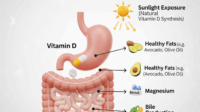
Vitamin D metabolism involves conversion pathways primarily in the liver and kidneys, mediated by enzymes that are sensitive to broader metabolic conditions. While the “best hour” is not universally fixed, there’s a practical principle: Vitamin D absorption is closely tied to whether it’s taken with a meal that contains fat.
So, in a seasonal context, the “best time” often becomes the time when your routine most reliably includes dietary fat—commonly with breakfast or lunch. This is less mystical and more biochemical: fat improves solubility and helps escort Vitamin D into the bloodstream more efficiently.
Seasonal Reality: UVB vs. Supplemental Timing
In summer, your skin may contribute a meaningful fraction of Vitamin D stores. That doesn’t mean supplements become useless; it means your baseline may already be supported. During spring and early summer, you might notice that your blood levels rise gradually, often lagging behind sun exposure by weeks.
In winter, UVB exposure drops. Stores decline, and supplementation may take on a more prominent role. But the key detail is timing relative to physiology, not just daylight. Vitamin D has a longer half-life than many nutrients. That means you’re not chasing immediate effects minute-to-minute; you’re supporting a slow replenishment cycle.
Therefore, the “best time” in winter may be less about a dramatic timing shift and more about consistency: taking Vitamin D regularly when sunlight is minimal, and taking it with meals to maximize absorption.
Absorption: Why Taking It With Food Often Wins
Vitamin D is fat-soluble. That single trait strongly influences practical timing. If you take a supplement on an empty stomach, absorption may be less predictable. Fat-containing meals—whether from eggs, yogurt, olive oil, nuts, or richer dishes—act like a convoy for Vitamin D molecules traveling through the digestive system.
Short sentence, strong message: timing with a meal can matter. Long sentence, equally important: because season changes your eating schedule and food composition, the same “time of day” recommendation might land differently in different months.
In colder seasons, some people eat earlier, more heavily, or less consistently. Those behavior shifts can quietly alter absorption outcomes. Align your supplement with a meal that truly includes some dietary fat—consistency is often the real superpower.
Winter Strategy: Calm Replenishment When Sun Is Sparse
Winter often invites a “start now” mindset. It’s reasonable, especially for individuals who rarely get sun exposure. Yet the best approach isn’t necessarily to cram supplements into any convenient moment—it’s to create a steady rhythm.
Taking Vitamin D after a lunch or a fuller breakfast tends to fit winter lifestyles. The goal is to reduce variability. When days are short, schedules are often tighter, and meals can be rushed. Choose the meal you can keep, not the one you hope will happen.
Also, be mindful that winter can coincide with reduced physical activity. Vitamin D isn’t a muscle tonic by itself, but it interacts with broader systems tied to bone, immunity, and inflammation. When you pair supplementation with movement, adequate protein, and overall dietary quality, the seasonal picture becomes more coherent.
Summer Strategy: Maintain Without Overreacting
In summer, it’s tempting to stop supplementation entirely because sunlight is abundant. For some, that might make sense—particularly if blood levels are solid and sun exposure is consistent. For others, “summer confidence” can lead to under-supplementation when UV exposure is actually irregular (think travel schedules, heavy sunscreen use, or indoor lifestyles).
The fascination here is that sunlight feels omnipresent, but it isn’t always consistent in practical terms. A person who spends weekdays indoors and weekends covered may still have limited UVB exposure. In that scenario, summer may not be as protective as it appears.
Rather than treat Vitamin D as a seasonal switch, many people do better treating it as a baseline support—adjusting dose with clinician guidance if needed.
Considerations Beyond Season: Weight, Skin, and Lifestyle
Season is only one variable in a larger equation. Body composition influences Vitamin D storage and availability. Higher body fat can sequester Vitamin D, potentially lowering circulating levels. Skin pigmentation also affects UVB-driven synthesis; darker skin often requires more UVB exposure to produce comparable Vitamin D.
Then there’s clothing behavior, latitude, cloud cover, and sunscreen. Sunscreen reduces UV exposure, which is protective for skin health—yet it also reduces the amount of Vitamin D production. That tradeoff can shift the relevance of supplementation across seasons.
So when you wonder whether season changes the best time, it’s really worth asking a sharper question: does your routine in that season change your absorption capacity, baseline status, and consistency?
How to Personalize the Timing: A Practical Checklist
If the aim is “best time,” a personalized checklist helps make the recommendation actionable. First: take Vitamin D with a meal containing fat. Second: choose a time you can repeat daily. Third: consider your season-driven habits—sun exposure, meal timing, and outdoor time. Fourth: verify with blood testing if deficiency risk is plausible or if you’re adjusting dosage.
Short sentence: consistency beats heroics. Long sentence: if Vitamin D is taken irregularly, the body’s gradual replenishment cycle becomes harder to track, and perceived benefits may become confusing.
A Closing Note: The Fascination With “When” Is Really About System Timing
Season does change the context—sometimes dramatically. But the fascination with the “best time” is ultimately a fascination with timing at multiple levels: sunlight availability, circadian rhythm, digestive efficiency, and personal routine. Vitamin D is not a quick lever; it’s a slow-acting support system.
When you align supplementation with meals, maintain regularity, and respect seasonal shifts in exposure, you turn a vague question into a grounded strategy. And in the end, that’s the real advantage: not guessing, but syncing.