There’s a particular kind of quiet that follows a question like “Can I get enough K2 from food instead of supplements?” It sounds simple, almost practical—like deciding whether you can meet your daily needs with what’s already on your plate. But the moment you start tracing the pathways of vitamin K2 in the body, the question becomes less like a checkbox and more like a journey through timing, tissue selectivity, and the choreography of calcium. Add D3 into the mix, and the conversation turns into a debate about whether your diet can do what supplements promise: consistent, targeted support.
Let’s shift the lens. Instead of asking only how much K2 you can obtain, consider how reliably your diet can deliver it—and whether D3 and K2 truly belong to the same storyline inside your physiology. The answer is both hopeful and nuanced, and it may surprise you in the details.
Understanding Vitamin K2’s Role: More Than “Another Vitamin”
Vitamin K2 is often described as the “other” vitamin K, but it behaves less like a side character and more like an essential coordinator. K2 is deeply involved in how your body handles calcium. Without adequate K2 activity, calcium can be more likely to drift toward places you’d rather it avoid—such as arterial walls—while other tissues that require calcium may not receive it efficiently. In contrast, when K2 signaling is robust, calcium is guided toward pathways associated with bone mineralization and away from processes linked with vascular stiffness.
This is where the question begins to feel less straightforward. K2 isn’t just about meeting a number. It’s about directing mineral traffic. And mineral traffic is sensitive to context: timing, vitamin cofactors, gut absorption, and the chemical forms of K2 you actually consume.

K2 vs. D3: Why Pairing Matters (and Why It Doesn’t Automatically Guarantee Results)
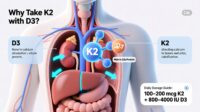
Vitamin D3 is widely recognized for supporting calcium absorption and immune function. But D3 doesn’t operate alone; it sets the stage. Think of D3 as the “unlocking” signal that increases how your body brings calcium into circulation. Then comes the question: what instructs the body where that calcium should go?
That’s K2’s terrain. When D3 raises calcium availability, K2 may help determine whether the body uses calcium for intended structural functions or permits it to accumulate in less desirable areas. This is why many supplement strategies pair D3 and K2. The logic feels tidy. Yet diets are rarely tidy. Food patterns vary wildly by region, culture, and dietary preference, and K2 content can be uneven even among foods that seem nutritionally similar.
So the real question becomes: can your diet deliver K2 with enough consistency to “match” the D3 effect?
What Counts as “Enough” K2? The Hidden Problem of Measuring Intake
Even if you eat K2-rich foods regularly, the concept of “enough” remains slippery. Unlike some nutrients where deficiency thresholds are more uniformly defined, K2’s adequacy can be influenced by baseline status, genetics, gut health, and the body’s responsiveness to vitamin D. In other words, two people can consume similar K2 amounts and experience different downstream effects.
There’s also the matter of K2 forms. Vitamin K2 isn’t one single substance—it exists as a family of related molecules (commonly referred to by MK-n forms). Dietary sources often provide a mix, but the balance can differ from one food group to another. Therefore, meeting “enough K2” isn’t just about calories or frequency. It’s about whether your intake aligns with the kinds of K2 activity the body uses.
This is one reason supplements sometimes feel “predictable.” They attempt to standardize what food delivers naturally—but the tradeoff is that standardized pills don’t account for your unique absorption and lifestyle context.
Dietary Sources of K2: The Foods That Actually Carry the Signal
To answer whether you can get enough K2 from diet, you need to know where K2 is concentrated. The most notable dietary sources typically include fermented foods and animal-based foods—especially those with fats—because K2 is fat-soluble.
Fermented foods can contribute meaningful K2 activity, with traditional products such as natto often highlighted due to their distinctive nutrient density. Still, natto isn’t universally appealing, and access varies by location.
Animal-based foods—particularly those that are higher in fat—often carry K2 in meaningful amounts. Certain egg yolks, high-quality dairy, and some meats are commonly discussed in nutrition circles for their K2 contribution. However, the K2 content can shift depending on animal diet, processing, and overall food quality.
Here’s the perspective shift: diet can supply K2, but the reliability depends on whether your eating pattern consistently includes K2-bearing foods in sufficient quantities.
How Much Can Food Provide? A Practical Reality Check
It’s tempting to assume that eating “healthy” automatically secures adequate K2. Yet “healthy” and “K2-forward” are not the same category. For many people, K2 intake from diet is likely inconsistent—sometimes seasonal, sometimes dependent on meal planning, and sometimes limited by dietary preferences such as vegetarian or vegan patterns.
If your routine includes only small amounts of K2-rich foods, your body may still function, but the margin of safety may be slimmer than you imagine—especially if you’re also using D3 strategically. The risk isn’t dramatic in a single day; it’s the quiet accumulation of imbalance over time.
That’s why curiosity is useful here. It pushes you to ask: What do I eat repeatedly, not occasionally? What you eat most days is what ultimately becomes your biochemical baseline.
Absorption Isn’t Automatic: Gut Health, Fat Intake, and Consistency
K2 is fat-soluble. That means absorption often improves when K2-containing foods are eaten with dietary fat. If you consistently eat low-fat meals, your body may absorb less K2 than expected. Likewise, gut health matters. Conditions that impair fat absorption can reduce the availability of fat-soluble vitamins.
Consistency is another silent variable. A one-time K2 boost is different from a steady inflow. Your body responds to patterns, not slogans. If D3 is on board—whether through sun exposure, food, or supplementation—K2 becomes the companion that determines how calcium cues are interpreted.
This is where perspective changes again: the question isn’t “Can I get K2?” It’s “Can I get K2 in the way and rhythm my body can use?”
D3 and K2 Timing: Should They Be Taken Together?
Some people assume that taking D3 and K2 at the same time is the only way to get synergy. Diet offers a different pattern. Many K2-rich foods are naturally eaten at meals that also contain fat, and many D3 sources—like eggs and certain dairy—appear in breakfast or dinner contexts. In real life, timing becomes situational.
Yet the concept of meal-based pairing is still relevant. When D3 and K2 are consumed during a meal that includes fat, absorption can be more efficient. If you rely on diet, you can mimic this logic by ensuring your K2-rich foods are not isolated from the nutritional environment your body requires to absorb them.
Curiosity pays off: observe how your meals are structured, not only what nutrients you intend to consume.
Vegetarian, Vegan, and Dietary Restrictions: Can Diet Still Win?
For those who avoid animal products, obtaining K2 can be more challenging—but not impossible. Fermented foods, especially certain traditional products, may offer K2. Still, K2 intake depends heavily on whether those foods are part of your regular diet and whether portion sizes are realistic for your lifestyle.
For many plant-based eaters, K2 may be lower due to fewer naturally concentrated sources. That doesn’t automatically mean deficiency, but it does mean you may need to be more deliberate—either by including specific fermented foods or considering whether supplementation aligns with your risk profile and goals.
In nutrition, intent matters. Restrictions can reshape nutrient pathways, so thoughtful planning becomes the substitute for convenience.
Signs You Might Need to Reassess: When “Diet Only” Feels Thin
There aren’t universal, dramatic symptoms that say, “Your K2 is low.” However, certain scenarios can justify reevaluation: a diet that rarely includes K2-rich foods, long-term high D3 intake without corresponding K2 sources, digestive issues that affect fat absorption, or concerns about bone density and vascular health.
Rather than waiting for certainty, it can be wise to look at your overall pattern: meal composition, frequency of K2 sources, and whether you’ve built a dietary structure that reliably supplies what D3 may increase demand for.
When Supplements Enter the Conversation: A Shift from Fear to Strategy
Supplements aren’t inherently superior. They’re tools. The advantage is predictability. A supplement can standardize K2 intake when food variety, access, or preferences make dietary K2 inconsistent. If your lifestyle makes K2 acquisition unreliable, supplementation can close the gap.
But the most satisfying approach is often integrated: you keep food as the foundation and use supplements as a targeted reinforcement rather than a replacement for nutrition quality. The promise here isn’t perfection—it’s alignment.
A Clear Conclusion: Yes, But Only If Your Diet Is Built for It
Yes, you can get enough K2 from diet instead of supplements with D3—but only if your eating pattern consistently includes meaningful K2 sources and supports absorption. For some people, especially those who regularly consume K2-rich fermented foods and fat-containing animal foods (or specific plant-based options), diet may be sufficient. For others—particularly those with low fat intake, limited variety, or dietary restrictions—food alone may not deliver K2 with the reliability needed to match D3’s calcium effects.
The real promise isn’t that diet will always cover the gap. The promise is perspective: when you understand the roles of K2 and D3, you can design meals that do more than “seem healthy.” You can design meals that communicate with your body in a language it recognizes.