Every parent has felt the quiet ache of uncertainty—worrying about what might help, what might worsen, and what might be quietly missing. In discussions about Autism Spectrum Disorder (ASD), one question keeps returning like a familiar refrain: could vitamin D play a role? It’s a small nutrient, yet it seems to cast a surprisingly long shadow. Some families notice patterns around low sun exposure, selective eating, or persistent indoor routines. Others are simply struck by the elegance of the idea that something as ordinary as vitamin D could intersect with brain development, immune balance, and neurobehavioral outcomes. The fascination is understandable. The research, however, is not a single straight road. It’s more like a mosaic—pieces that suggest possibilities, with enough complexity to demand care.
Why vitamin D is more than “just a vitamin” for brain and body
Vitamin D is often introduced as a bone-supporting nutrient, but its influence is broader and more biologically textured. The body uses vitamin D to maintain calcium homeostasis and support skeletal health. Yet vitamin D also functions like a signaling hormone, interacting with receptors found in many tissues, including the brain and immune cells. That matters for kids with ASD because neurodevelopment and immuno-regulation are often intertwined in the broader conversation. A child’s body is not a set of isolated systems; it’s a continuously negotiating ecosystem.
Vitamin D’s role in gene expression and inflammatory pathways has drawn attention from researchers. When inflammation drifts out of balance, it can change how tissues function—sometimes subtly, sometimes dramatically. In that sense, vitamin D becomes less “supplement” and more “biological conductor.” It may not produce the whole symphony, but it can influence tempo.
The common observation: low vitamin D levels show up more often
One of the most frequently discussed findings is that children—particularly those with ASD—may experience lower serum 25-hydroxy vitamin D levels than peers. Parents may describe reduced outdoor time, heightened sensitivity to sensory stimuli (including sunlight or heat), and routines that keep children indoors longer than expected. In many households, meals can be selective too. That combination can quietly reduce vitamin D intake from diet.
There’s another layer: some children with ASD may have gastrointestinal differences or feeding patterns that limit nutrient variety. Even when caloric intake is adequate, nutrient density can be uneven. Vitamin D, which is not abundant in many foods, can become one of the first micronutrients to run low when variety is restricted. The resulting low levels can be mistaken as “just a lab number,” but vitamin D insufficiency can affect energy, immune responses, and muscle function—domains that often appear in day-to-day ASD concerns.
Deeper reasons that might explain the pattern
The “why” is rarely one-factor. Consider the convergence of lifestyle and biology.
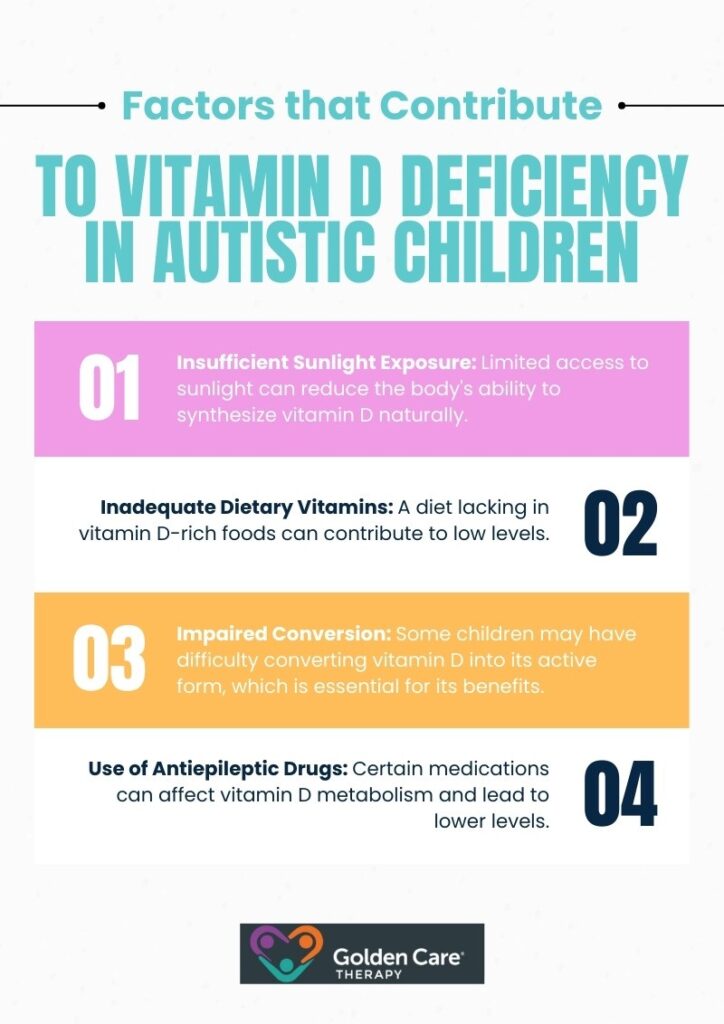
First, behavioral patterns can influence exposure. A child who prefers indoor activities, avoids outdoor transitions, or becomes distressed during midday light exposure may accumulate less natural vitamin D. Second, dietary selectivity can limit sources such as fortified dairy, fatty fish, or eggs. Third, sleep irregularities—sometimes present in ASD—can shift daily rhythms and indirectly affect outdoor activity. Fourth, genetic and metabolic factors might influence how vitamin D is processed or utilized, altering the relationship between intake and blood levels.
This multi-causal story is precisely what makes the topic so captivating. It invites a question that feels almost detective-like: is low vitamin D simply a reflection of routine, or could it be part of a more entangled physiology?
What researchers measure: serum 25-hydroxy vitamin D and why it matters
In clinical research, vitamin D status is typically assessed using serum 25-hydroxy vitamin D. This marker is valued because it reflects vitamin D from both dietary sources and sunlight exposure. It also gives a more reliable snapshot of the body’s vitamin D “reservoir.”
When studies report differences in vitamin D status among children with ASD, the findings often lead to follow-up questions: do low levels correlate with symptom severity, immune markers, or developmental trajectories? Sometimes, patterns emerge; sometimes they don’t. That variability doesn’t necessarily mean vitamin D is irrelevant. It may indicate that vitamin D is one variable within a complex web of risk, opportunity, and biology.
Possible mechanisms: immune modulation, inflammation, and neurodevelopment
Several biological hypotheses aim to explain how vitamin D could intersect with ASD. One theme involves immune modulation. Vitamin D influences the maturation of immune cells and the balance between pro-inflammatory and anti-inflammatory signaling. Since neuroinflammation is a topic of ongoing interest in autism research, vitamin D’s immunoregulatory capacity becomes a logical candidate for investigation.
Another theme relates to neurodevelopment. Vitamin D signaling may affect brain development processes, including cell differentiation and synaptic function. The brain is astonishingly plastic during childhood, which means the timing of vitamin D sufficiency could matter. A nutrient that is adequate during critical developmental windows might shape outcomes differently than a nutrient that is chronically low.
These mechanisms are compelling, but they remain hypotheses until translated into consistent clinical outcomes. Still, mechanism and observation are often how science begins to sketch a map.
Research findings: associations, variability, and what the evidence can’t yet promise
Across studies, researchers frequently observe that children with ASD are more likely to have insufficient or deficient vitamin D levels. Some work explores whether vitamin D status relates to broader functioning, such as behavior, cognition, or adaptive skills. Yet results can be inconsistent—partly because study designs vary, partly because baseline nutrition, sun exposure, and supplementation practices differ between families.
It’s also important to remember that ASD is heterogeneous. Two children can share the diagnosis while having very different sensory profiles, feeding patterns, comorbidities, and routines. This heterogeneity can blur group-level associations. A benefit of vitamin D might exist only in subgroups—such as children with pronounced deficiency, limited diet variety, or specific immune patterns.
Research can hint at possibilities without guaranteeing a universal effect. The absence of a dramatic, uniform response in studies doesn’t negate potential value. It may simply mean that supplementation is not a one-size intervention.
Supplementation in real life: balancing safety, dosing, and goals
If vitamin D levels are low, addressing deficiency is often a sensible clinical step. The key is individualized dosing based on age, baseline blood levels, and clinician guidance. Vitamin D is fat-soluble, meaning excess can accumulate. That’s why “more” isn’t automatically better. Overcorrection can lead to hypercalcemia and related complications.
In practice, supplementation goals are typically grounded in restoring sufficiency rather than chasing extreme numbers. For many families, this becomes a rhythm: test, discuss, supplement, retest. The process can feel slow. Yet it’s careful—and for a child’s long-term health, caution is not a weakness. It’s a safeguard.
Because children with ASD may have selective diets, supplement adherence can also become a behavioral consideration. Some preparations may be easier to incorporate than others. A clinician or dietitian can help align the supplement choice with sensory tolerances and feeding routines.
Beyond supplements: sunshine, food sources, and practical strategies
Vitamin D can come from sunlight and fortified or naturally rich foods. However, for many families, “just get more sun” isn’t feasible or comfortable. Sensory sensitivities, weather patterns, and safety considerations can all interfere.
Still, small adjustments can matter. Planned outdoor time at comfortable temperatures, gradual exposure routines, and clothing strategies that reduce discomfort may help. Food strategies can also be surprisingly powerful. Fortified milk alternatives, yogurt, eggs, and fatty fish (when tolerated) can expand vitamin D intake. For selective eaters, incremental introduction—one texture or brand at a time—may work better than abrupt change.
Vitamin D becomes part of a larger nutrition architecture: not only supplementing the missing nutrient, but building an environment where nutrient variety is attainable.
Comorbidities that may amplify the need for attention
Some children with ASD may have co-occurring concerns such as gastrointestinal symptoms, sleep disruption, low appetite variability, or limited physical activity. These factors can indirectly influence vitamin D status. For example, reduced activity can mean less outdoor time. Gastrointestinal differences might affect absorption. Sleep irregularities can shift the day’s schedule, changing exposure patterns.
In such cases, vitamin D assessment can be less about curiosity and more about preventive care. Addressing deficiency may support muscle function and overall wellbeing, which can make therapeutic routines easier to sustain.
What families can do now: testing, conversations, and expectation management
The most grounded approach is to treat vitamin D like a measurable health variable. If a clinician recommends testing, it provides clarity. If levels are low, supplementation can be considered with dosing tailored to the child. If levels are normal, the focus may shift to maintaining sufficiency through diet and safe outdoor exposure.
It also helps to frame expectations correctly. Vitamin D is not a cure for ASD. Yet correcting deficiency is a health win that can support broader functioning. Sometimes improvements are subtle—better stamina, fewer fatigue complaints, smoother routines. Other times they may be more noticeable. Regardless, the goal is not “autism reversal.” The goal is restoring a foundational component of child health.
When families navigate the uncertainty together—through testing, thoughtful supplementation, and consistent follow-up—the fascination becomes something constructive. It turns a question into a plan.
Image: visualizing the connection and the real-world context
A careful conclusion: vitamin D as a promising piece of a larger puzzle
Vitamin D for kids with Autism Spectrum Disorder sits at the crossroads of observation and mechanistic plausibility. Many studies suggest lower vitamin D levels occur more commonly, and several pathways could explain why that matters. Yet the evidence is not a single, definitive headline. It’s a growing body of research—consistent about deficiency risk in many children, more variable about symptom-level outcomes.
Still, the logic is hard to ignore: when a nutrient is low, correcting it supports health. And when health supports functioning, families often feel the difference in daily life. Vitamin D may not rewrite neurodevelopment, but it can help remove a potential constraint—one small biochemical key that may unlock better general wellbeing, especially for children whose routines keep them indoors and whose diets are limited.