You don’t need a sunbathing regimen that feels like punishment to support your vitamin D status. You need the right amount of sunlight, at the right time, for your skin—because “one size fits all” is where good intentions often go to fade. And once you see sunlight through the lens of Fitzpatrick skin type, the mystery begins to unravel: the same sky can deliver dramatically different outcomes from one person to another.
Vitamin D and the Sun: Why Timing Feels Personal
Vitamin D synthesis in the skin is not governed only by “how bright” the sun is. It’s governed by how much ultraviolet B (UVB) radiation reaches your skin and how effectively your skin converts that energy into pre-vitamin D. That conversion is influenced by pigment density, which is where Fitzpatrick skin types enter the story like a hidden director shaping the scene.
So, rather than treating sunlight as a monolith, it helps to regard it as a spectrum. Some Fitzpatrick types have more pigment as nature’s built-in screen, others have less. The sun doesn’t “know” your intentions. It responds to physiology, and physiology responds to UVB dosage.
This is also where perspective shifts. Instead of asking, “How much time do I need in the sun?” try asking, “How much UVB dose is my skin likely to receive in a given time window?” The answer is imperfect—but it becomes surprisingly practical once you anchor it to skin type.
The Fitzpatrick Skin Type Scale: Your Skin’s Built-In Filter
The Fitzpatrick scale is commonly described in categories (I through VI), based on skin color and how it behaves with sun exposure. Each type can be imagined as having a different “attenuation coefficient” for UVB penetration.
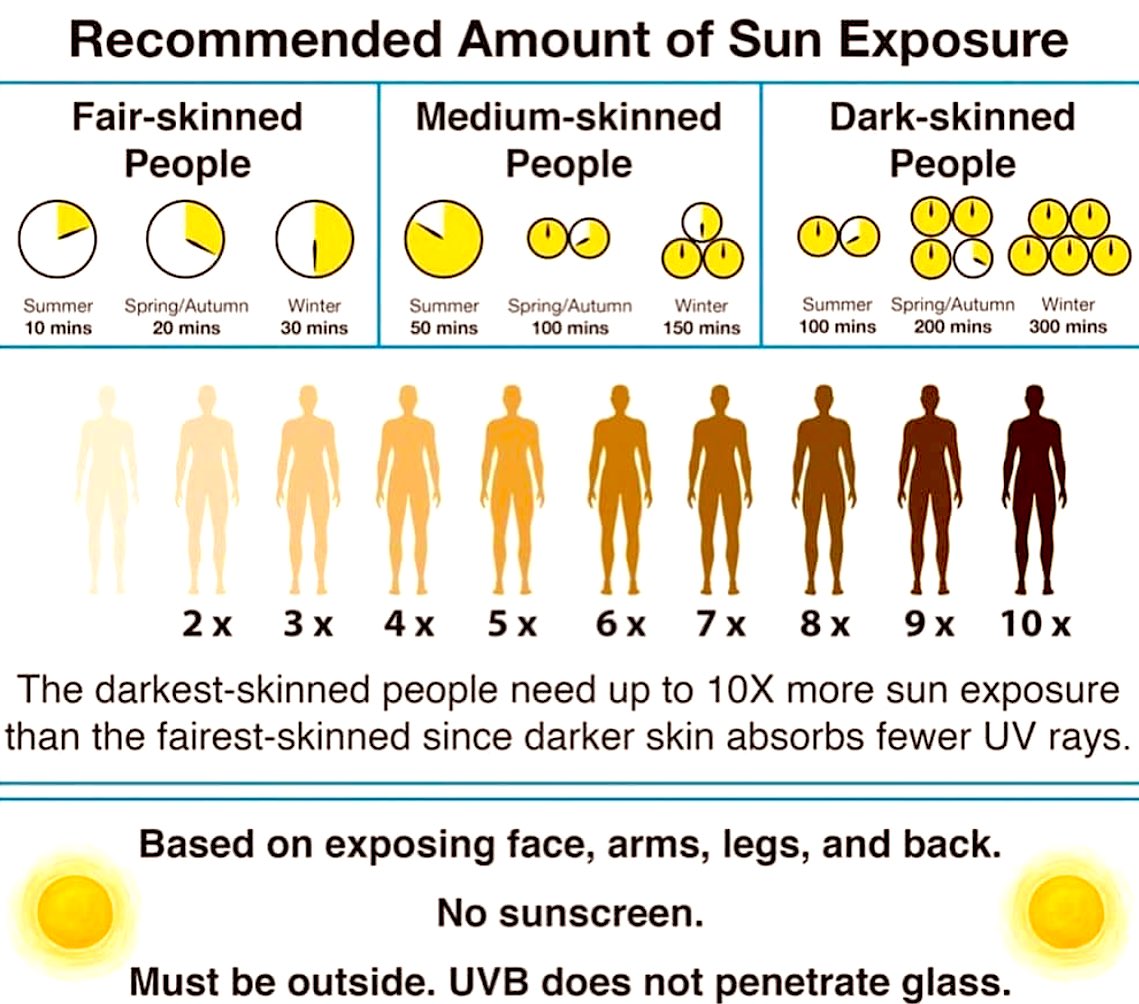
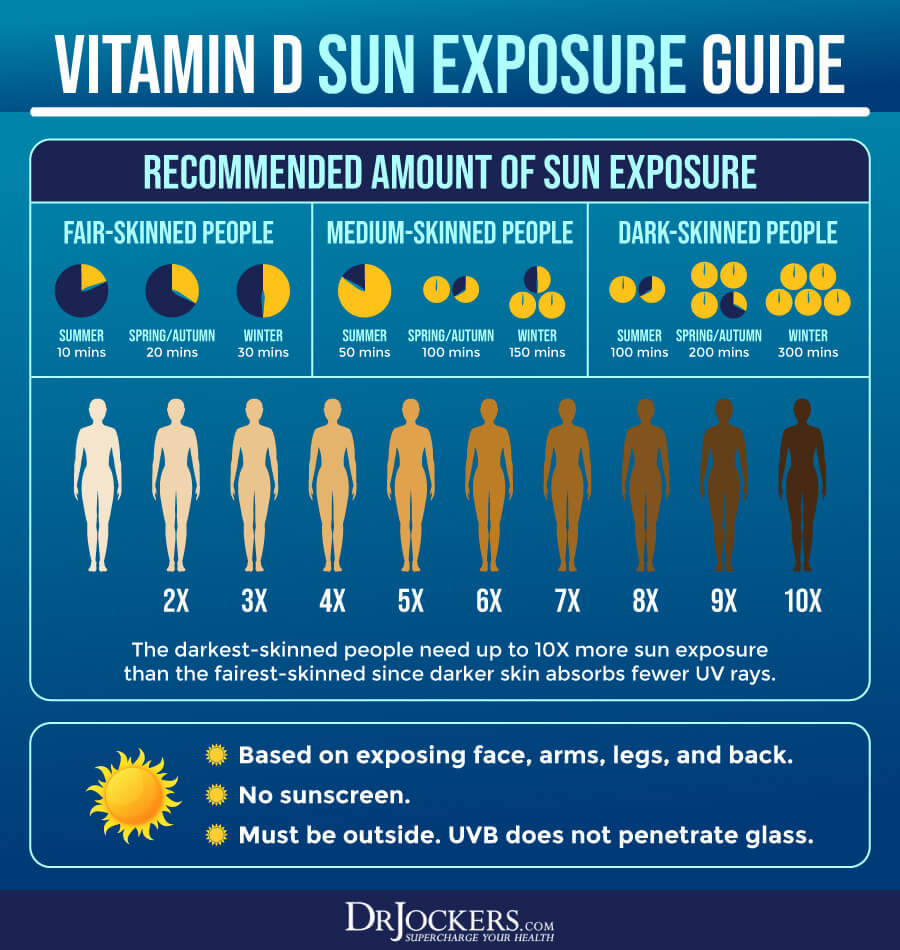
In plain terms: lighter skin types generally burn more easily and may produce vitamin D more efficiently at shorter exposures. Deeper skin tones often require longer exposures for comparable vitamin D production, not because they “lack” vitamin D capability, but because melanin absorbs more UVB before it can trigger the photochemical steps.

To make this useful, you’ll want a quick self-check: do you burn easily and rarely tan (often Type I/II)? Do you burn sometimes then tan (often Type III)? Or do you rarely burn and tan easily (often Type IV and beyond)? Your pattern guides the starting point for how long to seek sunlight.
Time Needed by Skin Type: A Curious Starting Map
Exact timing varies with latitude, season, cloud cover, time of day, and even reflection from sand or snow. Yet the underlying pattern is consistent: as Fitzpatrick skin type increases, the time to achieve meaningful vitamin D synthesis generally increases too. Think of it as a sliding scale—less pigment means less UVB absorption, which can shorten the “conversion window.” More pigment means more absorption, which often lengthens it.
Type I (very fair, burns very easily, rarely tans): Often the shortest effective windows. The risk of burning climbs quickly, so it’s wise to think in terms of brief, gentle exposures rather than extended sessions.
Type II (fair, burns easily, tans minimally): Slightly longer windows may be needed, but the burn threshold still tends to be low. You can aim for modest timing, with frequent reassessment.
Type III (medium, burns moderately, tans gradually): This is where curiosity meets calibration. A person often needs more time than Type I/II, but not necessarily hours at a time—smaller doses, more reliably repeated, may work better than sporadic long exposures.
Type IV (olive, burns minimally, tans well): UVB requirements are commonly higher. Longer exposures may be necessary, yet it’s still important to avoid sun-stretching habits. If your skin rarely burns, your intuition may underestimate cumulative UV exposure.
Type V–VI (brown to very dark skin, very rarely burns): The conversion is real, but it can be slower to reach effective dose thresholds. These skin types often require more time than lighter types for equivalent vitamin D synthesis. Still, “more time” should not become “unbounded time.” Sunscreen, clothing, and purposeful timing remain relevant tools.
Notice what’s happening. The story shifts from “How long should I be in the sun?” to “How much UVB am I receiving relative to my skin’s absorption?” That’s a more intelligent question, and it changes the tone of the solution—from guesswork to strategy.
Sun Angle, Season, and the Hidden Clock in the Sky
Even two sunny days can be different days for vitamin D synthesis. UVB strength changes with the sun’s angle. Midday—when the sun sits higher—often provides stronger UVB exposure than early morning or late afternoon, which can be more UVA-heavy and less UVB-effective.
Season matters as well. In many regions, winter UVB is insufficient for meaningful vitamin D synthesis, particularly for people who require longer exposure times. Clouds can also complicate the picture. They don’t always block UV completely, but they can dilute UVB enough to extend the time you’d need.
Here’s a perspective that’s surprisingly liberating: you can’t control the sky, but you can choose the hour. You can also choose repeatability—short, planned exposures on days when UVB is more favorable often outperform random “maybe I’ll catch some sun” attempts.
Skin Exposure: Surface Area and Strategy
Vitamin D synthesis depends on which skin you expose. Exposing small areas produces less total vitamin D than exposing more. That means your clothing choices, your posture, and even the way you sit outdoors can quietly influence outcomes.
It’s tempting to think that “time in sun” alone is the variable. But in practice, the area matters. Two people with the same Fitzpatrick type might get different results if one exposes more skin while the other covers most of the body.
If you’re experimenting, choose consistency: same general area exposed, similar time of day, similar weather conditions. Your body is not a lab instrument, but it will respond with patterns if you observe them.
Burn Thresholds vs. Vitamin D Goals: Avoiding the Misleading Marker
Burning is not a reliable “vitamin D success signal.” Skin can respond by turning red before enough UVB has delivered the photochemical sequence for vitamin D production. That’s why the burn threshold should function as a safety boundary, not as a target.
Many people mistakenly treat “a little pink” as a badge of achievement. But for vitamin D, the goal is not visible damage—it’s conversion. That’s a subtle but important shift in mindset.
If you’re fair and burn easily, the healthiest approach is often shorter exposures with greater frequency, rather than prolonged sessions that push too close to irritation. If you’re darker and rarely burn, it’s still critical to avoid long exposures driven by comfort. Your skin may not warn you in the same way, yet UV can still accumulate.
How Much Sun, Really? The Curiosity of Dose and Tracking
To move from vague intention to actionable routine, it helps to think in “dose increments.” Dose increments can be guided by typical recommendations, then refined with your skin’s response over time.
Some people use sun trackers or educational calculators to visualize likely UV exposure, especially when they want to understand how rapidly UV intensity can change throughout the day. You don’t need perfection—just a method that reduces randomness.
If you do experiment, keep notes: date, approximate time, location, clothing coverage, and how your skin behaved afterward. Over a few weeks, you may notice patterns that feel almost like decoding a personal cipher.
Barriers and Considerations: Sunscreen, Age, Latitude, and Lifestyle
Sunscreen can significantly reduce UVB reaching the skin, which may reduce vitamin D synthesis. However, sunscreen is also a protective tool against UV-related damage. This is where nuance matters: for many people, the safest approach balances skin health with intentional sunlight.
Age can also play a role. With aging, skin may become less efficient at producing vitamin D. Latitude and season alter UVB availability. Even lifestyle factors—working indoors, commuting, or living in heavily shaded environments—can shift what “normal” sunlight exposure actually means.
Think of vitamin D not as a single event, but as a recurring conversation between your environment and your biology.
When to Consider Testing and Support
Because individual responses vary, laboratory testing is the most direct way to understand your vitamin D status. If you’re aiming for a specific target, testing turns curiosity into clarity.
Dietary sources and supplements can also matter, especially during seasons when UVB is weak. The sun may be the headline, but it isn’t always the whole script.
Final Thought: A New Relationship with Sunlight
The time needed in sun for vitamin D by Fitzpatrick skin type is not a rigid rule—it’s a guide for thoughtful experimentation. Light skin often requires less time; deeper skin often requires more. Yet the deeper truth is this: your skin’s pigment is a storyteller, telling you how much of the sun’s energy is converted versus absorbed.
So don’t chase “sun time” as if it were a universal metric. Instead, chase appropriate exposure—measured by skin type, guided by season and sun angle, and tempered by safety. That shift in perspective turns sunlight from a vague background into a deliberate, intelligent ally.