Vitamin D has a curious way of slipping into everyday routines. One moment it’s a tidy supplement bottle on the kitchen counter; the next, it’s a question that keeps recurring: how many hours after eating should you take vitamin D? People feel the pull of this detail the way anglers study tide charts—half instinct, half hope that timing will sharpen results. The truth is less mystical than it feels, yet it’s never purely arbitrary. Digestion, absorption pathways, and your own physiology all quietly collaborate in the background.
Why the “hours after eating” question won’t go away
Many supplement questions revolve around whether to take something with food at all. Vitamin D, however, carries a specific rumor: timing might matter. That rumor persists because vitamin D behaves like a fat-soluble nutrient. Fat-soluble compounds tend to follow digestive rhythms and lipid transport mechanisms. So when you take vitamin D after a meal, you’re not just waiting—you’re aligning with how your body is already processing dietary fats.
It’s also fascinating that people often notice subtle differences. One person takes vitamin D “whenever,” then feels foggier fatigue in the following days. Another takes it after dinner and swears the routine feels steadier. While placebo is real, so is absorption physiology. The mind notices patterns; the body sometimes rewards them—especially when fats and bile production are involved.
Vitamin D’s digestion rules: fat-soluble reality
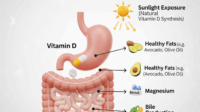
Vitamin D comes primarily in two common forms: D2 (ergocalciferol) and D3 (cholecalciferol). Both are fat-soluble, meaning they’re absorbed more effectively when the digestive tract is in “fat-processing mode.” After you eat, bile release and intestinal activity increase, creating a more welcoming environment for fat-soluble molecules to move through enterocytes and into circulation.
Think of it like rigging a net. If the water is calm but you throw the net late, you lose efficiency. If the water is active and conditions are favorable, you pull in more reliably. In the same way, taking vitamin D when your meal has already kicked digestion into gear can improve uptake for many people.
General guidance: how many hours after eating?
For most people, the practical answer is straightforward: take vitamin D about 0 to 2 hours after a meal, especially if the meal includes some fat. If you’re deciding between “with food” and “right after,” aim for the immediate post-meal window. In many routines, that means lunchtime or dinner dosing, not late-night fasting hours.
If you tend to eat smaller meals, the “0 to 2 hours” rule still works. You’re essentially timing it to coincide with active digestion. However, if you’re eating a low-fat snack, the advantage of timing may be smaller, and you may still do well taking it with a more balanced meal.
Some people ask for a precise number of minutes. The body is not a clock. It’s a system with variable digestion rates based on meal size, macronutrient composition, stress levels, and individual metabolism.
What if you forget and only remember later?
Life interrupts routines. If you remember vitamin D several hours after eating, consider whether you have eaten since. If your last meal was still relatively recent—within about 3 to 4 hours—taking it may still be reasonable. Absorption is not instantly switched off the moment you finish chewing. Digestion fades gradually.
Yet if it has been a long stretch of fasting—say 6 to 10 hours—then taking vitamin D may be less efficient. In that case, it’s often better to wait until your next meal rather than trying to force timing after the “digestive window” has closed.
One calm strategy: make it a habit around a meal you already trust, like after dinner. Consistency frequently beats precision.
Does meal composition matter more than timing?
Timing is a lever; meal composition is the engine. Vitamin D absorption tends to benefit from the presence of dietary fat. That doesn’t mean you need a heavy, buttery dinner every time. It means your meal should include at least a modest amount of fat—such as olive oil, nuts, avocado, eggs, or fatty fish.
Short sentence: Fat helps carry vitamin D along the absorption pathway. Longer sentence: If your meal is nearly fat-free, your body has fewer lipid resources to facilitate the same degree of transport and uptake, so the timing advantage may diminish.
So, if you want the best odds, pair vitamin D with a meal that feels “normally balanced,” not one designed to be lean and fasting-adjacent.
Morning vs evening: is one better?
People often wonder whether taking vitamin D in the morning or evening changes outcomes. The evidence doesn’t universally crown a single best hour, but there are practical reasons people choose different times. Morning dosing fits routines; evening dosing may be easier for adherence, especially if the person takes supplements with dinner.
There’s also the psychological and behavioral factor. If vitamin D is tied to a predictable action—like “after I eat dinner, I take my capsule”—you’re more likely to take it consistently. Consistency, over months, is where the real physiology has a chance to show itself.
Short sentence, softly true: Adherence is a form of timing too.
How long does vitamin D “take” to work?
Vitamin D is not an immediate energizer for most people. Blood levels take time to shift because vitamin D participates in a longer metabolic pathway, including conversion processes in the liver and kidneys. So even if you take it correctly after eating, you may not feel anything within the first day or two.
That slow cadence is part of the fascination. People expect quick results from supplements, but vitamin D often acts more like a structural update than an instant app refresh. For many, noticeable changes—if they occur—emerge over weeks rather than hours.
It’s also why timing questions feel intense. When something can’t be felt immediately, people search for certainty in details like the “hours after eating” rule.
Common scenarios: who should pay extra attention?
Certain circumstances can make absorption less efficient, and in those cases, meal timing may matter more. If you have a condition that affects fat absorption—such as some gastrointestinal disorders—or you’re using medications that interfere with bile or lipid handling, the question becomes more than convenience. It becomes a tactical decision.
People who take vitamin D alongside other supplements should also consider scheduling. Some minerals and vitamins can create competition in absorption depending on the formulation and co-ingested substances. Don’t assume everything fits together without friction.
When in doubt, ask a clinician for guidance, especially if you have low vitamin D on past labs, symptoms suggestive of deficiency, or conditions that affect digestion.
How to take it for maximum absorption
Here’s a practical, habit-friendly approach: take vitamin D within 0 to 2 hours after a meal, and choose a meal with at least some fat. Swallow with water. Keep the dosing consistent daily or as your regimen dictates.
Some people take vitamin D with a dedicated fat-containing snack—like yogurt with nuts or eggs with toast—if they’re not eating a full meal. That can work, but a true meal often provides steadier digestive conditions.

Safety considerations: avoid the temptation to over-time
It’s tempting to respond to uncertainty by taking vitamin D more frequently or taking a “missed dose” whenever the memory strikes. Over time, excessive vitamin D can cause problems by increasing calcium levels too much. That’s why the timing question should not expand into dosing experimentation.
Keep doses aligned with the label or clinician advice. If you miss a dose, follow the guidance for missed doses specific to your product or your healthcare provider’s instructions. Short sentence: Correct timing supports absorption; it does not justify extra dosing.
The deeper takeaway: your body runs on patterns
The allure of “how many hours after eating” isn’t just about numbers. It’s about wanting control over an invisible process. Yet vitamin D absorption is governed by patterns: digestive activation, fat transport, liver metabolism, and gradual blood-level changes. When you take vitamin D shortly after eating—particularly after a meal with some fat—you cooperate with those patterns.
So, if you want a single answer to carry through daily life: plan to take vitamin D within 0 to 2 hours after a meal. Keep it consistent. Let the slower biology do its work. And remember—sometimes the most effective timing is the one you can actually maintain.