Vitamin D3 and K2 work like a quiet duet in the body—one helps usher calcium to the right places, while the other helps keep it from lingering where it shouldn’t. Most discussions about these nutrients center on bones, but the story is more intricate. When the two are balanced, a broader set of benefits can emerge—spanning immunity, cardiovascular health, metabolic signaling, and even the rhythm of cellular growth. Below are eight little-known advantages of pairing Vitamin D3 with Vitamin K2, along with the kinds of content you can expect to take away: practical, mechanism-driven, and lifestyle-oriented guidance.
1) Better “Calcium Logistics” With Coordinated Signaling
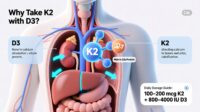
Calcium isn’t a free-floating resource. It must be transported, buffered, and deployed. Vitamin D3 plays a foundational role by increasing the intestinal absorption of calcium and supporting serum levels. Vitamin K2, however, contributes to the activation of vitamin K–dependent proteins (often described through the lens of “carboxylation”), which guide calcium toward bone-building pathways.
In plain terms: Vitamin D3 helps you take calcium in; Vitamin K2 helps you route it correctly. This partnership is frequently framed around bone health, yet its ripple effects touch multiple tissues. The body’s regulatory choreography becomes more efficient when both nutrients are present in the right context.

2) Support for Vascular Elasticity (Beyond the Usual Bone Focus)
Arteries are not static pipes. They rely on elastin integrity and controlled calcification to maintain flexibility. A little-known role for K2 is its association with inhibiting inappropriate mineral deposition in vascular tissue. This is often discussed through the activity of proteins that help prevent calcification of soft tissues.
Vitamin D3 also influences cardiovascular systems indirectly through immune modulation and endocrine pathways. When both nutrients work together, some people may notice a subtle shift in markers tied to vascular health—though individual responses vary. The key takeaway isn’t guaranteed outcomes; it’s that the D3/K2 duo can be relevant when the conversation expands from skeleton to circulation.
3) Enhanced Immune “Readiness” and Balanced Inflammatory Tone
Vitamin D3 is widely recognized for immune interactions, but the nuance is easy to miss: immune regulation is not synonymous with immune stimulation. Vitamin D3 helps tune innate and adaptive immune signaling, supporting barrier-related defenses and modulating inflammatory pathways that can otherwise tip into chronic overactivity.
Vitamin K2 adds another layer. Some vitamin K–dependent processes appear to influence inflammation-related protein networks. The result can be a more even inflammatory tone—shorter-lived surges, fewer prolonged “heat” cycles, and a steadier immune posture.
Look for content that explains “immune tone” using non-dramatic language—less about battling germs and more about maintaining responsive equilibrium.

4) Bone Quality Through Mineralization Efficiency, Not Just Bone Density
Many people measure bone health only by density, yet the structural quality of bone involves mineralization mechanics. Vitamin D3 supports calcium absorption and helps the body utilize calcium to build and maintain bone matrix. Vitamin K2 is frequently connected to improved mineralization patterns by activating bone-related proteins involved in directing calcium into the extracellular matrix.
This distinction matters. Higher density doesn’t always equal better resilience. Quality includes microarchitecture—how minerals are laid down and how the bone resists microdamage. Content that goes beyond “denser bones” to discuss mineralization efficiency is often the most useful for long-term planning.
5) Reduced Risk of Soft-Tissue Calcification (A Quiet Protective Angle)
When calcium regulation goes awry, mineral can accumulate where it shouldn’t—tendons, valves, and vascular walls. K2’s contribution is frequently framed as a protective counterweight. By supporting proteins that keep calcification in check, K2 may help the body maintain a more sensible distribution of minerals.
This benefit is “little-known” not because it’s irrelevant, but because it is less intuitive than the bone narrative. Still, it’s central to the D3/K2 partnership: D3 increases calcium availability, while K2 supports how that calcium is allocated.
For readers who prefer scenario-based learning, think of it like smart inventory management—preventing overstock in sensitive locations.
6) Metabolic Signaling: Possible Effects on Insulin Sensitivity and Weight-Related Pathways
Vitamin D3 participates in cellular signaling and gene expression pathways that can influence insulin sensitivity and metabolic regulation. The relationship between vitamin D status and metabolic outcomes has been studied from multiple angles, and while results vary, patterns suggest that adequate D3 may support healthier metabolic signaling.
K2 enters the conversation through its role in mineral-related protein activation and potential effects on inflammation and oxidative stress—factors that can indirectly shape metabolic physiology. The combined effect is not “magic weight loss.” Instead, it’s about a more supportive biological environment for metabolic balance.
The most valuable content here often includes practical framing: consider overall diet quality, movement, sleep, and sunlight exposure alongside supplementation, rather than viewing D3/K2 as an isolated lever.

7) Muscle Function and Physical Performance Through Calcium-Dependent Pathways
Calcium isn’t only a bone mineral—it’s a key signaling molecule for muscle contraction and neuromuscular coordination. When D3 improves calcium absorption and K2 supports calcium handling through protein activation, muscles may benefit from steadier mineral availability.
People often associate vitamin D with fatigue and muscle aches. The mechanism is plausibly connected to neuromuscular function. K2’s role is less discussed, but by contributing to calcium routing and cellular environment stability, it may complement D3’s effects.
If you’re browsing for content that feels “real-world,” seek narratives that connect supplementation to training consistency, recovery timing, and gradual improvements—rather than sudden transformation claims.
8) Cellular Health: Supporting Growth, Differentiation, and Tissue Maintenance
Vitamin D3 acts like a hormone with far-reaching effects. It influences gene expression involved in cell differentiation, proliferation control, and tissue maintenance. This is why vitamin D status has been linked in research discussions to overall health across multiple systems.
Vitamin K2, through its participation in enzyme-related activation processes, may contribute to how tissues regulate mineralization and maintain structural proteins. While the exact clinical significance can be complex, the conceptual synergy is compelling: D3 helps orchestrate cellular instruction signals, while K2 supports structural and regulatory proteins that depend on vitamin K.
For readers who enjoy deeper understanding, look for content that uses mechanism-friendly language—cells, receptors, enzymatic activation—yet remains grounded in practical implications.
How to Use This Information: Expect Content That’s Practical, Not Promissory
When Vitamin D3 and K2 appear together in content, the strongest articles usually do three things well: they explain why the pairing matters, they clarify that individual needs differ, and they encourage readers to evaluate lifestyle fundamentals. Short content might include quick “what it does” summaries. Long-form content should explore mechanisms and tradeoffs. Visual content should simplify complexity—calcium logistics, vascular protection, and cellular signaling—into understandable diagrams.
Whether you’re reading for education, planning, or performance support, the theme remains consistent: Vitamin D3 and K2 are best viewed as collaborators, not competitors. Their combined potential lies in balance—helping the body absorb calcium, activate the right mineral-regulating proteins, and sustain healthy structure across bones and beyond.