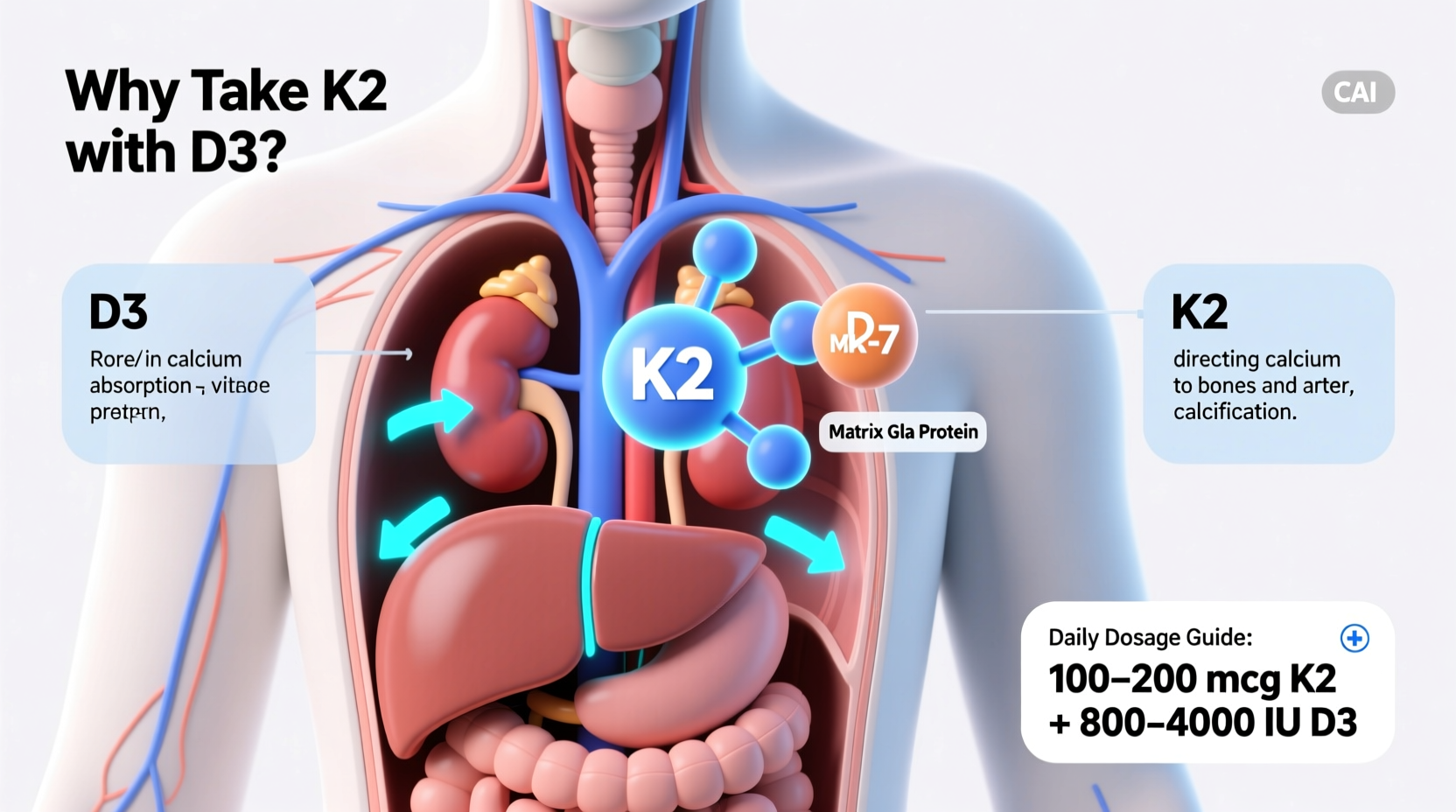
There’s a peculiar kind of logic in supplements: we often imagine nutrients as friendly guests who arrive, mingle, and leave. But vitamin D3 is more like a foreman with a clipboard—stimulating activity in the body—while vitamin K2 is the meticulous quality-control inspector who decides where that activity is allowed to go. Without K2, D3 can be like turning on the lights in an empty theatre: the beams are bright, yet something essential about the stage remains unguarded. Newer research and evolving clinical observations are sharpening this metaphor into a practical question—why should you never take D3 without K2?
D3 Is a Signal; K2 Is the Navigation
Vitamin D3 is often celebrated for its role in calcium absorption and bone metabolism. Yet biology rarely works as a simple “add nutrient, get outcome” equation. D3 functions more like a signaling molecule that increases the body’s capacity to use calcium. It raises the volume of mineral “traffic,” urging calcium to move more readily through the bloodstream and toward tissues that can utilize it.
But K2 is the navigator. Its job includes activating proteins that help govern calcium deposition—essentially influencing whether calcium is guided toward bones and away from soft tissues. In metaphorical terms, D3 opens the gates to let calcium pass. K2 ensures the gates lead to the right destination, rather than allowing calcium to drift into unintended territories.
Think of your body as a city with streets and zoning laws. D3 increases the number of delivery trucks. K2 is the signage and enforcement that determines which neighborhoods receive them. When K2 is absent, the risk is not that D3 is “bad,” but that the system’s logistics may become untidy.
The Calcium Conundrum: More Isn’t Always Better
It’s tempting to believe that if D3 helps you absorb calcium, then higher D3 means stronger bones. Sometimes that’s true. Other times, the body’s capacity to properly allocate calcium becomes the bottleneck. In that bottleneck scenario, calcium can accumulate in places where it is not meant to settle, contributing to undesirable calcification patterns.
Emerging findings and mechanistic studies are increasingly focused on how calcium handling is orchestrated by vitamin-dependent pathways. K2’s activated proteins help regulate the “where” of mineralization. Without them, calcium may be more likely to deposit where it shouldn’t—along vessel walls and within other soft tissues.
Short sentence, long implication: D3 without K2 may increase the load without ensuring the itinerary is correct. Bone health is not only about mineral availability; it’s also about mineral placement.
What K2 Actually Does (And Why It’s Not Optional)
Vitamin K2 is not a decorative vitamin. It supports the activation of specific proteins involved in calcium regulation. These proteins act like ceremonial gatekeepers at a cathedral of mineralization—permitting calcium to take part in the architecture of bones while discouraging inappropriate calcification.
Different forms of vitamin K2 exist, and research suggests that their distribution and effectiveness can vary. However, the broader biological function remains the anchor: K2 helps turn on the molecular tools responsible for calcium choreography. Without those tools, D3’s increased calcium availability may not translate into the intended structural outcomes.
This is the heart of the warning: D3 can be a spark. K2 is the sprinkler system and the safety protocol. Together, they create controlled transformation rather than chaotic accumulation.
New Research Signals: The Conversation Is Shifting
For years, D3 dosing discussions centered primarily on vitamin D status and bone biomarkers. Now, the conversation is broadening. Researchers and clinicians are paying closer attention to cardiovascular calcification indices, vascular health markers, and the interplay between vitamin D and vitamin K-dependent processes.
Mechanistic evidence and observational patterns are pointing toward a more integrated perspective: vitamin D status influences calcium flux, while vitamin K influences where that calcium goes. The “stack” is therefore crucial. Taking D3 while neglecting K2 may tilt the balance toward unfavorable mineral deposition in some people, particularly those who are already vulnerable due to diet, age, baseline inflammation, or existing metabolic conditions.
Not everyone will experience harm. Still, the ethical question for wellness is simple: why create avoidable risk when a paired strategy can better respect the body’s natural design?
Who’s Most at Risk When D3 Comes Without K2?
The likelihood of an imbalance is not uniform across all bodies. Several factors may increase the chances that D3’s effects will outpace K2’s regulatory capacity. People with low dietary K2 intake—often due to limited consumption of fermented foods or certain animal-based foods—may start with a weaker “K2 reserve.”
Older adults may also have shifting calcium handling dynamics, and they may experience changes in vascular elasticity that make unintended calcification more consequential. People with gut absorption issues could have irregular vitamin status patterns as well, including variable uptake of fat-soluble vitamins.
Finally, those taking higher-dose D3 for deficiency correction should pay extra attention. Higher dosing can raise the probability that the calcium pathway needs better navigation. The body doesn’t always run a parallel “assistant system” automatically—it adapts, but only within the resources available.
Metaphor Matters: The Body as a Warehouse and a Builder
Imagine your body as a combined warehouse and construction site. D3 brings in building materials—calcium—by changing how readily they’re absorbed. But calcium must be unloaded into the correct storage bays: bones, not arteries; structure, not congestion.
K2 is the foreman’s checklist that ensures materials are stamped and routed correctly. Without that checklist, delivery crews may unload too freely. The result can be “construction” happening in the wrong places—like paving sidewalks with gravel intended for foundations.
That image isn’t meant to frighten you. It’s meant to clarify: nutrients are not isolated actors. They operate as a coordinated ensemble.
Practical Guidance: Pairing D3 with K2 Thoughtfully
If you’re considering supplementing, treat it like designing a system, not buying a single item. Pairing D3 with K2 may support a more coherent calcium pathway. Many people aim for a balance that reflects their goals—bone maintenance, vitamin D optimization, and long-term cardiovascular support.
It’s also smart to consider baseline status. Testing can reveal whether you’re truly deficient. Then supplementation can be more precise, avoiding the “shotgun approach” of unnecessarily high dosing. Short sentence: precision beats guesswork.
Choose forms and dosing strategies that make sense for your regimen. Because vitamin D and vitamin K are fat-soluble, consistent intake with meals can support better absorption for some individuals. Still, individual responses vary, so your plan should be tailored, especially if you have medical conditions.
Important Caution: Vitamin K Interactions and Safety
Not all bodies can treat vitamin K as a casual add-on. Vitamin K may interact with medications that affect blood clotting pathways, including warfarin. This isn’t a reason to panic; it’s a reason to be disciplined. If you use anticoagulant therapy, consult a clinician before adding K2.
Similarly, if you have chronic kidney disease, hypercalcemia, or other metabolic concerns, you’ll want guidance because mineral handling can become complex. The safest approach is to avoid improvisation and instead build a plan with professional oversight.
The Unique Appeal of the D3-with-K2 Approach
The appeal is not merely that it’s “more complete.” It’s that it respects the body’s internal logic. Many supplement strategies focus on single outcomes. This one leans into systems biology: D3 improves calcium mobilization; K2 improves calcium governance. Together they can support a more elegant path from nutrient status to structural benefit.
And there’s a psychological appeal, too. You’re not just chasing a number on a lab report. You’re building a protective framework—a coordinated pairing that mirrors how nature designed nutrient function: in ensembles, not solo performances.
So the lesson is less about fear and more about fidelity to physiology. D3 without K2 is like lighting the stage while leaving the safety rigging unchecked. Add K2, and you move from scattered brilliance to controlled choreography.
Closing: A Better Question Than “How Much D3?”
Instead of only asking how much vitamin D3 to take, ask whether your body has the regulatory capacity to handle the mineral movement D3 encourages. That’s where vitamin K2 earns its place—not as a secondary accessory, but as a strategic co-pilot.
If your goal is bone strength and long-term metabolic harmony, consider the partnership. D3 may be the ignition. K2 may be the steering. Take both wisely, and you give your body a clearer route toward the outcomes you actually want.