At first glance, vitamin D seems straightforward: take a dose, enjoy the benefits, move on. Yet the vitamin world has a habit of turning “simple” into a debate. A particularly persistent argument—circulating among clinicians, supplement formulators, and researcher-driven communities—is the claim that D3 alone may be sufficient. Why do some experts say this is fine, while others push back with talk of cofactors, timing, and synergy? The controversy isn’t merely academic; it’s reflected in product labels, patient experiences, and the way labs are interpreted. To understand it, you have to look at what vitamin D actually does, what “enough” means, and where the disagreement truly lives.
What “D3 alone” really means in practice
When someone insists that D3 alone is sufficient, they’re usually pointing to a specific chain of logic. Vitamin D3 (cholecalciferol) is the form many people can convert into the biologically active metabolites the body needs. In other words, the argument starts with the idea that the body is already “configured” to use D once it’s available in adequate amounts. If D status improves—often measured via 25-hydroxyvitamin D—then downstream effects may follow without requiring additional nutrients like vitamin K2.
But in the real world, “D3 alone” can mean different dosing approaches. Some experts emphasize modest, physiologically aligned supplementation, coupled with monitoring. Others rely on population-level reasoning: if deficiency is widespread, then correcting the deficiency with D3 might yield most of the benefit by itself. The friction arises when outcomes differ between individuals—some people improve, some plateau, and a few report no meaningful change despite supplementation.
The biochemical role of vitamin D3: more than a single-purpose vitamin
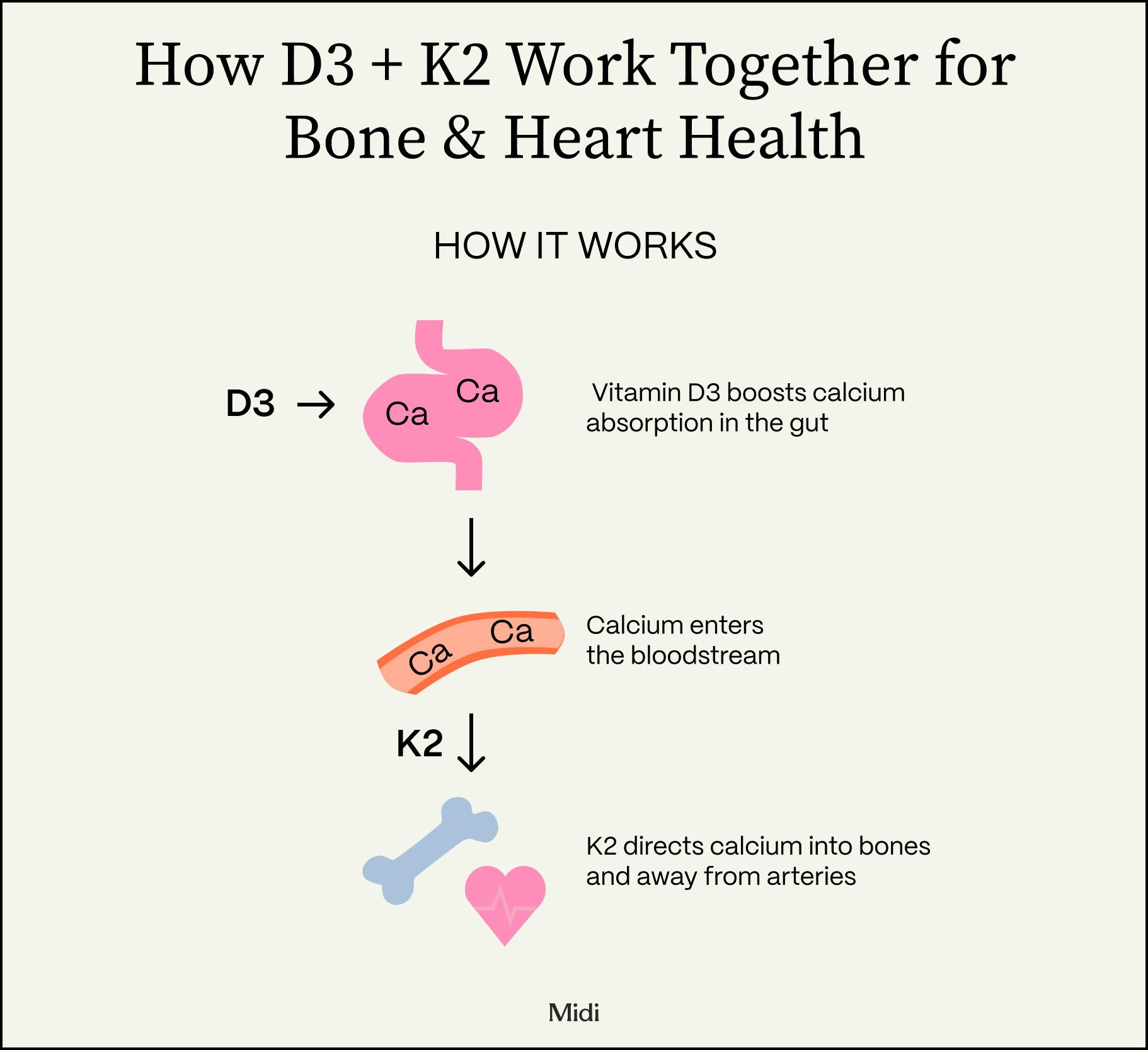
Vitamin D is often reduced to “bone health,” but that’s only one chapter. D3 influences calcium absorption in the gut, supports mineralization processes, and interacts with gene expression pathways that affect immune signaling and cell regulation. That broad reach helps explain why many clinicians consider D3 central. They argue: if the molecule directly governs calcium handling and cellular regulation, why would additional supplements always be necessary?
There’s also a conceptual nuance. Vitamin D deficiency can be thought of as an upstream bottleneck. If the body can’t adequately absorb or utilize calcium because D is low, then adding D is the earliest lever you can pull. In that view, cofactors like K2 are downstream or supportive—not mandatory in every situation.
Still, critics counter that “upstream” doesn’t eliminate the possibility of downstream constraints. Biology rarely operates as a single-line relay; it’s more like a symphony where several instruments must be tuned to avoid discord.
Why some experts focus on lab targets and individualized adequacy
The “D3 alone” camp often leans heavily on measurement. They argue that supplementation should be guided by evidence of deficiency rather than by a universal recipe. If vitamin D levels are insufficient, D3 correction may be prioritized. If levels are adequate, adding more—whether D alone or D plus K2—may be unnecessary.
This mindset makes the controversy less about whether K2 exists in the conversation, and more about whether it’s warranted for a given person. The same dose can have different effects depending on baseline status, body weight, absorption capacity, sunlight exposure, diet, and even genetic differences in vitamin D metabolism.
Some practitioners also interpret clinical endpoints differently. If a person’s bone density, muscle function, or inflammatory markers improve after D3 alone, they view the debate as resolved for that patient. Skeptics respond that improvements can stem from several variables at once—diet changes, lifestyle shifts, or natural fluctuations—so they urge caution in attributing causality.
The counterargument: K2 as a missing link in calcium routing
Those who challenge the “D3 alone” claim frequently point to a very specific concern: calcium routing. Vitamin K2 is often described as helping direct calcium toward appropriate tissues (such as bones) while discouraging deposition in less desirable places. The logic is compelling in a narrative sense: if vitamin D raises calcium absorption, then K2 might help ensure calcium is used correctly.
This is where the controversy becomes less like a debate about “existence” and more like a debate about “necessity.” Supporters of D3 plus K2 often believe K2 closes a loop created by D3’s effects. Opponents argue that the body already has multiple mechanisms to manage calcium and that K2 supplementation isn’t automatically required—especially for people with adequate dietary K2 intake.
There’s also the practical issue of the data. Some clinicians interpret available studies as supportive but not definitive; others consider the evidence strong enough to recommend a combined approach. Both sides can feel justified, and that’s what keeps the conversation alive.
Dietary reality: the silent variable most debates forget
One reason “D3 alone is fine” persists is that many people already have some vitamin K2 exposure through food. Fermented foods, certain animal products, and gut microbiome contributions can influence K2 status. If someone eats in a way that supports K2, then the incremental benefit of adding K2 to D3 may be smaller—or absent.
Conversely, someone with limited dietary K2 might be more likely to feel the case for combining nutrients. This is why the controversy looks inconsistent from person to person. A strategy that works elegantly in one dietary context may falter in another.
Even the gut can matter. Vitamin absorption is affected by bile flow, overall dietary fat, gut health, and medications. A person who absorbs D3 poorly might not reach an adequate level at all, making the “D3 alone” argument seem wrong when the real issue is delivery.

Who is most likely to benefit from D3 alone?
Proponents typically highlight scenarios where D3 is most plausible as a primary intervention. These include individuals with confirmed deficiency or insufficiency, people with low sun exposure, and patients whose overall diet provides limited vitamin D but otherwise includes adequate minerals and nutrients. If their clinical outcome improves with D3 and monitoring shows stability, the “alone” position strengthens.
Some experts also argue that modern supplementation often overcomplicates what can be a clean correction. If the immediate priority is raising 25-hydroxyvitamin D, then adding multiple ingredients may dilute clarity: did the improvement come from D, or from something else in the formula?
There’s a pragmatic elegance to minimalism. Fewer variables can mean fewer confounders, and—when approached responsibly—more predictable adjustment. Short sentences often appear here for a reason: the reasoning is direct.
Who may need more than D3?
On the other side, the “more than D3” camp tends to focus on risk profiles and clinical contexts. People with malabsorption issues, certain dietary restrictions, or conditions that complicate calcium handling may be more likely to require a broader approach. Those on long-term regimens that affect vitamin metabolism may also fall into this category.
Additionally, individuals with persistently low vitamin D despite supplementation may need re-evaluation: dosing, form, timing, and absorption factors. If D doesn’t rise, debating K2 becomes a secondary question. The debate doesn’t happen in a vacuum; it happens after preliminary troubleshooting.
One more caution often enters the conversation: medications can interact with vitamin pathways. This is where “fine” can become “not for everyone,” not because D3 is inherently unsafe, but because the body’s balance is delicate.
Safety, dosing, and the hidden danger of certainty
The controversy isn’t only about what works—it’s also about what’s assumed. Vitamin D can accumulate when dosing is excessive, and hypercalcemia is a real risk if supplementation is poorly matched to needs. For that reason, many experts insist that supplementation should be monitored, especially for higher doses or long-term use.
This is where the debate takes on a moral quality: certainty can tempt people into overcorrecting. Someone convinced that “D3 alone is enough” might increase doses aggressively rather than verifying results. Meanwhile, someone convinced that “D3 requires K2” might treat the combined stack like an insurance policy, ignoring lab values and assuming the minerals will sort themselves out.
A careful approach respects both sides. Short-term experiments can mislead. Long-term outcomes—bone health trends, calcium balance indicators, and overall functional measures—are harder to fake.
What readers can expect: content styles that shape the debate
This controversy appears across multiple content formats, each with its own persuasive gravity. Some articles lean narrative, emphasizing personal testimonies: “I took D3 and felt better.” Others use educational scaffolding, explaining calcium metabolism and cofactor roles with diagrams and checklists.
Then there’s the research-centric style, which breaks down study quality, endpoints, and statistical strength. These pieces often feel slower to read, but they aim to prevent story-driven conclusions from outpacing evidence. Another category is supplement-brand messaging, which can frame “D3 alone” as incomplete and “D3 + K2” as the only rational choice.
Finally, there are clinician guidance posts that prioritize labs, dosing adjustments, and safety warnings. They can be the most actionable because they reduce the debate to measurable steps: test, interpret, supplement appropriately, reassess.
As you navigate these formats, look for whether the content offers a plan or simply a position. The controversy persists largely because people are seeing different kinds of information—and different kinds of certainty.
The practical middle ground: evaluate, don’t dogmatize
The most useful takeaway is not that one camp is universally correct. The “D3 alone is fine” argument may be right for many people—especially when deficiency is corrected thoughtfully and dietary context is favorable. The “D3 needs K2” argument may be compelling for others—particularly when calcium routing concerns intersect with low K intake or specific risk factors.
Between them is a strategy that doesn’t require allegiance. Start with the fundamentals: adequate vitamin D status, safe dosing, and appropriate monitoring. Then consider whether adding cofactors is rational for the individual, not merely fashionable.
In the end, this debate endures because human biology is nontrivial and outcomes are not uniform. The question isn’t whether D3 can work alone. The deeper question is whether “enough” has been defined correctly for you.