It’s a familiar refrain: “I’m eating light, staying disciplined, and watching my calories.” Yet sometimes the body’s paperwork tells a different story. Bloodwork returns with a familiar flag—low vitamin D. People often assume vitamin D is purely a sunshine issue, but absorption is a biological choreography that depends on fat, bile, and time. When dietary fat drops too low, the story becomes more intricate than many expect. And that fascination you feel—the nagging sense that something “should be simple” but isn’t—is exactly where the real physiology lives.
Vitamin D: A Fat-Liking Molecule With a Mission
Vitamin D is a secosteroid, and that chemistry matters. Unlike water-soluble vitamins, vitamin D is lipophilic, meaning it prefers fatty environments. In the gut, this preference isn’t just a preference—it’s a logistical problem. For the vitamin D you consume or that your body synthesizes in the skin to become usable, it must be packaged and delivered through digestion pathways that are deeply entwined with lipid handling.
Low-fat diets can create a situation where vitamin D exists, but absorption remains inefficient. It’s like sending important letters without the correct delivery trucks. The letters aren’t worthless—they’re simply delayed, scattered, or never properly routed.
Bile: The Unsung Conductor of Absorption
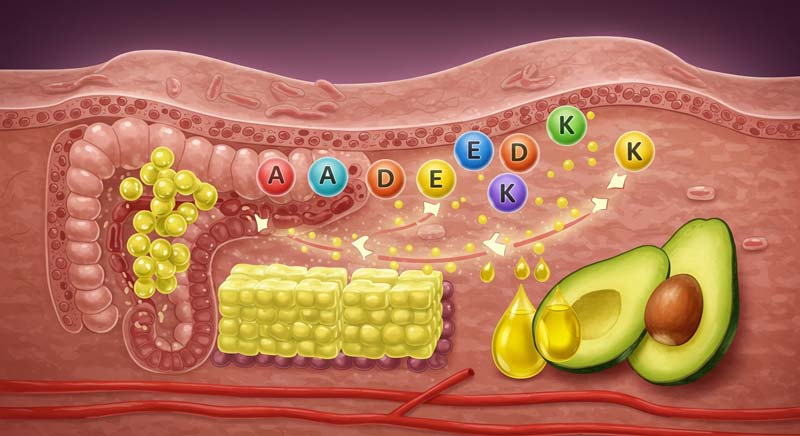
Bile is often treated as a background character, but it’s a conductor. Produced by the liver and stored in the gallbladder, bile contains bile acids that emulsify dietary fats into smaller droplets. That emulsification creates the surface area that fat-soluble compounds need to hitch a ride into the intestinal cells.
When fat intake is consistently very low, the stimulus for bile release may diminish. The result can be reduced micelle formation. Micelles are tiny molecular “bubbles” that transport lipophilic substances through the watery environment of the intestine. If micelles are scarce or less abundant, vitamin D absorption can become suboptimal—even if your supplement dose is respectable.
This is why some people experience persistent low levels despite adequate sun exposure or moderate supplementation. Their intake might not be the villain. The delivery system might be.
Micelles and the Mobility Problem
Consider the intestinal lumen as a bustling marketplace divided into watery streets. Vitamin D needs passage across those streets. Micelles act like compact vehicles: they keep fat-soluble nutrients soluble long enough to cross the watery barrier and reach absorptive cells.
A low-fat diet can reduce the availability of the components that help form micelles efficiently. Without enough lipid traffic, the system is less “activated.” This creates a paradoxical situation: vitamin D can be present in the diet, but the intestine fails to manage it with high efficiency.
Long-term, even small inefficiencies can accumulate. A slightly lower absorbed fraction repeated day after day can nudge blood levels downward over months.
Supplements Are Not Magic Without Context
Many vitamin D supplements are taken with little attention to timing or dietary surroundings. If vitamin D is swallowed without dietary fat, the absorption may be blunted. Some people take vitamin D on an empty stomach, assuming it will simply “be absorbed later.” The intestine, however, operates on immediacy. It prefers logistics occurring together—bile flow, micelle formation, and lipid transport all aligning like synchronized gears.
In practical terms, this doesn’t mean everyone must consume a high-fat diet. It means that vitamin D absorption often benefits from meals that contain at least some fat. The goal is not excess; it’s adequacy for transport.
Think of it as providing enough scaffolding for a building. The building—vitamin D—can’t rise fully without the scaffolding process.
Common Observation: “I Eat Healthy—So Why Am I Still Low?”
Low vitamin D levels often surprise people who interpret “healthy eating” as “minimal fat.” Yet nutritional health is not a single-axis concept. A diet can be calorie-appropriate and micronutrient-forward while still being too low in fat to support fat-soluble vitamin uptake.
Another wrinkle is that “low-fat” means different things to different people. Some diets are mildly reduced in fat; others are aggressively constrained. The more constrained the diet, the higher the odds that absorption becomes the bottleneck.
Then there are behavioral patterns: taking supplements inconsistently, skipping meals, eating vitamin D with low-fat snacks, or following strict regimens during travel and stress. The blood test reflects accumulation, not intention.
Deeper Reasons Behind the Fascination: Why the Body Doesn’t Compensate Fully
One might wonder why the body doesn’t simply compensate when vitamin D is scarce. The answer lies in physiological priorities. Vitamin D status depends not only on intake and sun exposure, but also on absorption and transport. If absorption is chronically underwhelming, downstream processes cannot fully correct it without adequate substrate arriving through the gut.
Moreover, conversion processes—like hepatic hydroxylation—require time and dependable inputs. The body does not treat the intestine’s inefficiency as an emergency that instantly overrides digestive constraints. Instead, it settles into a new steady state. That steady state can be lower than ideal.
The fascination comes from how tightly interconnected the system is: sunshine chemistry, gut transport, bile signaling, and lipid handling all weave together. One thread tugged too far—by reducing dietary fat—can alter the whole tapestry.
Beyond Diet: Gallbladder Removal and Malabsorption Clues
Diet isn’t the only variable. Some people are uniquely vulnerable to fat-soluble vitamin issues due to altered bile delivery or intestinal function. Gallbladder removal, certain gastrointestinal disorders, celiac disease, pancreatic insufficiency, and chronic inflammatory conditions can all affect the absorption landscape.
When gallbladder function is altered, bile flow patterns may change. While the liver still produces bile, the timing and concentration in the intestine can differ. This can influence micelle availability and, in turn, vitamin D uptake.
So a low-fat diet plus an underlying absorption challenge can create a double whammy. The body’s margin for error shrinks.

How to Think About Fat: Adequacy Over Extremes
In the pursuit of metabolic health, “low-fat” sometimes becomes a rigid dogma. Yet vitamin D absorption generally prefers moderation with meals rather than deprivation. For many people, pairing vitamin D with a meal that includes some dietary fat can improve uptake.
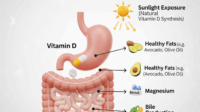
Practical choices vary by person—olive oil, nuts, avocado, eggs, fatty fish, and yogurt can all help provide the lipid environment that supports absorption. The exact amount depends on the individual’s broader dietary context and tolerance.
What matters is avoiding the extremes. Deprivation can silence the delivery pathway. Balance keeps the machinery well fed.
Checking the Right Markers and Watching the Trend
If vitamin D remains low, the next question is measurement and monitoring. The most informative blood marker is typically 25-hydroxyvitamin D. But interpretation should consider context: baseline levels, supplementation habits, seasonality, body weight, and absorption risk factors.
Trends matter. If levels improve after adjusting meal composition—especially adding fat at the time of dosing—this can confirm an absorption bottleneck. If levels remain stubbornly low, deeper gastrointestinal issues or inadequate consistent intake may be worth investigating.
Physiology responds slowly but predictably. Give the system time to reflect the new input.
Putting It All Together: Low-Fat Diets Can Undermine the Delivery Path
Vitamin D absorption is not a standalone event. It’s a collaborative process requiring bile acid signaling, micelle formation, and lipid-friendly transport through intestinal cells. A low-fat diet can reduce the “activation energy” of these steps, leading to diminished absorption even when vitamin D intake is otherwise reasonable.
The lesson is both humbling and empowering. Healthy eating is not synonymous with fat avoidance at all costs. It’s about matching dietary patterns to biological needs. When the meal provides the right environment, vitamin D can transition from circulating chemistry to functional availability.
And perhaps that’s the real reason this topic feels compelling: the body is not a simple container. It’s an intelligent system with specific rhythms. When you respect those rhythms—rather than fighting them—vitamin D levels have a better chance to rise.