Vitamin D has a way of slipping into the background of everyday health conversations—until you feel the consequences. Energy dips. Mood shifts. Bone discomfort becomes noticeable. And then, almost inevitably, the question arrives: should vitamin D be taken on an empty stomach? The answer is less like a single rule and more like a small map—one that changes depending on your body, your formulation, and the rhythm of your meals. Let’s walk that map together, with a fresh perspective that may surprise you.
First, Know What Vitamin D Actually Does
Vitamin D isn’t simply “a vitamin.” It behaves like a hormonal messenger, nudging your body toward better calcium absorption, immune regulation, and muscular function. When levels are low, the downstream effects can feel oddly broad. Weakness can masquerade as fatigue. Fatigue can disguise itself as stress. Stress, in turn, can make you forget meals are missing or inconsistent.
So timing matters—but not in the simplistic way people imagine. Vitamin D is fat-soluble, which means it doesn’t just float around neutrally waiting to be absorbed. It needs the right conditions to hitch a ride through your digestive system. That’s where the question of “empty stomach” becomes more than etiquette—it becomes physiology.
Empty Stomach vs. With Food: The Absorption Reality
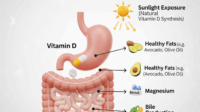
The most intuitive explanation is also the most helpful: fat-soluble vitamins generally absorb better when taken with dietary fat. If you take vitamin D on an empty stomach, absorption may be slower or less efficient for many people. This doesn’t mean it becomes useless. Rather, it can mean the journey isn’t as smooth.
Yet here’s the pivot that shifts perspective: “less efficient” isn’t always “insufficient.” If your vitamin D deficiency is mild, if your overall diet includes some fats later, or if your dosage is therapeutic, empty-stomach dosing might still raise levels over time. Your body can adapt. Still, the most practical approach often favors consistency and maximizing uptake.
If you’re curious, try thinking of vitamin D like a key and digestion like a lock. On an empty stomach, the mechanism may work—but it’s not fully warmed. With food, the lock turns more readily.
Does Empty Stomach Cause Side Effects?
Vitamin D is generally well-tolerated, but some people experience nausea, stomach discomfort, or a sense of “heaviness” after taking supplements. This tends to be more noticeable when taken without food, particularly on an unsettled stomach. The body can be a finicky negotiator; it might not want to meet a pill with zero context.
If you’ve ever taken a medication that felt rough at first, you already understand the principle. Food can buffer the experience. It doesn’t merely enhance absorption; it can also improve tolerability.

Timing Tips: Morning, Afternoon, or Evening?
There’s no universally perfect hour, but patterns emerge. Vitamin D is sometimes taken in the morning because it pairs nicely with daily routines—after breakfast, with coffee, or alongside other supplements. Morning dosing also offers a psychological advantage: you’re less likely to forget it later.
Evening can also be reasonable, especially if your dinner includes some fat. Some people prefer evening because their stomach is calmer at that time. Short sentences matter here: your schedule shapes your consistency. Consistency shapes your results.
Try anchoring vitamin D to a meal you already eat reliably. If you frequently skip breakfast, then morning empty-stomach dosing might not be the best strategy. If your dinner is the most consistent meal, then taking vitamin D with dinner may be quietly optimal.
Choose the Right Formulation (It Changes the Rules)
Vitamin D comes in different forms, and the formulation can influence how your body handles it. Many supplements are oil-based drops or softgels, which already carry lipids that support absorption. Others are tablet-based, sometimes with carriers that vary by brand.
Here’s a curiosity-worthy nuance: even if you take vitamin D “on an empty stomach,” the product itself may include ingredients that improve uptake. In other words, the pill’s architecture can soften the empty-stomach disadvantage.
If you want a clean decision path, look for your product’s instructions and observe your personal response. Tolerability is a data point, even when it’s subjective.
What If You’re Taking Vitamin D Alongside Other Supplements?
Timing becomes more interesting when vitamin D shares the stage with calcium, magnesium, or multivitamins. Calcium absorption is intertwined with vitamin D status, but taking them at the same time isn’t always mandatory. Some people prefer combining vitamin D and calcium for convenience, especially if they also eat a meal with fats.
Magnesium, too, plays a role in vitamin D metabolism. If your supplement stack is dense, it can be tempting to take everything at once. That can work, but it can also overwhelm your stomach.
Long story short: if you feel queasy, separate. Short story short: your digestion is part of the equation.
Consistency Beats Precision (Most of the Time)
Vitamin D is not a “one-day miracle” nutrient. It’s slow, methodical, and cumulative. A single missed timing choice rarely derails progress. But a month of inconsistency can.
If your goal is steady elevation of vitamin D levels, the most effective habit is repeatability. Choose a time you can sustain. Take it with the meal that most reliably includes dietary fat—whether that’s lunch or dinner.
Then give it time. Your blood levels respond to patterns, not spur-of-the-moment intentions.
When Empty-Stomach Dosing Might Still Make Sense
Empty-stomach dosing can be acceptable in certain circumstances. If your supplement label specifically supports it, or if you’ve tried it and tolerated it well, you might continue. Some people absorb fine even without food, especially if their overall diet includes fats earlier or later the same day.
There’s also the “behavioral compliance” factor. If forcing a meal only to take a pill makes you skip doses entirely, then the “perfect timing” plan collapses. A slightly imperfect schedule you actually follow can outperform a theoretically ideal schedule you abandon.
That’s the kind of tradeoff worth honoring: your adherence is part of the treatment.
Practical Scenarios: Make It Personal
If you eat breakfast lightly and reliably, taking vitamin D with breakfast can be a gentle compromise. If breakfast is often skipped, avoid empty-stomach morning habits. If you eat dinner with fats—olive oil, eggs, fish, nuts—then dinner becomes a strong candidate for your dosing anchor.
Short and sharp: your meal pattern matters.
If you’ve had stomach discomfort after taking vitamin D, try taking it with food for a couple of weeks. If symptoms improve, that’s not a random coincidence—it’s feedback from your body’s tolerance circuitry.
Safety: Don’t Guess Your Dose
Too much vitamin D can be problematic. While vitamin D deficiency is common, megadoses are not a casual experiment. Regular blood tests and clinician guidance help prevent overshooting. This is especially important if you use high-dose therapy schedules or take multiple supplements that contain vitamin D.
If you’re planning to adjust timing, do so thoughtfully and keep the dose within prescribed guidance. Timing is a lever, not the engine. The engine is dose accuracy and long-term consistency.
The Takeaway: A Thoughtful Answer to the Empty-Stomach Question
Should you take vitamin D on an empty stomach? For many people, taking it with a meal is the smoother route—better absorption, often better tolerability, and a more dependable routine. Yet empty-stomach dosing isn’t automatically wrong. The better question is: what does your body tolerate, and what does your schedule make sustainable?
Consider this a small shift in perspective: vitamin D timing isn’t a test of willpower. It’s a choreography between your digestion, the supplement’s formulation, and the consistency of your meals.
Choose the option that you can repeat, pair it with your most reliable food window, and let your results accumulate. Then, when you review your levels, the “timing debate” will transform into evidence—personal, practical, and quietly definitive.