Imagine for a moment that two nutrients could collaborate like a well-rehearsed duet—one acting as the spark, the other as the architect. That’s the compelling idea behind Vitamin D3 and K2: Vitamin D3 helps your body sense and absorb what it needs, while Vitamin K2 helps direct those benefits toward the places they matter. In 2025, more people are asking sharper questions—less about hype, more about mechanism, safety, timing, and outcomes. This is the ultimate FAQ to help you shift your perspective from “taking supplements” to “orchestrating biochemical priorities.”
1) What exactly are Vitamin D3 and Vitamin K2?
Vitamin D3 (cholecalciferol) is a fat-soluble vitamin that your body uses to support calcium absorption, bone mineralization, immune modulation, and broader cellular signaling. When sunlight triggers Vitamin D production in the skin, a cascade begins—first converting it to active forms the body can use.
Vitamin K2 (menaquinone) is also fat-soluble, but it’s often described with a different role: it helps activate proteins involved in coagulation and calcium handling. In plain terms, Vitamin K2 can help decide where calcium goes—bone and teeth versus soft tissue. That “where” question is the reason the D3 + K2 pairing feels more intentional than supplementation in isolation.

2) Why do people combine D3 and K2 instead of taking them separately?
Think of Vitamin D3 as increasing the supply chain: it raises the availability of calcium and supports bone-focused mineralization. But supply without routing can be messy. Vitamin K2 acts like a traffic controller for calcium-binding proteins. When K2 is present, the proteins that regulate mineral deposition can function more effectively.
So the combination is less about “more vitamins” and more about coherence. It’s a shift from isolated nutrient thinking toward systems thinking—how absorption, activation, and targeting interlock. Many people find this framing emotionally satisfying: you’re not merely filling a deficiency; you’re building a physiological storyline.
3) What are the most common promises people associate with D3 + K2?
The most frequent promises fall into a few categories: improved bone health, better calcium utilization, and potential support for cardiovascular calcification management. Another, more subtle promise is comfort in planning—knowing your strategy is not random. When supplements are paired with intention, you’re more likely to stay consistent and monitor results.
Yet it’s worth holding a balanced curiosity. Promises can be directional but not guaranteed. Individual genetics, baseline lab values, diet, sun exposure, and medication history can dramatically alter outcomes. The real win is not the fantasy of instant transformation—it’s the likelihood of optimizing the conditions your body already uses.
4) What does Vitamin D3 actually do in the body?
Vitamin D3 works through conversion to active metabolites that influence gene expression and cellular function. Its well-known role involves supporting the absorption of calcium and phosphorus in the gut. That’s why Vitamin D is often tied to bone density and muscle function.
But Vitamin D3 also participates in immune signaling and may influence inflammation-related pathways. You might notice how that sounds: not merely “bones,” but a broader biological governance. This is where many people experience perspective shift—Vitamin D begins to feel less like a “bone vitamin” and more like a regulatory hormone-like nutrient.
5) What does Vitamin K2 do that Vitamin D3 doesn’t?
Vitamin K2 activates specific proteins that help regulate calcium’s role in the body. For example, it supports bone-associated proteins and contributes to mechanisms that discourage calcium deposition in inappropriate tissues. This calcium-handling aspect is the reason K2 is frequently paired with D3.
In a way, D3 is the invitation and K2 is the choreography. Without K2, calcium may still be absorbed and circulated—but the signaling proteins that help guide mineral placement may not operate with optimal efficiency.
6) Which forms of Vitamin K2 matter—MK-4 or MK-7?
Vitamin K2 is not a single molecule—it comes in several forms, often discussed as MK-4 and MK-7. MK-7 is commonly associated with longer-lasting activity in the bloodstream, which may support steadier status. MK-4 is used in various contexts and is often discussed as having different pharmacokinetic behavior.
Because products vary, the most practical question is often simpler: “Does the dose and form match the intended outcome?” Not all K2 products behave identically. Consider reading labels carefully and, if you’re using higher doses or managing health conditions, ask a clinician which form aligns with your plan.
7) How do I know if I’m deficient in Vitamin D3?
The gold-standard method is a blood test, typically measuring 25-hydroxyvitamin D. Deficiency thresholds vary slightly across guidelines, but the key idea remains: you can’t truly optimize what you can’t measure. Many people who begin with supplementation later realize that their true starting point was unclear.
Curiosity can help here. Rather than asking, “How much should I take?” start with, “What is my baseline?” Then the strategy becomes rational, not improvised.
8) How do I know if I’m low in Vitamin K2?
Vitamin K status is harder to assess than Vitamin D. There are tests that evaluate specific biomarkers, but in many routine settings, clinicians rely more on risk context: dietary patterns, gut health, and medication use.
Since K2 is influenced by food sources and gut conversion pathways, people with limited dietary variety or certain digestive conditions may have different nutritional realities. This is another perspective shift: “deficiency” isn’t only about lab numbers; it can also be about context and consistency.
9) What’s a typical dosage range for D3 + K2 in 2025?
Dosage depends on baseline labs, diet, latitude, seasonality, body weight, and overall health. For Vitamin D3, many people discuss maintenance doses in the range of 1,000–2,000 IU daily, while others use higher short-term strategies under guidance. Vitamin K2 dosing often falls in a different numeric scale, commonly measured in micrograms, with product ranges varying widely.
Because fat-soluble vitamins accumulate, moderation and monitoring matter. The most effective approach is individualized rather than copied. Think of dosing like setting the thermostat: too low may do nothing; too high without oversight can be counterproductive.

10) Is it safe to take D3 and K2 together?
For many healthy adults, D3 and K2 are commonly used together without issues. Still, “safe” is a sliding scale. Safety changes when you consider medications, existing calcium levels, kidney health, liver conditions, and anticoagulant therapy.
One of the most crucial safety considerations involves blood thinners. Vitamin K directly affects the coagulation pathway, so anyone taking warfarin (or similar therapy) should not adjust Vitamin K intake without medical supervision. This is less about fear and more about precision.
11) What about side effects—what should I watch for?
With Vitamin D3, excessive intake over time can lead to hypercalcemia—too much calcium in the blood. That can present as nausea, constipation, excessive thirst, weakness, or confusion. If these occur, it’s a prompt to stop and seek advice.
Vitamin K2 is generally well-tolerated, but again, medications and individual conditions shape the risk profile. The best habit is to track how you feel and, ideally, to reassess labs after a reasonable interval when using higher doses.
12) When should I take D3 + K2—morning or evening?
Because both vitamins are fat-soluble, taking them with a meal containing dietary fat often improves absorption. Timing can be flexible. Some people prefer morning for routine consistency; others prefer evening, especially if they take other supplements then.
The “best” time is the time you can stick to without becoming erratic. Consistency is a kind of quiet power.
13) What does food have to do with all this?
Food can either reinforce your supplement plan or make it redundant. Vitamin D3 sources include fatty fish and fortified foods. Vitamin K2 sources often include fermented foods and animal-based foods, depending on your dietary pattern.
If your diet already provides substantial D3 and K2, your supplement strategy may need rethinking. The goal isn’t to stack everything endlessly; it’s to close gaps, not create overlap that your body doesn’t need.
14) Can D3 + K2 help muscle function and recovery?
Vitamin D status has been linked with muscle performance and strength in various studies, likely because Vitamin D receptors are widespread and involved in muscle-related signaling. While supplements can support function when someone is deficient, they aren’t necessarily a “performance cheat code.”
Still, many people report feeling more grounded—less fatigue, improved training steadiness—especially after correcting a deficiency. The mechanism is plausibility; the outcome is personal.
15) How long does it take to see results?
Vitamin D can change blood levels within weeks, but “results” vary: energy and mood may change differently than bone remodeling, which is slower. Think in timelines: labs can adjust sooner, while skeletal outcomes require sustained nutrition over months.
So, rather than chasing immediate effects, consider this a seasonal project—ongoing, monitored, and adapted. That’s where long-term curiosity becomes wisdom.
16) What should I do if I’m already taking other supplements?
Stacking supplements can be beneficial, but it can also become a foggy overlap. If you already take a multivitamin containing D, or a calcium supplement, or magnesium, you may accidentally duplicate nutrients.
A practical strategy is to list everything you take—dose and frequency—then adjust based on baseline labs and goals. Sometimes the most effective plan is subtraction: remove redundancy, then keep the necessary components.
17) What are the most important interactions and contraindications?
Anticoagulants are the headline interaction due to Vitamin K’s role. Other interactions may involve certain medications affecting fat absorption, liver function, or calcium handling. Kidney disease and high baseline calcium levels can also change the safety calculus.
If you have a chronic condition, pregnancy, or a history of kidney stones, consult a clinician before starting. Not because supplements are inherently dangerous, but because your physiology is not generic.
18) How do I choose a quality D3 + K2 product?
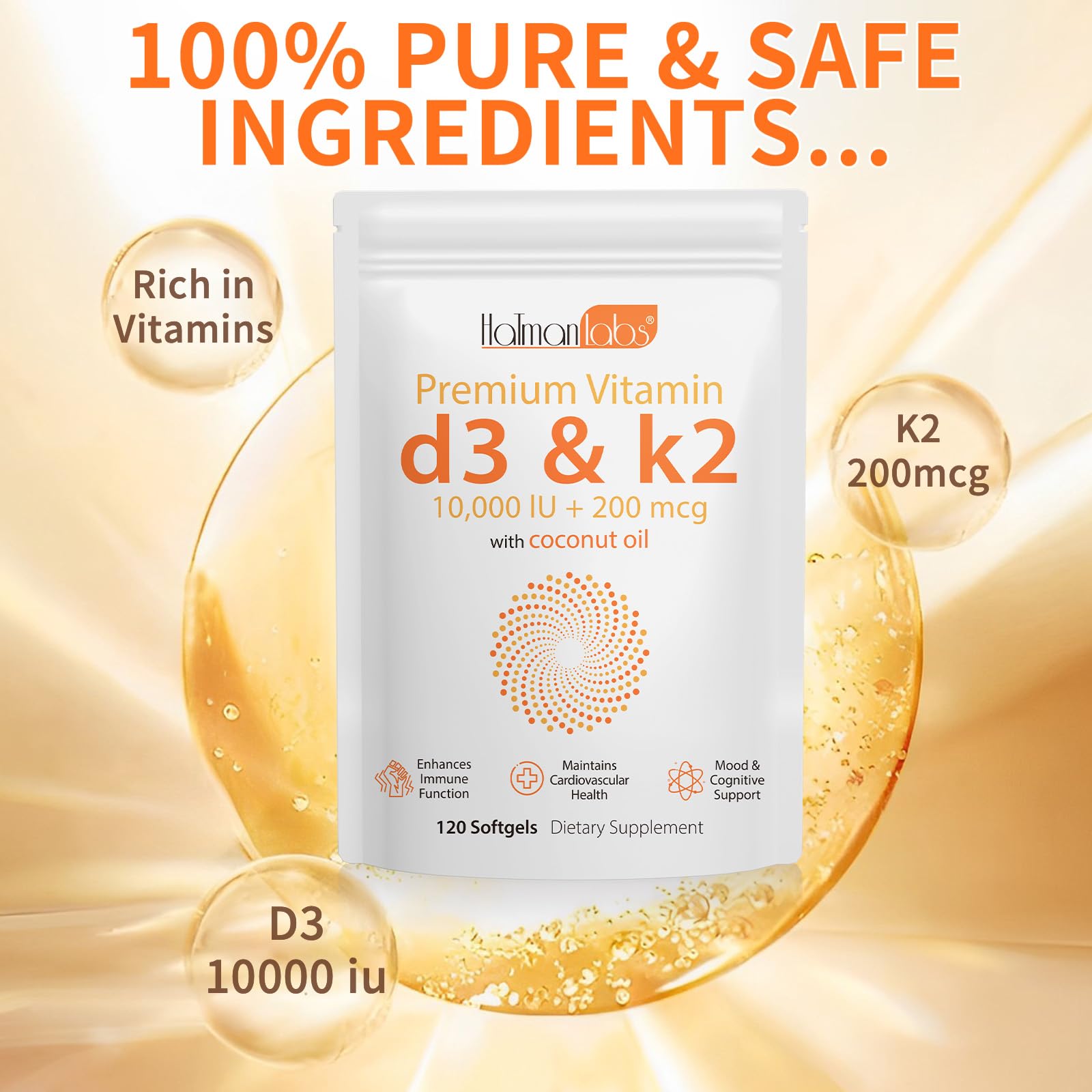
Look for transparent labeling: clear amounts of D3 (IU), K2 (mcg) and the specific form (often MK-7 or MK-4). Third-party testing for purity can also be a useful indicator.
Quality is not just marketing. It’s consistency, dosing accuracy, and fewer surprises. When you choose well, your plan becomes easier to evaluate—because you can trust what you’re actually taking.
19) Is there a “best” goal—bones, immunity, or something else?
The best goal is the one aligned with your current status. If your Vitamin D is low, correction is a logical starting point. If you’re working on bone support, sustained dosing plus adequate calcium and protein intake may matter. For cardiovascular concerns, the rationale often centers on calcium management and vascular mineralization pathways.
Yet it’s okay to keep it simple. Many people begin with deficiency correction and bone support. Later, as labs and health markers evolve, you may refine your approach with more targeted intent.
20) The final mindset: how to approach D3 + K2 in 2025
In 2025, the smartest way to think about Vitamin D3 + K2 is as an adaptive protocol—not a one-time decision. Start with measurements when possible. Respect safety interactions. Keep your plan consistent and your expectations realistic.
Most importantly, let your curiosity mature into discernment. The promise isn’t magic. It’s alignment: Vitamin D3 helping absorption and signaling, Vitamin K2 helping guide calcium’s destination. When that alignment clicks, the results—whether subtle or substantial—tend to feel less like a gamble and more like a deliberate shift in bodily harmony.