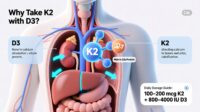
For years, vitamin talk has been oddly segmented—like your body is a set of separate rooms, each with its own supply closet. But D3 and K2 don’t behave like that. They feel less like two independent supplements and more like a duet. One helps build a usable foundation; the other steers where that foundation is allowed to land. When you start viewing them as a coordinated system, the story becomes harder to ignore—and easier to believe.
Meet the Duo: D3’s Role in Activation
Vitamin D3 is often framed as the “sun vitamin,” and that’s not entirely wrong. In your body, however, its most consequential gift is not sunshine—it’s conversion. D3 travels through metabolic checkpoints where it is transformed into active forms that your cells can recognize. Think of D3 as the architect who draws the blueprint and prepares materials for a specific kind of construction: calcium handling.
Without sufficient D3 status, calcium regulation becomes comparatively clumsy. Cells receive weaker signals, transport systems don’t operate with full confidence, and the downstream processes that depend on calcium and phosphate can feel muted. This is where perspective shifts: D3 isn’t merely “good for bones.” It’s closer to a regulatory conductor—setting tempo for mineral management.
So you can understand why D3 draws attention. But attention is not the same as precision. And that precision is the territory where K2 enters the scene.
K2’s Role: The Cellular Courier and the “Where” Question
Vitamin K2 is sometimes described with a single function—supporting proper coagulation, for example. Yet K2’s deeper significance lies in what it enables your body to do with minerals, especially calcium. After D3 helps make calcium available and properly sensed, K2 helps determine where calcium should go and where it should not.
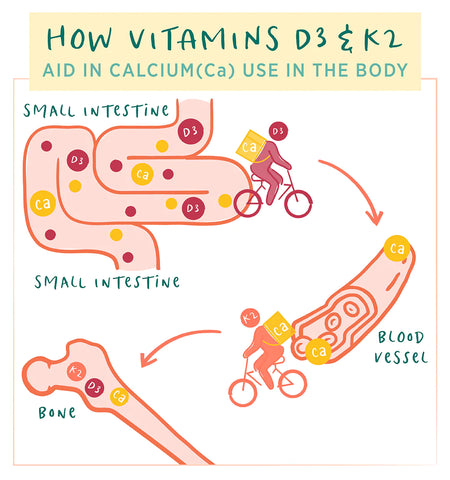
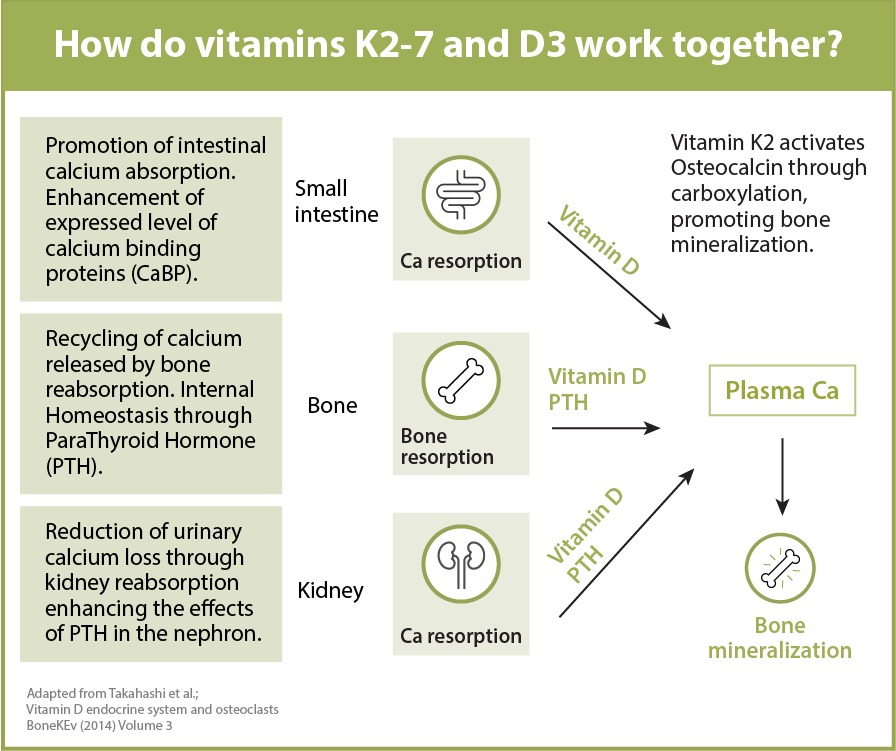
To understand this, imagine calcium as a delivery truck. D3 is what helps the address become legible—calcium becomes more “ready.” K2 is what ensures the delivery is made to the correct department. Without K2, the system can behave like misrouted logistics: calcium may still move around, but it may not be guided with the same discriminating intent.
In practical terms, K2 supports activation of specific proteins involved in calcium binding and tissue organization. This is the part of the story that makes the synergy feel almost elegantly designed.
The Big Idea: Calcium Routing (Not Just Calcium Quantity)
Most people think in quantities: more calcium, more benefit. But the body rarely rewards simplistic arithmetic. It prefers choreography. D3 and K2 together contribute to a more refined outcome—calcium routing. This is a subtle but crucial distinction.
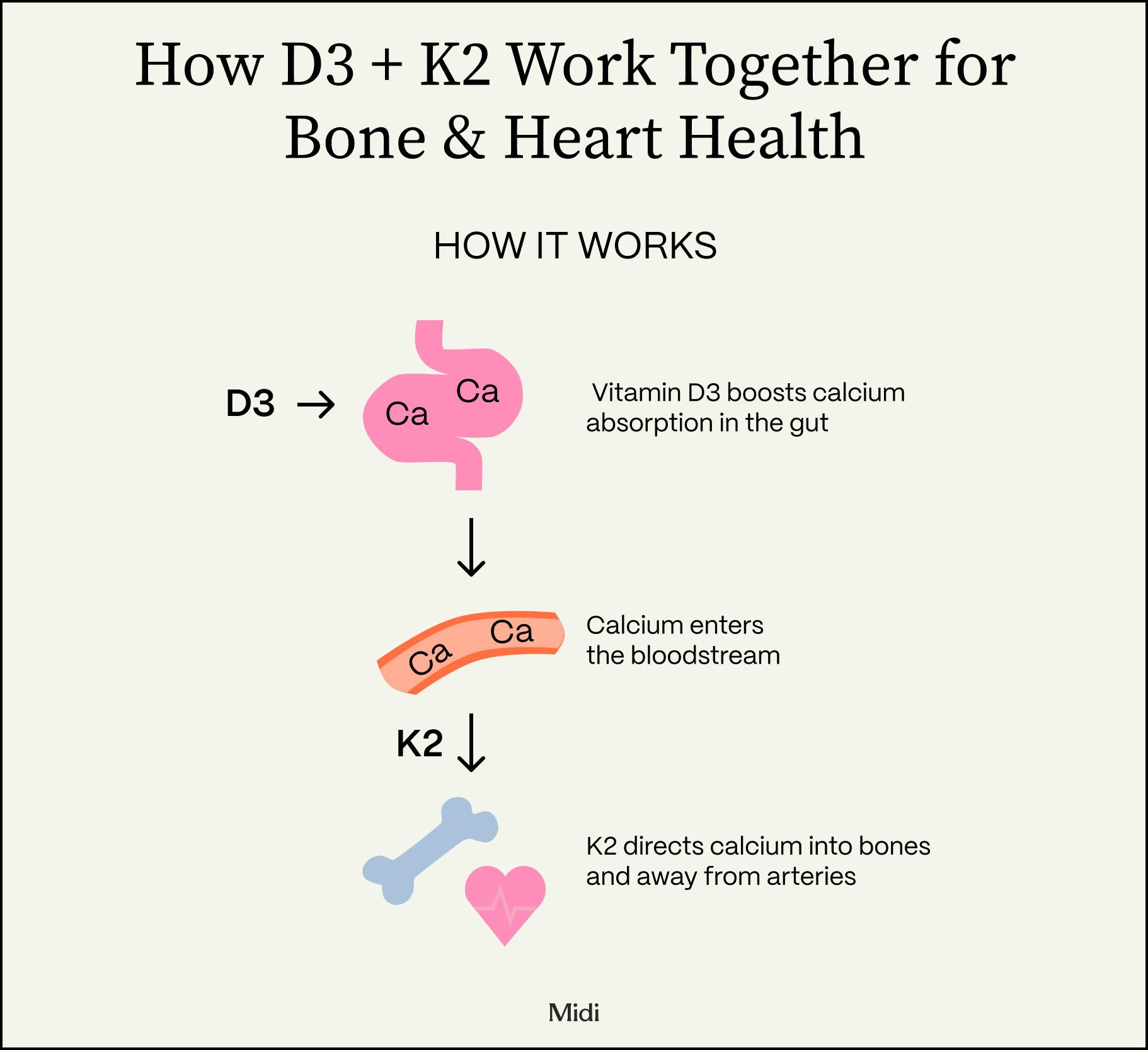
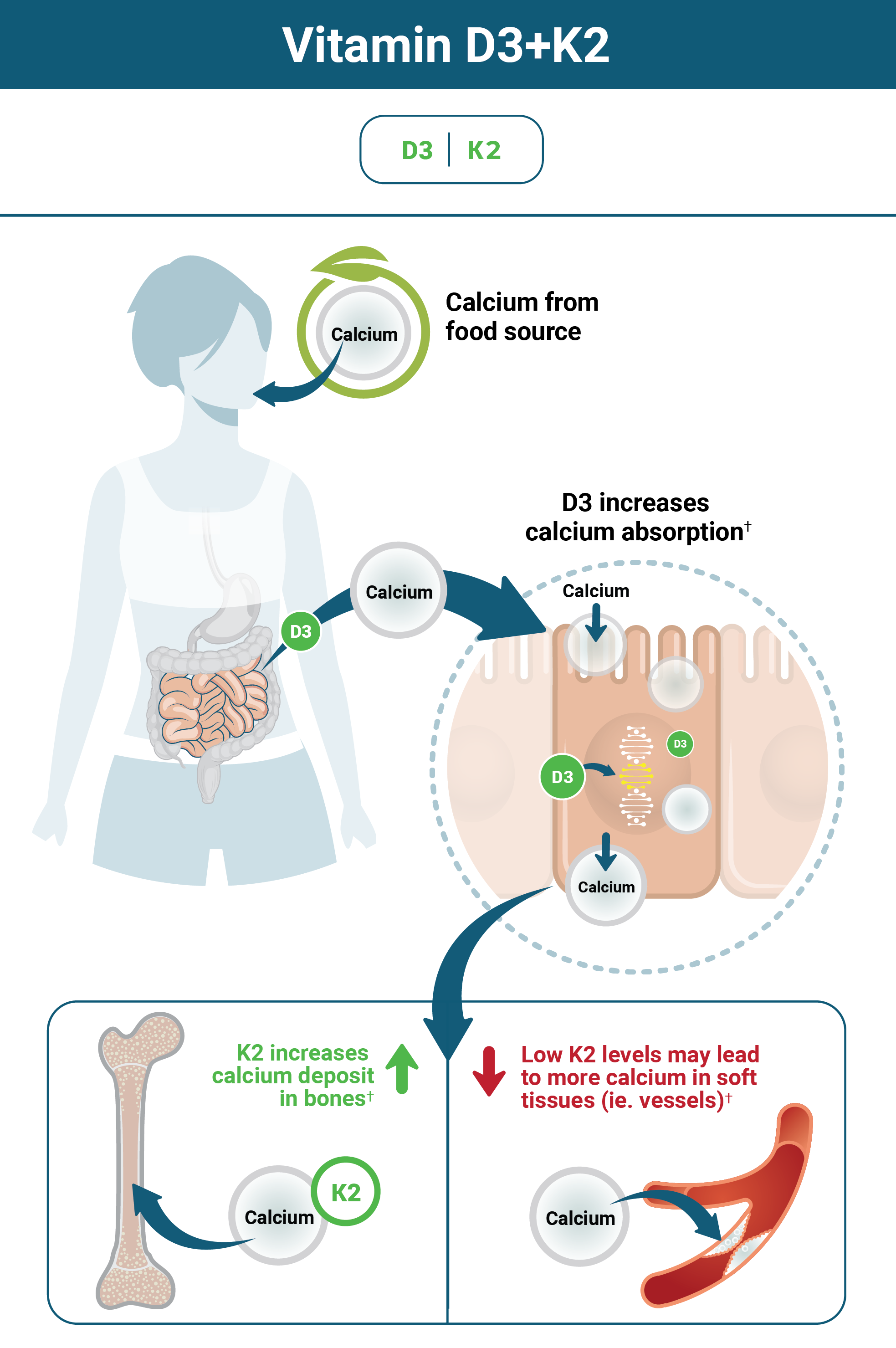
D3 influences the availability and mobilization of calcium. K2 influences the destination. When both vitamins are present in a supportive context, the body’s mineralization processes can become more coherent—less chaotic, more purposeful.
Here’s the shift in perspective: you’re not only “supplying calcium.” You’re helping create the instructions your tissues respond to. That is why the pairing is often described as nutritional synergy rather than convenience.
Bones: Strength as an Architectural Preference
Bone health is not only about density. It’s also about structure—microarchitecture, remodeling cycles, and the stability of mineral matrices. D3 contributes by supporting calcium absorption and signaling that feeds bone-related physiology. It helps establish an environment where mineralization can occur.
K2 then adds a directive element: supporting proteins that are associated with proper mineral deposition in bone tissue. This combination encourages mineral to integrate where it belongs. The result isn’t magic. It’s a better-tuned process.
Short sentences can carry weight here: D3 helps bring materials. K2 helps them land correctly. Over time, this coordinated approach aligns with the concept of maintaining resilient skeletal scaffolding.
Beyond Bones: Why the “Heart Connection” Matters
Calcium’s story doesn’t end in the skeleton. Vessels, tissues, and the broader cardiovascular landscape also interact with calcium-related biology. When calcium regulation becomes misdirected, the body may respond in ways that are less favorable over time.
That’s where K2’s calcium-routing concept can feel especially relevant. By supporting protein activation associated with discouraging inappropriate calcification pathways, K2 may help maintain the elasticity and functional integrity of vascular structures.
It’s not a claim that vitamins replace medical care. It’s a reminder that nutrient roles often reach farther than their popular headlines suggest. When you picture calcium as a substance that must be guided—not merely stored—you start to see why pairing D3 and K2 attracts long-term curiosity.
How the Body Orchestrates the Pairing: Timeline and Timing
Synergy isn’t only about who is present. It’s also about when the system is allowed to use what’s available. D3 participates in upstream activation and supports calcium absorption patterns. K2 works as the downstream guide—helping activate proteins that regulate mineral placement.
That’s why the relationship is often described as “start-to-finish” rather than “both at once.” D3 primes. K2 directs.
In everyday life, you also consider consistency: nutrient systems respond more reliably to regular, supportive intake than to occasional spikes. The body is a slow reader. It prefers steady signals, not drama.
Different K2 Forms, Same Theme
Vitamin K2 comes in various forms, commonly including menaquinones such as MK-4 and MK-7. Each form may differ in how the body handles it, which is why people sometimes compare them in terms of bioavailability and tissue distribution.
Even without getting lost in chemical taxonomy, the theme remains consistent: K2 supports the proteins responsible for calcium organization. So while the specific form can matter, the central narrative is still the “routing” function.
Curiosity grows when you realize how nuanced the body’s response can be. The same vitamin family carries instructions through slightly different pathways, like different interpreters delivering the same message in different accents.
What “Synergy” Feels Like: A More Cohesive Cellular Story
When D3 and K2 are both supported, the overall system can become more coherent. You’re not just stacking nutrients; you’re reducing the odds of “partial success.” D3 without K2 can create a context where mineral-related processes are less guided. K2 without D3 can leave the system short on the upstream activation signals that make calcium management operate with confidence.
This is why the phrase “synergy” is more than marketing language. It points toward a biological logic: the body uses interlocking steps. If one link is weak, the chain doesn’t break—it simply slips more easily.
And once you notice that logic, you start asking better questions: What does my body need for activation? For guidance? For completion?
Practical Considerations and Responsible Curiosity
Before changing anything significant, it helps to consider individual factors—diet, sun exposure, baseline nutritional status, and existing health conditions. Vitamin D status can vary widely, especially with limited sunlight. Calcium handling and tissue mineralization patterns are also influenced by age and lifestyle.
One especially important note involves medications. Individuals taking anticoagulants (blood thinners) should consult a clinician before using vitamin K supplements. This isn’t a scare tactic—it’s responsible biology, because vitamin K can influence coagulation pathways.
With the right medical guidance, pairing D3 and K2 can be approached as a thoughtful alignment: supporting calcium absorption signals while providing directional support for mineral placement.
The Perspective Shift: From Supplements to Systems
D3 and K2 make sense when you stop thinking of vitamins as isolated benefits and start thinking of them as a coupled system. D3 helps set the stage. K2 helps enforce the blueprint. Together, they support more precise calcium utilization—bone-forward, and perhaps cardiovascularly meaningful in the broader context of mineral organization.
So the next time you see D3 and K2 mentioned as a pair, don’t treat it like a simple combination. Treat it like a narrative with a beginning and an ending—one that invites you to picture your body as an organized, responsive environment rather than a passive container.
That’s the real allure: not just what D3 and K2 do, but how their roles interlock, turning “nutrient support” into a more complete story of physiological direction.