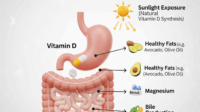
Vitamin D does not simply “arrive” in the body—it is recruited, carried, and finally negotiated into use. Imagine it as a luminous courier trying to cross a crowded city. Fatty acids are the streets, the vehicles, and sometimes the bribed gates. Depending on their type and arrangement, they can either escort vitamin D into absorption pathways or stall it in biochemical traffic. The effect is not uniform; it is selective, kinetic, and surprisingly elegant.
Fatty acids as the body’s lipid highways
To understand vitamin D uptake, picture the intestinal environment as a busy harbor where cargo must be stabilized before docking. Vitamin D is lipophilic—meaning it prefers fats. Fatty acids behave like influential logistics managers. Some forms blend smoothly with bile-derived emulsions, creating micelles that act like tiny soap-bubbles transporting cargo through watery surroundings. Other fatty acids are less cooperative, altering micellar architecture and potentially slowing the courier’s transit.
Short-chain fatty acids often behave differently from their long-chain counterparts. Long-chain fatty acids can integrate into transport structures more robustly, but only if the resulting assemblies remain stable enough to ferry vitamin D onward. The body is not merely taking in vitamin D; it is curating the conditions under which vitamin D can be carried across the boundary between digestion and absorption.
In practical terms, the “fatty acid profile” of the meal can change the efficiency of vitamin D uptake. A meal rich in certain fatty acids may produce more favorable emulsification dynamics, while another composition may yield transport particles that are less accommodating.
Chain length: from swift rafts to sluggish barges
Fatty acids vary in chain length, and that variability changes their physical behavior. Short-chain and medium-chain fatty acids tend to be more soluble and can influence digestive processes in distinctive ways. Medium-chain fatty acids, in particular, may be absorbed through pathways that are not identical to those used for long-chain lipids. This matters because vitamin D transport often depends on lipoprotein and micellar handling that is more characteristic of long-chain lipid processing.
Long-chain fatty acids, by contrast, can promote the formation of mixed micelles that are capable of solubilizing lipophilic compounds. This is where vitamin D benefits: the more stable and appropriately sized the micelles, the more likely vitamin D will be delivered to enterocytes—the intestinal cells that serve as the “customs officers” deciding what gets through.
Yet long-chain fatty acids are not automatically beneficial. Their degree of saturation can change membrane fluidity and intracellular trafficking. A kitchen can be full of ingredients, but the recipe determines whether the cake rises or collapses.
Saturation and fluidity: the difference between wax and oil
Saturated fatty acids pack tightly, resembling waxy blocks. Unsaturated fatty acids contain one or more double bonds, which introduce kinks and prevent tight packing—making them behave more like oil. That physical distinction influences how lipids organize at interfaces and within cellular membranes.
Vitamin D uptake is sensitive to membrane behavior because vitamin D must cross lipid-rich boundaries and then be processed inside cells. When dietary fatty acids create a membrane environment with higher fluidity, they may support more efficient incorporation and transport. Unsaturated fatty acids can also modulate signaling pathways tied to lipid digestion and transporter activity, indirectly affecting how much vitamin D ultimately moves from the intestinal lumen to the circulation.
In contrast, a diet dominated by saturated fats may alter the consistency of lipid assemblies, potentially reducing the capacity of micelles to carry vitamin D efficiently. The body can still absorb vitamin D, but the process may feel like moving a delicate instrument across a crowded stage—possible, yet less graceful.
Trans fats and distorted choreography
Trans fatty acids are molecular rule-breakers. They straighten into configurations that mimic saturated fats’ packing patterns, but they do so in ways that can disrupt normal lipid metabolism. In the metaphor of logistics, trans fats can be thought of as poorly labeled crates that jam the conveyor belt.
Because vitamin D uptake relies on orderly lipid handling, distorted lipid organization may reduce the quality of micelle formation and the subsequent intracellular processing. Additionally, trans fats are associated with broader metabolic disturbances that can influence bile acid physiology and lipoprotein patterns—both relevant to vitamin D transport.
The result is a more complicated picture: trans fats may not merely “compete” for absorption; they can also degrade the environment in which absorption occurs. Even when vitamin D is present, the choreography required for smooth uptake may become less coordinated.
Omega-3 fatty acids: sculptors of transport and signaling
Omega-3 fatty acids—such as EPA and DHA—are often described as biological architects. Their influence extends beyond solubilization. They can modify membrane lipid composition, shift the behavior of signaling molecules, and alter the inflammatory tone of tissues.
From the perspective of vitamin D uptake, omega-3s can support favorable lipid environments that facilitate transport particle formation and uptake kinetics. They may also influence gene expression related to lipid metabolism and—indirectly—how efficiently vitamin D is handled after absorption.
It is not that omega-3s act like a magic lever. Rather, they are like well-designed scaffolding around a complex construction site. When the scaffolding is sturdy, vitamin D has a cleaner pathway from digestion to circulation.
Omega-6 fatty acids: a balancing act with vitamin D’s entourage
Omega-6 fatty acids frequently enter the conversation as partners or competitors depending on the context. Linoleic acid and related omega-6 compounds can change the composition of dietary fats and, therefore, the structure of micelles and lipoproteins. They can influence the broader metabolic milieu—particularly through effects on fatty acid oxidation and inflammatory mediators.
However, vitamin D uptake is not governed by a single fatty acid. It is governed by the relative proportions—the ensemble cast. A higher omega-6 intake may alter membrane properties and lipid processing routes. Whether that enhances or suppresses vitamin D absorption depends on the overall mixture, including the presence of saturated fats and the ratio to omega-3s.
Think of it as music: vitamin D is the melody, but the fatty acids are the rhythm section. Changing the beat can shift how the melody lands in the listener’s ear.
Bile, micelles, and the emulsification ecosystem
Vitamin D absorption is strongly linked to the creation of micelles—tiny dispersions that allow lipophilic nutrients to travel through aqueous conditions in the gut. Fatty acids influence emulsification because they affect digestion dynamics and can modulate bile acid utilization. If fatty acids promote robust emulsification, vitamin D becomes more “discoverable” and easier to transport across the intestinal barrier.
Moreover, the digestibility of different fats affects how quickly lipids are broken down and incorporated. That timing can determine whether vitamin D is available at the right moment for uptake. Short windows of absorption create opportunities for efficient uptake; poorly synchronized digestion can reduce effective contact between vitamin D and transport structures.
Lipoproteins and hepatic handling: what happens after absorption
Uptake is only the first chapter. Once vitamin D enters enterocytes, it must be packaged into forms that circulate through the body—often via lipoproteins. Fatty acids shape lipoprotein formation and secretion. This means that even if initial uptake occurs, downstream processing can still be influenced by dietary lipid composition.
Some fatty acids may support more efficient incorporation into transport lipids, while others may alter the balance between chylomicrons and other carriers. The liver then becomes the next gatekeeper, integrating vitamin D into broader metabolic frameworks.
In narrative terms, fatty acids do not merely escort vitamin D through the door. They also decide which rooms the courier is allowed to enter afterward.
Practical implications: designing meals that cooperate
Dietary patterns can influence vitamin D uptake without requiring complex strategies. When vitamin D is consumed alongside fats that generate stable micelles and appropriate membrane fluidity, uptake may be more efficient. This is one reason vitamin D is often better utilized when taken with meals rather than on an empty stomach.
For many people, the most actionable approach is to consider fat quality: favoring unsaturated fats, incorporating omega-3 sources, and limiting trans fats and heavy saturated fat loads. But there is no universal recipe. Absorption also depends on bile availability, gut health, and individual metabolic states.
If the goal is to optimize vitamin D status, the meal’s fatty acid composition can be viewed as a lever—subtle, yet potentially consequential. A well-designed meal can make vitamin D feel less like a lone traveler and more like part of a well-organized procession.
Summary: the fatty acid fingerprint of vitamin D uptake
Different fatty acids influence vitamin D uptake by reshaping the lipid environment that surrounds digestion: emulsification quality, micelle stability, membrane fluidity, and downstream lipoprotein handling. Saturation affects packing and transport fluidity, chain length influences micellar behavior, omega-3s can modify transport and signaling environments, and trans fats can disrupt orderly lipid choreography.
Ultimately, vitamin D uptake is a collaborative event. The fatty acid “cast” determines whether the absorption stage is bright and spacious—or cluttered and obstructed. When fats are cooperative, vitamin D moves with luminous momentum; when they are discordant, the journey becomes slower, less efficient, and less reliable.