Some nutrients arrive like straightforward messengers—do X, get Y. Vitamin D behaves more like a seasoned strategist: it requires the right internal environment to function well. Now picture avocado, not just as a creamy sidekick, but as a carefully composed delivery system. The question isn’t merely whether Vitamin D can pair with avocado. It’s whether you can shift your perspective on absorption—turning a routine supplement habit into something almost alchemical.
Vitamin D: The Fat-Soluble Twist That Changes Everything
Vitamin D is fat-soluble. That single fact is a door you can walk through. Instead of floating freely and being absorbed on sheer momentum, it integrates with dietary lipids in the digestive tract. In simple terms, the body treats Vitamin D like a passenger who prefers to travel in the “comfort of oils” rather than alone.
When Vitamin D is taken without any dietary fat, absorption can feel like trying to catch smoke with a net. It might still happen, but the efficiency is less predictable. With fat present, the conditions become friendlier—bile activity increases, lipid transport pathways get engaged, and absorption potential improves.
This is where your curiosity should begin to glow. Because avocado isn’t just “healthy fat.” It’s a structured food: emulsifying-friendly, nutrient-dense, and psychologically satisfying. Satisfaction matters, too—because consistency is the hidden ingredient in long-term outcomes.
Avocado’s Role: More Than “Good Fats” in a Single Bite
Avocado contains monounsaturated fats, specifically oleic acid, plus a medley of supportive compounds. Those fats can help carry fat-soluble nutrients, functioning like escorts. Yet the story goes deeper than macronutrients.
Avocado also includes fiber and plant bioactives that influence digestion and gut environment. While fiber doesn’t “turn on” Vitamin D absorption directly, it can improve overall digestive cadence. A smoother digestive process often means your meals—and your supplements—are processed more coherently.
Consider this: Vitamin D absorption is not only about a single pill. It’s about the choreography of digestion. Avocado, by changing meal texture and fat availability, can subtly alter that choreography.

Timing Strategy: When to Pair Vitamin D with Avocado
If Vitamin D is fat-soluble, timing becomes your steering wheel. The most practical approach is to take Vitamin D with your meal—ideally one that includes some dietary fat.
Avocado is particularly easy to integrate because it can be eaten as part of breakfast, lunch, or dinner. Think in scenarios rather than rules:
Breakfast pairing: Vitamin D with avocado toast or avocado blended into a smoothie (with a little yogurt or olive oil, if you tolerate dairy).
Lunch pairing: A salad bowl with avocado chunks and a dressing containing olive oil.
Dinner pairing: Guacamole-like accompaniments or avocado added to a warm meal (even a slightly warm meal supports comfort and adherence).
Short and long version: take it with food, not on an empty stage. And if you’re inconsistent, absorption can behave like a rumor—present sometimes, absent other times.
How Much Avocado Is “Enough” for Absorption Support?
You don’t need an entire grove of avocados. You need a reasonable fat presence. A common middle-ground is about one-quarter to one-half of a medium avocado, depending on your meal composition.
Why this range? Because avocado doesn’t exist in isolation. If your meal already includes olive oil, nuts, eggs, or fatty fish, you may not require extra avocado fat. Conversely, if your meal is lean and low-fat, avocado becomes more consequential.
In absorption terms, the key is “lipid availability.” Avocado supplies it elegantly, without the heaviness some people associate with other high-fat foods.
What You’re Really Optimizing: Emulsification, Bile, and Transport
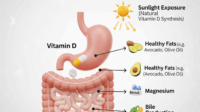
Absorption is a chain reaction. Fat triggers bile release. Bile helps break down fats into smaller droplets. Those droplets make it easier for fat-soluble substances—including Vitamin D—to integrate into absorption pathways.
Avocado contributes to this environment. It supports a meal profile that makes it more likely Vitamin D will be absorbed efficiently rather than merely swallowed. The difference is subtle, but over months, subtle changes can become visible in labs and, sometimes, in how you feel.
Uncommon vocabulary, simple meaning: you’re optimizing “bioavailability,” not just “intake.” Intake is what you do. Bioavailability is what your body actually leverages.
What About Different Vitamin D Forms? (The Practical Reality)
Vitamin D supplements often come as Vitamin D3 (cholecalciferol), and sometimes in liquid forms or capsules. The fat-related logic generally still applies because the nutrient remains fat-soluble.
If your supplement is oil-based, it may already contain a delivery system. In that case, avocado can still be helpful, but it’s more of a “supporting actor” than the main delivery method. If your supplement is a capsule with minimal oil, pairing with avocado may have a more noticeable effect.
Curiosity-worthy note: people assume the supplement is the whole equation. Often, the meal is the quiet co-author.
Potential Pitfalls: When Pairing Might Not Help (and When It Can)
Pairing Vitamin D with avocado doesn’t create magic in every context. If your overall diet lacks fat, or if you take Vitamin D at a time disconnected from any meal, absorption could remain inconsistent.
Another pitfall is doubling down on fat without considering your goals. You’re aiming for sufficient lipid availability, not an accidental calorie surplus. If weight management matters to you, think controlled portions and balanced meals.
Also, avoid viewing this as a replacement for bloodwork. If you’re testing Vitamin D levels, interpret changes with patience. Vitamin D status often shifts over time, not overnight.
Signs You Should Reassess: Testing, Symptoms, and Caution
Vitamin D is powerful, but it’s not a casual nutrient. Too much can become problematic. That’s why testing is a useful compass.
If you’ve been supplementing and aren’t seeing expected results—or if symptoms raise concerns—reassess dose, timing, and consistency. Absorption support is one part of the equation; dosage and baseline levels are the other parts.
Short sentence with sharp meaning: Pairing helps absorption, but it doesn’t justify reckless dosing.
A Simple Fat Absorption Guide: Make It Effortless
Use this easy playbook:
Step 1: Take Vitamin D with a meal.
Step 2: Include dietary fat—avocado is a friendly option.
Step 3: Keep portions sensible (often one-quarter to one-half avocado works).
Step 4: Stay consistent for weeks, not days.
Step 5: Recheck levels if you’re monitoring or adjusting.
Long sentence, gentle tone: when you build a routine where your meal and supplement align, you turn absorption from an unpredictable event into a dependable habit.
The Perspective Shift: Avocado as a “Delivery Environment”
Here’s the heart of the question: should you take Vitamin D with avocado? The most useful answer is yes—with a mindset upgrade. Avocado can provide lipid support that suits Vitamin D’s fat-soluble nature.
But more than that, avocado invites consistency. It makes meal planning pleasant. It nudges you toward meals that include healthy fats, fiber, and satiety. That combination doesn’t just serve absorption—it serves adherence. And adherence is where real change quietly gathers.
So take the supplement, but also take the meal seriously. Think of avocado as more than food. Think of it as the environment where Vitamin D can do its work—patiently, efficiently, and with less guesswork.