Ever wondered how you could turn a simple walk outside into a practical Vitamin D “alchemy” session—without accidentally overdoing the sun? Here’s a playful thought: what if your skin were a tiny sundial, and the day’s light determined whether you harvest benefits or collect regrets? The challenge is that sun exposure isn’t one-size-fits-all. Time of day, skin type, and even your body’s clothing pattern can quietly nudge the needle toward either efficient Vitamin D synthesis or unnecessary ultraviolet (UV) stress.
Start with the real goal: Vitamin D synthesis, not sunbathing
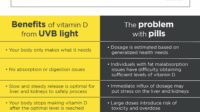
Vitamin D is primarily produced in the skin when UVB rays interact with a precursor molecule. This means the objective is not prolonged basking. Instead, think “targeted exposure.” Short, regular intervals often outperform marathon sessions in both effectiveness and safety.
A practical mindset helps: you’re aiming for enough UVB to stimulate Vitamin D production, then stepping back. Your body will continue processing what it has started, even after you go indoors. In other words, the best plan usually resembles a brief ritual rather than an extended performance.
Also, remember that factors like latitude, season, cloud cover, and air pollution can influence UVB intensity. Even the same afternoon can behave differently on different days.
Time of day matters: when the sun is most “Vitamin D friendly”
Consider the sun like a seasonal musician. At different hours, it plays different notes. UVB availability is typically greater when the sun is higher in the sky. This often places the most Vitamin D-effective window around late morning through mid-afternoon.
Yet there’s a twist: higher UV intensity also increases skin damage risk. The sweet spot is therefore conditional—effective timing plus disciplined duration.
If you’re aiming for Vitamin D support, start by choosing a time window when UVB is more likely present (commonly late morning to mid-afternoon). Then keep your exposure brief and adjust based on how your skin reacts.
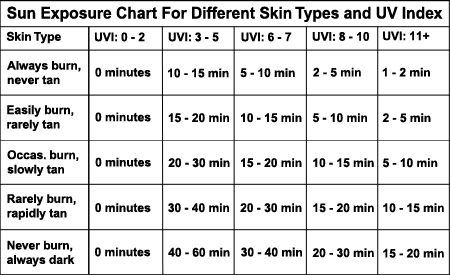
Skin type is your UVB tuning knob (I to VI)
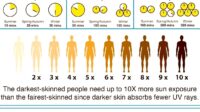
Skin type determines how quickly your skin responds to UV. Lighter skin generally produces Vitamin D more efficiently because UVB penetrates more readily. Darker skin often requires more exposure time for comparable Vitamin D synthesis, but the risks from cumulative UV exposure still apply across all skin tones.
Here’s the conceptual mapping:
Fitzpatrick Type I (very fair, burns easily, rarely tans): Minimal exposure time; strict sun-smart practices.
Type II (fair, burns easily, tans minimally): Short intervals with careful observation.
Type III (medium, sometimes burns, tans gradually): Moderate intervals; still monitor for redness.
Type IV (olive, burns minimally, tans well): Longer intervals may be needed, while still avoiding burning.
Type V–VI (brown to deeply pigmented, burns rarely): Vitamin D may require longer exposure, but “risk invisibility” is not risk absence. Cumulative UV effects can still accumulate.
A helpful heuristic: aim to avoid redness. Redness is a flare signal, not a badge of health.
How to find your safe, effective duration without guessing wildly
Duration is the hinge. Rather than treating “sun time” as a fixed number of minutes, treat it as a variable you can calibrate.
Start conservatively. Expose your skin for a brief period during your chosen time window, then reassess your skin response later (often later the same day or the next). If redness occurs, you overshot and should shorten the next session.
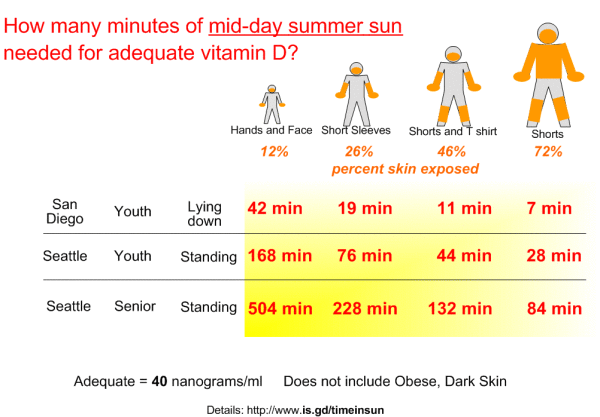
Another layer: skin exposure area matters. Exposing more skin—like forearms and lower legs—can improve Vitamin D production relative to leaving everything covered. Still, the principle remains: more exposure isn’t automatically better if it increases irritation or burning.
Think in terms of repeating smaller “doses” across the week rather than relying on a single extended outing.
Clothing, body position, and the myth of “whatever happens in the sun”
Your clothing isn’t background noise. Fabric color, weave tightness, and coverage directly affect UVB contact with skin. If you want Vitamin D support, consider how much skin is genuinely exposed.
Body position can also influence exposure. A relaxed stance or posture that allows direct skin exposure to sunlight can improve UVB contact compared with slumping in the shade. On the other hand, heat and glare can lead to longer exposure without realizing it—so keep the session purposeful.
And about the myth: “If I’m not getting sunburnt, it’s harmless.” That can be dangerously oversimplified. Skin may show little immediate redness while still absorbing enough UV to contribute to longer-term risks.

Weather, clouds, and location: your environment can dilute or intensify
Clouds can reduce UVB, but they don’t guarantee safety. Light cloud cover may still allow meaningful UVB penetration. Fog and haze can be deceptive, too—visibility can drop while UV levels remain significant.
Similarly, seasons shift the UVB spectrum. In winter or at higher latitudes, UVB may be too weak for meaningful Vitamin D synthesis. On those days, trying to “force” Vitamin D via long sun sessions can raise risk without payoff. In such situations, alternative sources (dietary or supplement approaches) may be more efficient—especially when guided by clinical advice.
Tracking your environment helps. If you use weather apps or sun calculators, treat them as orientation tools, not absolutes.
Balancing benefits with skin protection: the “strategic compromise”
Here’s the uncomfortable truth: sunscreen reduces UV exposure, which can reduce Vitamin D synthesis. Yet sunscreen is also a key defense against UV-driven skin damage.
The practical compromise often looks like this: keep the session brief and targeted first, then protect yourself if you’ll remain outside longer. For example, you might plan a short, pre-protection interval aligned with your skin type and time of day, then apply sunscreen before extending the outing.
This strategy doesn’t erase caution—it disciplines it. It recognizes that your risk increases with time, especially once UV exposure passes the point where additional benefit is likely diminishing.
Red flags and when to stop treating the sun as a Vitamin D tool
Stop and rethink if you notice persistent redness, blistering, new or changing moles, or skin that feels unusually tender after sun exposure. These are not “learning curves.” They are signals that the dose is too high for your skin’s threshold.
Extra caution is also warranted for individuals with a personal or family history of skin cancer, those taking photosensitizing medications, or those with autoimmune conditions affecting skin resilience.
In such circumstances, Vitamin D optimization may require more structured approaches—especially when sunlight is less controllable.
Make it consistent: a weekly cadence beats occasional extremes
Vitamin D production is not a one-time event. It responds to regular UVB stimulation within safe limits. Consistency supports smoother outcomes and reduces the temptation to chase results with longer sessions.
Try mapping your plan onto everyday life: a weekday lunchtime walk, a weekend morning outdoors, or a short afternoon exposure window that you can repeat. If you miss a day, do not compensate with a longer one. That’s how routines quietly drift into overexposure.
From curiosity to a clear routine: your next small step
So, how do you optimize sun exposure for Vitamin D while respecting your skin’s boundaries? Choose a time window when UVB is more likely present, match the session length to your skin type, expose an adequate area, and keep the duration intentionally brief. Then protect yourself when you’re done.
Your skin is not a passive canvas; it’s a responsive instrument. Tune it gently, and you can harvest Vitamin D benefits without turning sunlight into a gamble.