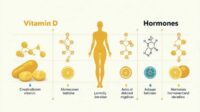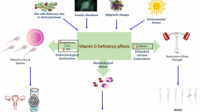
Vitamin D is often introduced as a “sunshine vitamin,” a nutrient that supports bones and mood. Yet beneath that familiar label lies a subtler storyline—one where endocrine chemistry plays the lead role. When vitamin D status is out of sync, estrogen and progesterone balance can follow, sometimes quietly at first, then unmistakably. Think of it as a backstage conductor: you may not see the orchestra, but you feel the music when timing goes wrong.
Vitamin D’s Endocrine Pathway: From Skin to Nuclear Dialogue
Vitamin D begins its journey in the skin under sunlight, then travels through a sequence of conversions—first becoming 25-hydroxyvitamin D, then eventually transforming into its active hormonal form. From there, it can influence gene transcription by binding to the vitamin D receptor (VDR), which behaves like a molecular switchboard.
Estrogen and progesterone are also governed by gene expression, receptor sensitivity, and feedback loops. The striking connection is that vitamin D doesn’t merely “affect hormones” in a vague way; it participates in the cellular instructions that determine how hormone receptors behave.
In practice, this means vitamin D may influence the expression of enzymes involved in estrogen metabolism, as well as the responsiveness of tissues to estrogenic signals. The result can be less volatility—fewer swings that feel like your body is constantly renegotiating the terms.
Estrogen Balance: The Double-Edged Sword of Signaling Intensity
Estrogen is essential. It supports the reproductive system, bone health, cardiovascular function, and even certain neural pathways. But estrogen is rarely “just right” by accident. Balance depends on production, metabolism, receptor binding, and clearance.
Vitamin D enters this balance as a modulator. Research suggests it can shift the way the body processes estrogen—particularly through pathways involving metabolites that vary in biological potency. Some estrogen metabolites may be more favorable, others more inflammatory, depending on context.
Here’s where perspective changes: rather than asking only, “Is my estrogen high or low?” consider the choreography of estrogen’s transformation. Vitamin D may help nudge the metabolic landscape toward smoother transitions, which can translate to fewer cyclical symptoms for some people.
If you’ve ever experienced irregular patterns—spotting, intensity shifts in PMS, or symptom timing that feels unpredictable—your body may be telling a story about receptor sensitivity and metabolic processing, not simply hormone quantity.
Progesterone Balance: Why Response Matters as Much as Levels
Progesterone is often cast as the “calming” hormone, but its role is more precise than that. It stabilizes the endometrium, tempers proliferative signals, and supports a progesterone-dominant environment after ovulation.
Vitamin D may indirectly support progesterone balance by influencing inflammation and immune signaling pathways. Chronic low-grade inflammation can interfere with ovulatory function and luteal adequacy—the period when progesterone should rise and do its stabilizing work.
So, while the conversation sometimes focuses on progesterone levels alone, it’s equally important to ask whether the body’s cellular environment is capable of responding appropriately. Progesterone effectiveness is not only about how much is circulating; it’s about whether receptors and downstream pathways receive the signal cleanly.
When vitamin D status is insufficient, that cellular responsiveness may become less reliable. Think of it like trying to play a song through a slightly detuned instrument: the notes exist, but the harmony doesn’t land.
Inflammation, Immunity, and Hormone Cross-Talk
Hormones do not float in isolation. They travel through a biological network influenced by cytokines, immune signaling, and oxidative stress. Vitamin D is known for its immunomodulatory effects—capable of influencing how the immune system behaves.
Estrogen and progesterone also interact with immune pathways. Estrogen can modulate immune activity in nuanced ways, while progesterone often supports an anti-inflammatory tilt during the luteal phase. When vitamin D is low, the immune tone may shift toward dysregulation, and that imbalance can reverberate back into endocrine function.
In plain terms: vitamin D can be part of why your hormones “feel” different. Some people notice that their cycles are more reactive to stress, infections, or inflammatory triggers when vitamin D status is inadequate.
Curiosity is warranted here. If your symptoms flare during stressful periods, or if you’ve noticed immune-related patterns (frequent infections, persistent inflammation, unusual fatigue), vitamin D could be an overlooked variable in the hormonal equation.
Cycle Timing and Symptom Patterns: Spot the Subtle Clues
Hormonal imbalance rarely announces itself with a single obvious symptom. It often arrives as a constellation: changes in cycle length, altered flow, mood fluctuations, breast tenderness, sleep disruption, and migraines that appear at specific times.
Vitamin D’s influence on estrogen and progesterone may show up as shifts in timing rather than dramatic swings. For example, some individuals report that improving vitamin D status corresponds with more predictable luteal-phase symptoms—less “all-or-nothing” intensity, fewer surprises.
Pay attention to repeating patterns. Do symptoms cluster more strongly in the late luteal phase? Does your mood destabilize as progesterone should be rising? Does your body seem to recover slower after menstruation?
These questions don’t replace medical assessment, but they sharpen observation. And sharper observation is the beginning of intelligent change.
Receptor Sensitivity: The Hidden Lever Behind Hormonal “Balance”
Even when hormone levels appear within reference ranges, symptoms can still occur. That’s because hormones act through receptors, and receptors can change in expression and sensitivity.
Vitamin D’s receptor-focused mechanism suggests it may affect how tissues interpret estrogenic and progesterone signals. When the “volume knob” on receptor sensitivity shifts, the same hormone amount can produce a different outcome.
Imagine a room with dimmer switches. The lights might be powered, but the perceived brightness changes based on the settings. Similarly, hormone effects can vary according to receptor dynamics. Vitamin D could be one of the switches.
This is why a perspective shift matters: it’s not only about quantity; it’s about cellular reception, downstream gene activation, and the final translation into physiology.
Who May Be at Greater Risk of Disruption?
Vitamin D deficiency is more common than many people assume. Limited sun exposure, darker skin pigmentation, higher latitude, indoor lifestyles, and certain diets can reduce vitamin D synthesis. Additionally, some gastrointestinal conditions and absorption issues can impair vitamin D availability.
If you also experience irregular cycles, ovulatory dysfunction, or symptoms consistent with luteal insufficiency, it becomes even more relevant to consider vitamin D status as part of the broader hormonal map.
This doesn’t imply deficiency is the only cause. Hormone balance is multi-factorial—genetics, thyroid function, stress physiology, metabolic health, and sleep patterns all play roles. Still, vitamin D can act as a meaningful “background condition” that influences the endocrine environment.
Practical Considerations: Supporting Vitamin D Responsibly
Improving vitamin D status typically involves a combination of sensible sun exposure, dietary sources, and supplementation when appropriate. Because vitamin D is fat-soluble, dosing matters. Too little may leave the endocrine pathways under-supported; too much can become counterproductive.
Consider testing—commonly measured as 25-hydroxyvitamin D—to understand baseline status. Then, adjust with clinician guidance to reach a healthy range. This approach reduces guesswork and supports a steadier biological trajectory.
Alongside vitamin D, it’s worth thinking about magnesium and vitamin K2, nutrients that can influence vitamin D metabolism and utilization. The endocrine system loves synergy. It rarely responds well to isolated interventions.
Curiosity can become momentum here. A calm, data-informed plan can transform vitamin D from an abstract concept into a tangible lever for hormone steadiness.
When to Seek Medical Guidance
Not every symptom should be treated as a vitamin D problem. If cycles are consistently irregular, if there is significant abnormal bleeding, severe pelvic pain, or symptoms that disrupt daily life, professional evaluation is essential.
Medical assessment can clarify whether the underlying issue involves thyroid dysfunction, PCOS, endometriosis, hyperprolactinemia, or other conditions. Vitamin D may still be relevant—sometimes as a supportive factor—but it should be integrated into a comprehensive plan.
Hormones are complex, and complexity deserves careful attention.

The Bigger Picture: Balance as a Systems Outcome
Vitamin D’s effects on estrogen and progesterone are best understood as systems medicine. It influences receptor dynamics, estrogen metabolism, inflammatory tone, and cellular responsiveness—elements that collectively determine whether your cycle feels steady or chaotic.
Instead of chasing a single hormone number, shift toward rhythm: how your body moves through phases, how symptoms cluster, and how you recover. Vitamin D can be one of the quiet architects of that rhythm, shaping the environment in which estrogen and progesterone do their work.
When that environment improves, the outcome can be surprisingly concrete—more predictability, calmer transitions, and a sense that your endocrine system is finally listening.