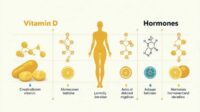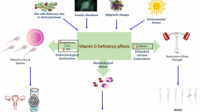
Pregnancy turns ordinary questions into urgent ones. How much vitamin D should be taken feels simple at first—until two rival numbers start appearing everywhere: 600 IU and 4000 IU. One sounds like a gentle suggestion; the other sounds like a bold “just in case.” And yet, the fascination with high-dose vitamin D isn’t accidental. It’s fueled by the way vitamin D behaves in the body—half vitamin, half hormone-like conductor—quietly orchestrating calcium handling, immune modulation, and even the choreography of fetal development. Let’s untangle what these doses mean, why the internet gravitates toward extremes, and what a more nuanced approach looks like.
Vitamin D in Pregnancy: More Than Bone Support
Vitamin D is often marketed as a bone nutrient, but in pregnancy it functions like a regulatory backstage crew. It helps the placenta and maternal circulation coordinate calcium and phosphorus availability. That matters because fetal skeletal mineralization requires a dependable supply chain. But vitamin D also participates in immune tuning—an area especially relevant during pregnancy, when the immune system must balance tolerance toward the fetus with defense against pathogens.
The reason people become fascinated by dosing is that vitamin D can be measured with a blood test (25-hydroxyvitamin D). When you can quantify it, you start believing you can precisely “optimize” it. And optimization is alluring. Still, pregnancy is not a laboratory experiment you can fully control. Your needs are shaped by sun exposure, skin pigmentation, latitude, seasonality, dietary intake, body composition, and baseline vitamin D status.

The Common Starting Point: 600 IU (The “Baseline” Dose)
600 IU per day is widely used as a baseline recommendation for pregnant adults. Think of this as the floor of adequacy—the dose intended to prevent deficiency in many people with typical circumstances. For someone with minimal risk factors and reasonably consistent dietary intake, 600 IU may be enough to maintain safe vitamin D levels without dramatically increasing blood concentrations.
However, “baseline” doesn’t mean “universal.” It means the dose was designed to cover a broad population. In real life, the starting line differs. A person living in a high-latitude region, working indoors, or having darker skin may synthesize less vitamin D from sunlight. Meanwhile, nausea, appetite changes, and food preferences during pregnancy can influence how reliably supplements and nutrient-rich foods are taken.
Another subtle point: vitamin D stores don’t update instantly. Your blood level is the result of prior intake and prior sun exposure. If someone begins pregnancy with low stores, a baseline dose may help—but not quickly enough to correct a deficiency.
Why 4000 IU Draws Attention: The “Correction” Narrative
4000 IU per day often enters the conversation because some clinical pathways use higher doses to treat deficiency or insufficiency. The number sounds decisive. It suggests a straightforward mechanism: increase dose → raise serum vitamin D → stabilize calcium metabolism → protect pregnancy-related outcomes.
That narrative is compelling, particularly for those who have experienced low vitamin D results before or who suspect they will be low during pregnancy. For individuals with confirmed deficiency, higher doses may be considered under medical supervision to restore levels efficiently.
Yet the deeper reason people gravitate toward 4000 IU is psychological as much as biochemical. When you feel uncertain—about the baby, about your own health—you search for the dose that feels like “more care.” High numbers feel like commitment. But in physiology, more isn’t automatically better. Vitamin D is fat-soluble, meaning it can accumulate over time. The body uses feedback systems to regulate activation pathways, but excessive intake can tip the balance, leading to elevated calcium (hypercalcemia) and associated symptoms such as constipation, frequent urination, excessive thirst, nausea, and in severe cases, kidney strain.
IU vs What Your Body Actually Shows: The Case for Lab-Guided Decisions
The comparison between 600 IU and 4000 IU becomes meaningful only when tied to blood measurements. The key test is 25-hydroxyvitamin D, often written as 25(OH)D. It’s the most useful marker because it reflects overall vitamin D status in the body.
If vitamin D levels are already adequate, 4000 IU may behave like over-correction. If levels are low, 600 IU may act like a slow drizzle rather than a corrective downpour. Pregnancy is especially sensitive to timing because maternal physiology changes gradually and fetal needs evolve continuously.
So the most “sensible” question isn’t, “Which number is better?” It’s: “What is my baseline status, and how fast does it need to change?” Clinicians often use a stepwise strategy—starting with an appropriate dose, rechecking levels after a period, and adjusting based on response.
Safety Considerations: The Tightrope Between Deficiency and Excess
Vitamin D is not a simple vitamin in the way vitamin C is. Its fat-soluble nature creates a pharmacokinetic different personality: it stores, it accumulates, and it persists. That’s why safety isn’t just about whether vitamin D is “good,” but about whether the dosing schedule aligns with individual metabolism and current lab values.
At lower intakes, the risk of toxicity is rare for most people. At higher intakes, especially without monitoring, risk becomes less theoretical. Toxicity is uncommon, but it is not imaginary—hypercalcemia can occur when vitamin D intake overwhelms regulatory capacity.

The best safety net is context: a clinician’s assessment, your baseline 25(OH)D, your dietary intake, your supplement label totals (including multivitamins), and your calcium intake. Some people unknowingly stack vitamin D from multiple sources—prenatal plus separate vitamin D plus fortified foods—pushing total intake beyond what they intended.
What About Calcium, Sunlight, and Diet?
Vitamin D does not work alone. Calcium is its companion molecule. Even with adequate vitamin D, if dietary calcium intake is low, bone mineralization can still be challenged. Conversely, someone with adequate calcium but severe vitamin D deficiency may struggle to activate and transport minerals effectively.
Sun exposure matters, but pregnancy-related sun habits vary widely. Some people avoid sunlight due to heat or skin sensitivity. Others spend time outdoors and assume their vitamin D is “handled.” Yet cloudy seasons, sunscreen use, and time-of-day all influence synthesis. Sunscreen reduces vitamin D production, but it also reduces skin damage risk—a tradeoff many pregnant people consider responsibly.
Diet contributes too: fatty fish, egg yolks, fortified milk or plant milks, and fortified yogurts can help. Still, dietary sources may not be enough if baseline status is low.
Who Might Need More Than 600 IU?
Higher-dose supplementation is more plausible when certain risk factors are present. These can include documented vitamin D deficiency, limited sun exposure, malabsorption syndromes (such as celiac disease), certain medications that alter vitamin D metabolism, higher body mass index, or a history of low vitamin D levels.
There is also a quiet category of risk: people who are diligent yet still low. Someone might take a prenatal vitamin faithfully and still have low 25(OH)D due to limited sunlight, genetic differences in vitamin D handling, or low dietary intake. That’s why lab-guided approaches have such staying power. They honor individuality instead of relying on averages.
For these groups, 600 IU may serve as prevention, while higher doses—sometimes around 2000–4000 IU depending on circumstances—may be used temporarily to correct deficiency. The key phrase is temporarily and supervised.
When 4000 IU Might Be Considered (and When It Shouldn’t)
4000 IU is often discussed as a correction dose, not a permanent lifestyle. It may be considered when vitamin D levels are significantly low, particularly under medical guidance and with follow-up testing to ensure the body is responding appropriately.
It should not be treated as an automatic upgrade for everyone simply because it “sounds stronger.” If someone’s baseline level is already sufficient, 4000 IU could overshoot the target. If someone has conditions that predispose them to calcium issues, the threshold for caution becomes even lower.
In pregnancy, the goal is not to “max out” vitamin D. The goal is to maintain a stable, adequate range that supports maternal health and fetal development—without drifting into excess.
Practical Guidance: A Decision Path You Can Actually Use
If the choice between 600 IU and 4000 IU feels like guesswork, use a decision path. First, check the vitamin D content in your prenatal and any additional supplements. Second, consider your baseline status and risk factors. Third, discuss whether a 25(OH)D blood test is appropriate at the start of pregnancy or in early prenatal care.
Once vitamin D is measured, dosing can become less dramatic. A clinician can recommend a regimen tailored to whether you need prevention (often closer to 600 IU) or correction (which may involve higher doses for a limited period). Then, after a suitable interval, recheck levels and adjust. This reduces the urge to chase numbers blindly and replaces it with measured, responsive care.
In the end, the fascination with 4000 IU versus 600 IU reflects a deeper human impulse: the desire to feel in control. But pregnancy rewards the opposite strategy too—humility before biology, partnership with monitoring, and careful calibration rather than extremes.