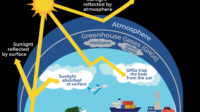
Sunlight is often imagined as a warm, golden visitor—quick to arrive, effortless to enjoy, and reliable as a daily ritual. Yet the atmosphere is a gatekeeper. Cloud cover, aerosols, and pollution can act like unseen hands, slowing the delivery of the rays that help your body manufacture vitamin D. The result can be subtle or severe, depending on where you live, how often you step outside, and what the sky is doing overhead. Think of sunlight as a letter with a critical message; clouds and grime are the thick envelopes that muffle the handwriting before it ever reaches your skin.
Vitamin D Production: The Sun’s Quiet Chemical Workshop
Vitamin D synthesis begins in the skin, not as a simple “sunbathing = vitamin D” equation, but as a chain reaction. When ultraviolet B (UVB) radiation penetrates the outer layers of skin, it triggers the conversion of a precursor molecule into vitamin D3 (cholecalciferol). Your body then edits that molecule further—first in the liver, then in the kidneys—until the biologically useful form can circulate and support multiple systems.
What’s intriguing is how selective sunlight must be. UVA may dominate the vibe of bright days, but UVB is the key for vitamin D. UVB is also more easily attenuated by the atmosphere. In other words, the sky can be “bright” while still being effectively “quiet” for vitamin D production. The difference between illumination and biochemical utility is where many people get surprised.
Cloud Cover: The Sky’s Diffusion Veil
Clouds can either soften light or block it, and that nuance matters. Thick, overcast skies tend to reduce UVB reaching the ground because clouds absorb and scatter radiation. However, lighter cloud cover can sometimes maintain sufficient daylight while still lowering UVB intensity. This creates a paradox: you may feel comfortably sunlit, yet your skin receives less UVB than you assume.
There is also a texture to cloud effects. Stratus clouds often behave like a broad filter, while broken clouds can let UVB stream in pulses between cloud gaps. For vitamin D, those “pulses” may not add up unless exposure is consistent. Short sessions under rapidly shifting skies can result in lower net UVB dose compared with longer exposure under stable conditions.
In metaphor terms, clouds can be a diffusion veil—turning sharp sunlight into a gentle glow that illuminates your surroundings but blurs the UVB signal your skin needs.
Pollution and Aerosols: Particulate Curtains That Absorb and Scatter UVB
Pollution is not merely a visual inconvenience. Fine particulate matter—soot, smoke remnants, and other aerosols—can intercept UVB radiation. These particles can scatter energy away from the path that would otherwise reach the skin, and many also absorb components of the spectrum. The outcome is a reduction in UVB availability even on days that appear relatively clear.
Some pollutants also act as chemical “matchsticks” for atmospheric reactions. Secondary aerosols form and increase the density of the optical barrier. This can make the atmosphere behave like a dimmer switch set lower than expected for vitamin D synthesis.
Imagine UVB rays as a narrow beam delivering a barcode. Pollution thickens the air so that the barcode becomes smeared—less readable, less effective.
Why UVB Is So Vulnerable: Atmosphere as a Spectrum Filter
UVB is inherently fragile compared with longer-wavelength light. Its journey through the atmosphere is affected by ozone concentration, humidity, and the concentration of particulates. Ozone absorbs UVB, so in seasons or locations where ozone levels are higher, the UVB fraction drops. Humidity can enhance the scattering of light, and together with aerosols, it can further blunt UVB arrival.
This is why a “perfectly sunny” day in one region might not yield the same vitamin D response as a “sunny but hazy” day elsewhere. The air’s filtering behavior determines how much of the UVB band survives to reach skin.
Skin, Geography, and Time: When the Odds Shift
Even with reduced UVB, vitamin D production is not uniform across populations. Skin pigmentation influences efficiency: melanin absorbs UVB and reduces its penetration. This doesn’t mean vitamin D production is impossible—only that more UVB exposure time is often required to generate the same outcome.
Geography plays its own role. Higher latitudes generally experience lower UVB intensity, particularly in winter months when the sun’s angle is shallow. The sun can be visible and warm while UVB is reduced significantly because the rays travel a longer path through the atmosphere.
Time of day matters as well. Midday sun typically produces higher UVB than early morning or late afternoon. Cloud cover and pollution then determine how much of that midday advantage survives the atmospheric gauntlet.
Clear Sky Isn’t Always Enough: Net UVB Dose Beats Vibes
People often evaluate sunlight by how it feels: warmth on skin, brightness in the eye, the sensation of “enough sun.” Yet vitamin D production depends on dose—UVB photons received over time. A bright day under heavy aerosol load can produce a surprisingly low UVB dose. Conversely, a moderately bright day with thin, broken clouds can deliver enough UVB to support synthesis if exposure is steady.
To think in terms of “net dose” is to shift from mood-reading the sky to measuring its biochemical usefulness. The sky may look cooperative while behaving conservatively.
Practical Strategies: Planning Exposure Without Compromising Safety
Efficient vitamin D support is about balancing UVB availability with skin safety. Short, sensible exposure can sometimes be preferable to marathon sessions. Consistency matters, especially when cloud cover is common or pollution levels fluctuate.
Cloudy doesn’t always mean zero UVB. If you live in an area with variable skies, consider flexible timing: when clouds thin briefly, the UVB transmission may increase. On high-pollution days, the UVB fraction may be further reduced; it may be wiser to prioritize indoor vitamin D sources or consult a healthcare professional for guidance.
Also consider clothing and sunscreen. Sunscreen reduces UVB and is designed to protect skin from damage. This is important. The key is not to “override” protection with extended exposure, but to pair safety with smart planning—potentially using dietary vitamin D or professional testing when needed.
Weather and Air Quality Monitoring: Turning the Sky Into a Data-Literate Ally
Because cloud cover and pollution can change rapidly, real-time awareness can make a difference. Many people benefit from checking air quality indexes and local weather forecasts to estimate whether UVB conditions are likely favorable. Even a small change in haze density can affect UVB transmission.
It can feel like learning a new language: instead of just asking whether it’s sunny, you begin asking how transparent the atmosphere is. That curiosity turns a frustrating variable into a controllable part of daily planning.
The Human Angle: Mood, Behavior, and Seasonal Drift
Vitamin D synthesis isn’t isolated from behavior. Seasons influence how often people go outside, how long they stay, and how much skin is exposed. Winter may bring more indoor time, colder air, and thicker clothing—often reducing UVB exposure even if skies briefly clear.
Cloudy seasons can also alter routine. If the sky frequently blankets itself, daily outdoor time may shrink, and the total UVB dose declines. Pollution can discourage outdoor activity as well, creating a double bind: fewer opportunities and reduced atmospheric transmission.
In this sense, clouds and pollution are not just physical filters; they also shape habits. The sky edits human life, and vitamin D production follows the edit.
Unique Appeal: A World Where Light Has Layers
The most captivating part of this topic is its layered complexity. Sunlight is not a single ingredient; it’s a spectrum with a narrow thread of biochemical relevance. Clouds, ozone, aerosols, and haze each tug on that thread in different ways. The atmosphere becomes a responsive canvas—sometimes letting UVB through like a thin ribbon, sometimes smothering it like a shuttered window.
So when people ask why vitamin D feels unpredictable, the answer is poetic and practical at once. The sky can appear generous while withholding the specific signal your body needs.


Ultimately, cloud cover and pollution change vitamin D production by altering how UVB rays travel, scatter, and survive. When you understand the atmosphere as a dynamic filtering system, sunlight stops being merely a feeling and becomes a measurable relationship—one that can be managed with patience, safety, and a sharper eye for the conditions overhead.