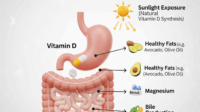
Timing can turn a good habit into a remarkably efficient one. Vitamin D behaves less like a quick “boost” and more like a slow-burn adjustment to your body’s biochemical cadence. In the 2025 update, the single best time to take vitamin D depends less on hype and more on how your physiology processes fat-soluble nutrients, how your day is structured, and what form of vitamin D you’re using. The goal is not simply to swallow a pill—it’s to synchronize absorption, consistency, and lifestyle rhythm so your intake actually lands where it’s meant to.
The Single Best Time: With a Meal Containing Dietary Fat
The best time to take vitamin D is with your largest meal that includes some fat—typically lunch or dinner. Vitamin D is fat-soluble, which means it’s packaged into the digestive tract alongside dietary lipids. When you take it on an empty stomach, absorption can be inconsistent, especially for people with lower bile flow or irregular meal patterns.
Short version: take vitamin D after eating, not before. Long version: choose a time window when food is already present, fat is likely in the mix, and your digestive system is actively processing nutrients. This approach tends to outperform “random” scheduling because it makes absorption less dependent on chance.
For many readers, lunch is the sweet spot—less rushed than morning routines, more reliably paired with balanced meals. Others thrive with dinner, especially if their evening eating patterns are consistent. Either works. What matters most is that vitamin D is taken with food, not merely at a time.

Why Meal Timing Matters: The Fat-Soluble Logic
Vitamin D travels through the gut differently than water-soluble vitamins. It requires micelles—tiny lipid-containing carriers—to be absorbed efficiently. When your meal includes fat, these carriers form more readily, and vitamin D can hitch a more reliable ride into circulation.
There’s also a behavioral component. Taking it consistently after a meal anchors the habit. Habits that are anchored to something stable—like lunch—tend to survive vacations, schedule shifts, and “busy-day” chaos. This is where the benefit of timing becomes practical rather than theoretical.
Consider it a logistical maneuver: your digestive tract is an organized supply chain. Pair vitamin D with a meal and it becomes a scheduled delivery, not a lost package waiting for the next opening.
Morning vs. Evening: Which One Wins in Real Life?
Many people ask whether morning or evening is better. If you compare two versions—vitamin D taken at breakfast vs. dinner—both can be effective as long as they’re taken with food. The “winner” is simply the meal that you most consistently eat with some fat and without skipping.
Morning routines can be difficult for those who eat lightly in the first hours after waking. If breakfast is typically a smoothie, coffee, or toast with minimal fat, vitamin D may absorb less predictably. Evening meals often provide more reliable macronutrient content. For others, breakfast is the main meal. Then morning becomes the better choice.
There’s no magic hour that overrides the fundamentals. Still, evening can be preferable for people who struggle with morning adherence. Consistency is quietly heroic.
Short-Acting vs. Long-Acting Strategies: Daily, Weekly, and High-Dose Options
Vitamin D scheduling also changes with dosing style. Daily doses are often taken with lunch or dinner to keep absorption steady and reduce the likelihood of missed catch-up decisions. Weekly dosing is common in clinical practice and can be equally effective when paired with food.
If you take a higher-dose regimen (sometimes prescribed), the timing principle remains the same: take it with a meal that contains fat. Whether it’s a daily capsule or a larger weekly dose, the “with-food” rule is a constant.
One caveat: avoid compensating for missed doses by doubling later unless a clinician has advised it. Vitamin D is not a stimulant; it’s a slow-moving regulator. Erratic dosing can create unnecessary peaks and valleys in blood levels.
Different Forms of Vitamin D: D2, D3, and Practical Considerations
Vitamin D comes commonly in two forms: D2 (ergocalciferol) and D3 (cholecalciferol). Many people gravitate toward D3 because it’s more commonly used in supplements, and it tends to integrate well into standard dosing strategies. Regardless of the form, absorption depends on fat intake and consistency.
Liquid drops, softgels, and chewables vary in convenience. Softgels often perform well because they already contain an oil-based matrix that can help dissolution. Drops can be effective too, especially when mixed into a fatty food or taken with a meal.
In 2025, a practical rule for readers is simple: choose the formulation you’ll actually take consistently, and pair it with your fat-containing meal. The “best” supplement is the one that becomes a dependable ritual.

How to Identify the Best Time for Your Schedule
To personalize timing, run a quick audit. Ask yourself: which meal do you reliably eat, and does it include some fat? Think olive oil on salad, nuts in yogurt, eggs at breakfast, cheese in lunch sandwiches, or fish at dinner. Fat doesn’t require excess; it just requires presence.
Then choose a time where you’re least likely to forget. If lunch is predictable and you usually eat something like eggs, yogurt, or a balanced plate, lunch becomes your anchor. If you skip breakfast and only eat a hearty dinner, dinner becomes the optimal window.
Finally, consider your routine stability over perfection. A “slightly imperfect” schedule that you follow faithfully beats a theoretically ideal schedule that collapses under real-world friction.
Absorption Enhancers and Interactions: What Helps, What Hinders
Some readers benefit from pairing vitamin D with dietary context. Fat intake is the headline. Additionally, magnesium status can influence vitamin D metabolism pathways. If magnesium is low, vitamin D may not be processed as smoothly, even if absorption occurs.
Certain medications and conditions can affect vitamin D levels and metabolism. If you take drugs for cholesterol, seizures, or chronic steroid use, timing and dosing strategy may require medical alignment. The best approach is not to gamble—confirm with a clinician when you fall into higher-risk categories.
Also watch out for supplement “stacking.” Taking vitamin D alongside many other supplements isn’t inherently bad, but it can create confusion about what you took and when. Keep timing consistent, and track your routine in a simple log or app.
What to Expect After Starting: Timeline and Benchmarks
Vitamin D isn’t an instant lever. Many people notice no immediate sensation, because the benefits are largely structural—supporting calcium balance, bone metabolism, and immune regulation. Over time, blood levels reflect adherence, dosage, and baseline status.
In practical terms, consider rechecking levels after an interval guided by a healthcare professional. The goal isn’t constant measurement; it’s informed adjustment. If your levels remain low, the fix often isn’t a different “hour,” but a more reliable “with-food” habit and an appropriate dosing plan.
For those who were deficient, the early phase can feel like waiting for a thermostat. Slow changes are still meaningful changes.
Implementation Checklist for 2025: A Clean, Repeatable Routine
Use this streamlined checklist to make the choice actionable:
1) Take vitamin D with your largest fat-containing meal (usually lunch or dinner).
2) Keep the timing consistent—same meal, same general time.
3) Choose a form you’ll remember (softgel, drops, chewable).
4) Avoid doubling missed doses without guidance.
5) Consider magnesium adequacy and discuss interactions if on medication.
6) Plan a follow-up blood test if you’re correcting deficiency.
This is how you turn timing into a stable advantage. Vitamin D becomes less of a supplement and more of a dependable biological rhythm—quiet, persistent, and calibrated to your everyday life.
Frequently Asked Questions: Common Timing Myths
Does taking vitamin D at night affect sleep? For most people, vitamin D is not a typical sleep disruptor. If you notice restlessness, review your overall supplement stack and dosing schedule with a clinician.
Is morning always best? Morning can be best only if breakfast includes fat and you consistently take it after eating.
Is it okay to take vitamin D with a low-fat meal? It’s not ideal for absorption. If your meal is extremely low in fat, absorption may be reduced.
Is the “single best time” universal? Universality depends on one principle: take it with food, ideally with dietary fat. The exact clock time is flexible, but the post-meal rule is not.