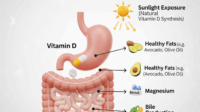
Vitamin D doesn’t simply “arrive” in the body—it behaves like a poised courier, knocking on cellular doors with a timing strategy. Choose the wrong moment, and the delivery feels sluggish. Choose the right moment, and absorption appears to glide into place, as if the body has quietly set the stage for it. The question of morning vs night is less about dogma and more about rhythm—your circadian tempo, your meal pattern, and the chemistry of how vitamin D travels and docks.
Why Timing Matters: Vitamin D as a Night-Shift Architect vs Morning Sunlit Gardener
Vitamin D is fat-soluble, which means it prefers the company of lipids. Think of it as a traveler who brings delicate equipment—something that packs best when carried in a suitcase rather than a flimsy envelope. In the body, vitamin D is absorbed in the gut, then transported through the bloodstream to tissues that need it. Timing can influence how conveniently that “suitcase” is packed.
In the morning, your body often acts like a sunlit gardener: enzymes wake early, digestion ramps up, and you may be ready to utilize nutrients with a predictable cadence. At night, the same organs become a night-shift architect—rest and rebalancing dominate, and absorption may benefit if the supplement is paired with the day’s lingering dietary fats.
Neither approach is inherently superior for everyone. The “best time” is the hour when your physiology is most receptive, and when your routine makes compliance effortless.
Morning Supplementation: The Case for a Fresh Start (and a Clear Routine)
Taking vitamin D in the morning can feel like turning a key at dawn. Many people wake, eat breakfast, and establish a stable pattern. Breakfast often includes some fat—eggs, yogurt, cheese, avocado, or cooking oils—creating an ideal escort for fat-soluble vitamins.
Morning dosing also tends to be memorable. When a supplement becomes part of a consistent morning ritual, adherence improves. And adherence is the quiet lever behind meaningful results.
There’s another subtle advantage: vitamin D is often associated with mood and energy. While it’s not a stimulant, some people report that morning intake aligns better with their daily tempo. If you’re someone who dislikes taking pills at night or tends to forget, morning may be more pragmatic than “perfect.”

Night Supplementation: When Dinner Becomes the Delivery Vehicle
Night intake has a distinct logic: vitamin D may travel more smoothly when taken with the evening meal—especially if that meal contains fats. Dinner often carries a heavier lipid presence than a light midday snack, and fat-soluble nutrients frequently hitch a ride more effectively when they can dissolve alongside dietary fats.
Some people prefer night dosing because mornings are chaotic. A late, structured meal followed by a consistent supplement moment can turn vitamin D into a nightly “bookmark,” one you never miss.
However, there is a counterpoint. If you take vitamin D late and you’re sensitive to reflux or have an unsettled stomach, you may experience discomfort. In that case, aim for a time closer to the end of dinner or shift earlier in the evening. Your digestive comfort is not a footnote—it’s part of absorption.

What the Body Actually Uses: Fat-Solubility, Bile Support, and Dissolution
Vitamin D belongs to the fat-soluble family, meaning it relies on the digestive machinery that handles fats. When you eat, the body releases bile and digestive enzymes that help break down fats and assist absorption. Vitamin D can integrate into those processes more effectively when timed alongside meals.
Picture it as a performer entering the stage only after the curtain rises. If the room is dark and quiet (fasting), the performer may still arrive, but the show may be less seamless. If the lights are on (a meal with fat), the performer steps into the correct spotlight.
So, regardless of morning or night, the most important variable is often whether vitamin D is taken with a meal that contains dietary fat. Timing becomes a choreography. Meal composition becomes the music.
Morning vs Night: A Practical Comparison for Real Life
Choose morning if your breakfast includes some fat and you want consistency. Choose night if your dinner is more substantial and reliably fat-containing, or if morning is too hectic.
For many adults, either can work well. The “best time” usually isn’t a single universal hour—it’s a compatible pairing: vitamin D plus meal plus routine.
Here’s a clean way to decide:
Pick morning if:
• You eat breakfast regularly
• Your breakfast includes modest fat
• You forget nighttime doses
• You prefer a daytime health routine
Pick night if:
• You eat dinner consistently
• Your dinner includes fats (oils, dairy, meat, nuts)
• You struggle to remember morning pills
• Your stomach tolerates evening supplementation
Subtle Factors: Sleep, Mood, and the Art of Not Overthinking
Sleep is a major variable in metabolic tone. If vitamin D seems to affect your schedule indirectly—perhaps through mood perception or general routine—it may be wise to observe your response. Some people feel perfectly fine taking it at night. Others prefer mornings to keep evenings serene.
It helps to look at the bigger picture. Vitamin D is not an “instant” nutrient. Its system-level benefits often reflect weeks to months of consistent use, not a single dose. In other words, the body is building a library, not a single page.
That perspective reduces pressure. If morning works because it’s reliable, reliability is often the win.
Special Considerations: Absorption Challenges, Higher Doses, and Doctor-Guided Precision
Certain conditions can complicate absorption. People with fat malabsorption disorders, certain gastrointestinal diseases, or those on specific medications may need tailored guidance. In those cases, the “best time” can depend on clinical considerations rather than convenience.
If a clinician recommends a higher dose, the strategy might include dividing doses or using schedules designed for safer, more stable blood levels. Lab values—especially 25-hydroxyvitamin D—serve as a compass.
Even then, the principles remain: vitamin D is fat-soluble, meals matter, and your routine determines success.
How to Maximize Absorption: Pairing Tips That Feel Like Good Luck
Maximizing absorption is often less about the clock and more about the pairing. Consider these tactics:
• Take vitamin D with a meal that includes fat—think olive oil, eggs, salmon, nuts, or full-fat dairy.
• Keep the dose consistent daily. Your body loves predictable signals.
• If you forget frequently, choose the time when you are least likely to miss it.
• Stay hydrated. It won’t “boost” vitamin D directly, but it supports overall digestion.
Some people also pair vitamin D with vitamin K2 for broader bone and cardiovascular support. If that’s your plan, coordinate timing with meals rather than treating supplements as isolated islands.
Final Decision: The “Best Time” Is the One Your Body Can Use Reliably
Morning and night are two doors. The key is not which door is prettier—it’s which one opens with the right mechanism: meal fat, digestive readiness, and consistent habits. If you can take vitamin D with breakfast and never miss it, morning becomes a dependable sunrise ritual. If dinner is your stable anchor and you absorb comfortably after eating, night can be your quiet, well-lit delivery window.
Pick the schedule that aligns with your meals and your memory. Then let consistency do what motivation can’t: turn intention into long-term benefit.