Picture a supplement tablet as a tiny package—sealed, compressed, and designed to travel intact. Now imagine liquid vitamin D as a navigable stream, already softened for the digestive landscape. Many people wonder why liquid vitamin D sometimes seems to “work better” than tablets, especially when the goal is absorption. The answer is less about magic and more about formulation physics, digestion dynamics, and how your body actually encounters nutrients. When the delivery system aligns with how your gut and liver processes fat-soluble compounds, the result can be noticeably smoother.
Absorption begins before the vitamin even dissolves
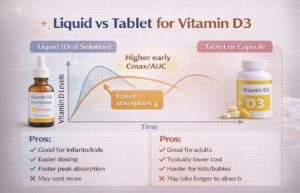
Vitamin D is fat-soluble, which means your body prefers to handle it in an environment that includes dietary lipids. Tablets must disintegrate, break down, and dissolve before vitamin D becomes available. That sequence can be slow or incomplete depending on the tablet’s coating, hardness, and the individual’s digestive conditions. Liquid formulations, by contrast, often present the vitamin in a ready-to-mix format, sometimes suspended in carrier oils or emulsified systems. That preparation can reduce the “waiting time” between ingestion and availability.
Think of it like delivering fuel: a tablet is like sending a sealed canister that must crack open on arrival, while a liquid can be poured directly into the engine. Even small delays in dissolution can translate into lower bioavailability for some people, particularly those with sensitive digestion or irregular intake of fats.
Liquid forms may offer better bioavailability through improved dispersion
One of the most underappreciated elements of absorption is dispersion—how thoroughly the nutrient disperses across the gut environment. Liquids frequently spread more evenly and can contact absorptive surfaces more consistently. Tablets may clump, dissolve unevenly, or pass through too quickly if the dissolution phase doesn’t keep pace with gastrointestinal transit.
Some liquid vitamin D products use advanced dispersion technologies (for example, emulsions or microencapsulation). These approaches can increase the surface area that the digestive process can “work with.” The practical implication is simple: if vitamin D is more evenly distributed, it is more likely to be loaded into the pathways that shuttle fat-soluble nutrients through the digestive system.
Carrier oils and emulsifiers can influence how vitamin D travels
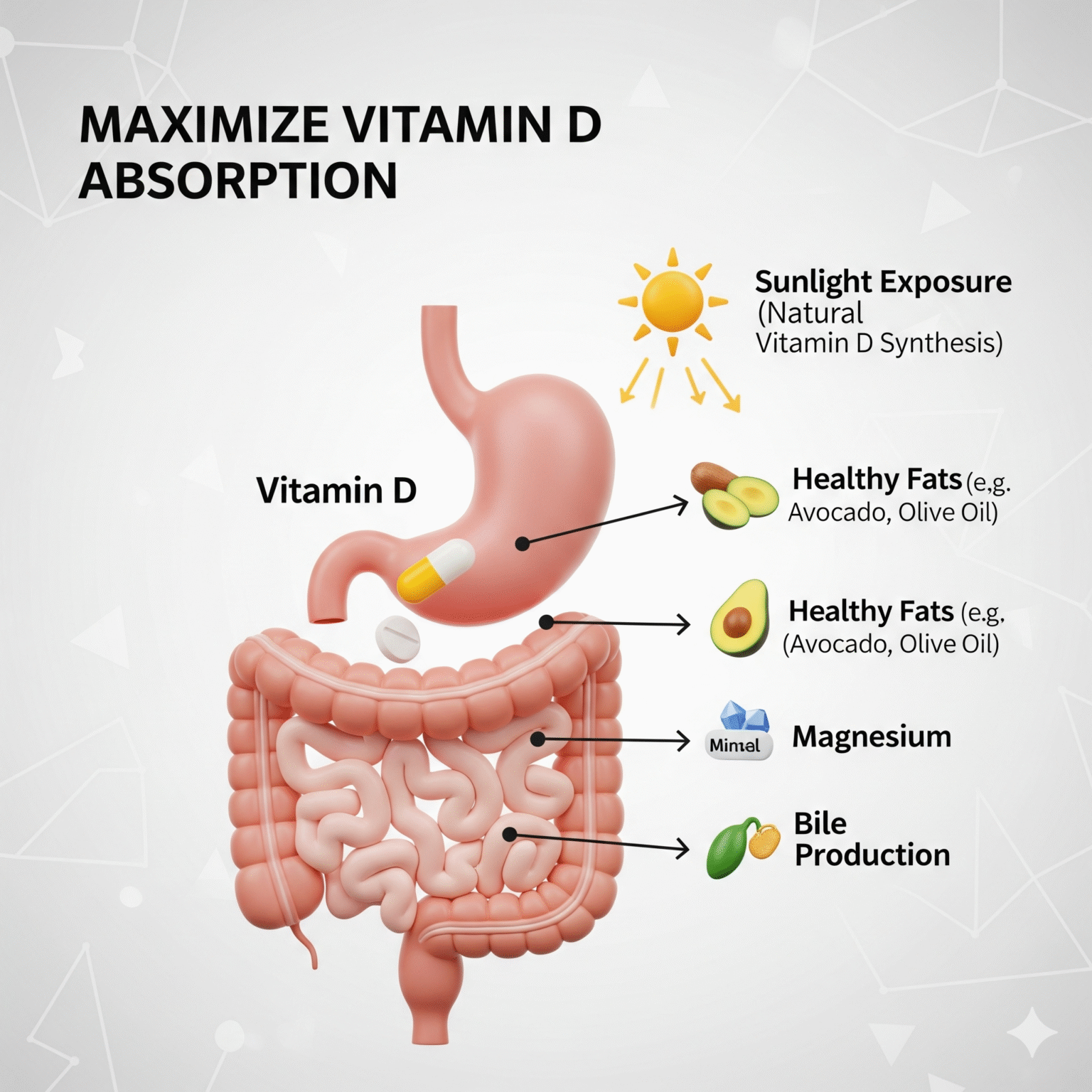
Vitamin D absorption depends heavily on how it’s packaged. Many liquid vitamin D supplements include carrier oils, such as medium-chain triglycerides (MCTs) or other lipid carriers. Since vitamin D naturally travels with fats, having the vitamin already paired with an oil can reduce friction in digestion. When vitamin D arrives alongside lipids, bile-mediated processes and micelle formation can occur more smoothly.
Emulsifiers may further refine this process. Emulsified systems can form tiny lipid droplets, allowing the nutrient to integrate into micelles more efficiently. That’s when the vitamin becomes part of a transportable structure designed to cross into intestinal cells. The outcome can be a more reliable absorption profile, particularly for individuals whose fat digestion is less consistent.
Dose flexibility: easier titration for real life
Another reason liquid vitamin D can feel more effective is dosing precision. Liquid formats often allow micro-adjustments—important if your body’s requirements shift seasonally, with weight changes, or after lab-guided adjustments. Tablets typically come in fixed strengths, and splitting them can lead to variability.
With liquid, you can fine-tune the dose to match your target range. That matters because vitamin D doesn’t work like an on/off switch. It’s more like a slow-settlement nutrient: steady intake supports stable serum levels. When dosing is easier to calibrate, adherence improves, and adherence is often the silent co-author of “results.”
Better for those who struggle with swallowing or adherence
Absorption is biochemistry—but consistency is behavior. Tablets can be a barrier for people who have dysphagia, nausea sensitivity, or trouble swallowing pills. If a supplement is difficult to take, it may be taken irregularly, which undermines the very goal of maintaining adequate vitamin D status.
Liquid supplements can also integrate more seamlessly into routines. Some people mix a measured dose with food, or take it with meals containing healthy fats. That simple habit can create a more absorption-friendly context. In practical terms, an “optimal” vitamin D supplement is the one that actually shows up in the body consistently and under the best conditions.
Who may benefit most from liquid vitamin D
Certain life circumstances can change absorption efficiency. People with gastrointestinal disorders, those who have had bariatric surgery, or individuals with bile-related conditions may find liquids more forgiving. If tablet dissolution is inconsistent or if digestion of fats is less robust, a formulation that already includes supportive carriers can be advantageous.
It’s also worth noting that elderly adults may experience slower gastric emptying and altered digestive chemistry. These factors can affect how tablets break down. Liquids, being immediately available, may require less mechanical work from the gut. The difference isn’t universal, but for some, it’s meaningful.
Form matters: vitamin D3 vs D2, and why it’s not just a label
Not all vitamin D is equal in performance. Many liquid products contain vitamin D3 (cholecalciferol), which is often preferred for raising and maintaining serum vitamin D levels. Vitamin D2 can also help, but D3 is frequently selected when the objective is long-term sufficiency. The “liquid vs tablet” conversation is important, yet it rides on top of a deeper variable: the specific vitamin D form and the quality of the formulation.
When choosing a supplement, readers can expect to see details about the type of vitamin D and the unit strength. A thoughtful label makes it easier to align intake with personal targets—especially when combined with periodic blood tests.
Timing with meals: turning absorption into a strategy
Even the best liquid vitamin D can underperform if it’s taken at an inconvenient time. Because vitamin D is fat-soluble, taking it with a meal that includes dietary fats can amplify the absorption process. Many people find that liquid formulations are easier to coordinate with meals, since the dose can be measured quickly and swallowed with food.
Short sentence, strong implication: timing is a lever. Pairing intake with lunch or dinner may improve consistency in micelle formation and bile activation. The result is often a more predictable absorption curve, which matters for those who monitor vitamin D levels.
Side effects and comfort: the “felt experience” can reflect tolerance
Some individuals experience stomach discomfort with certain tablets, sometimes due to excipients or the pace at which a tablet disintegrates. Liquid vitamin D—depending on its ingredients—can be gentler for sensitive stomachs. That doesn’t mean everyone will feel the difference, but the “tolerability factor” affects long-term adherence.
Comfort is not a trivial outcome. If a supplement causes nausea or distaste, users may skip doses. When absorption is the goal, reducing friction in the daily routine can indirectly improve biological outcomes.
What readers should expect from different types of content
When exploring this topic, readers typically encounter a mix of perspectives. Some articles focus on chemistry—emulsions, micelles, and dissolution kinetics. Others lean into practical guidance: how to take liquid doses, when to ingest with meals, and how to titrate gradually. Still others provide comparison frameworks: what to look for in labels, how to interpret dosage units, and when to speak with a clinician.
For a well-rounded understanding, the best content connects both worlds: mechanism plus method. Mechanism explains why absorption could be improved. Method explains how to actually implement it in daily life. Together, they transform an abstract nutrient into an actionable plan.
Bottom line: absorption can improve when the delivery system fits digestion
Liquid vitamin D may work better than tablets for absorption because it can dissolve or disperse more readily, pair vitamin D with lipid carriers more effectively, and support smoother transport through fat-soluble nutrient pathways. It also offers practical advantages: easier dosing, better tolerability for some people, and improved adherence. In nutrition, the path from bottle to bloodstream isn’t only about vitamin content—it’s about timing, formulation, and how your gut processes what you give it.
If you’re considering a switch, a sensible approach is to align the form with your digestive context, take it with meals when appropriate, and track progress through bloodwork when recommended. Over time, the “why” becomes visible in the numbers—and the routine becomes easier to maintain.
Ultimately, absorption is a conversation between chemistry and consistency. Liquid vitamin D often speaks that language fluently.