There’s a familiar, almost romantic notion that morning sunlight is gentler—so it must be ideal for coaxing vitamin D out of the skin. “Just step into the morning sun,” people say, as if time of day were the secret ingredient. Yet vitamin D is not manufactured by vibes or by tradition. It is manufactured by biology, and biology responds primarily to ultraviolet B, not to the clock. The “morning sun” myth persists because it feels intuitive, because it sounds safe, and because our attention naturally drifts toward patterns that seem personal and visible. But when the ultraviolet B (UVB) Index is the true control panel, the story becomes far more precise—and more liberating.
Why “Morning Sun” Feels So Persuasive
Most myths survive because they begin as half-truths. Morning light often appears softer. Shadows are longer. The air may feel cooler. People associate comfort with safety, and safety with benefit. When someone reports getting “a nice vitamin D boost” after a brisk morning walk, the narrative hardens into a rule.
There’s also a psychological scaffolding at work. Morning routines are structured and memorable: the walk, the coffee, the sunlit window. Memory favors vivid moments. And vivid moments become evidence, even when the mechanism is something else entirely.
Then there’s the deeper, more human fascination with beginnings. We like the idea that the body can be “tuned” early in the day—like sunlight is a daily conductor and the morning is the rehearsal. It is a charming thought, but vitamin D synthesis is not a rehearsal. It’s a chemical process governed by UVB photons landing in the right skin layers.
Vitamin D Chemistry Doesn’t Care What the Clock Says
Vitamin D production begins when UVB radiation transforms molecules in the skin, eventually leading to vitamin D that can be metabolized throughout the body. This is a photochemical chain reaction. It depends on how much UVB energy reaches the skin, how that energy is absorbed, and how long it stays within a threshold that is sufficient—without becoming excessive.
The key word is “UVB.” UVB is not evenly distributed across the day. It can fluctuate with cloud cover, latitude, season, ozone levels, altitude, and even reflective surfaces like sand, concrete, or water. The morning sky can look bright and promising, but brightness often correlates more with visible light than with UVB power.
So, the body’s “vitamin D factory” operates like an industrial system. The factory doesn’t run on dawn aesthetics; it runs on the specific spectrum of energy. The UVB Index is a practical indicator of that energy. If the UVB Index is low, morning can be beautiful and still biologically unproductive for vitamin D.
The UVB Index: The Real Indicator of Vitamin D Potential
The UVB Index is essentially a forecast of UVB intensity. Higher UVB Index values generally indicate a greater capacity for vitamin D synthesis and also a greater risk of skin damage. This duality is crucial: the same photons that enable vitamin D formation can contribute to DNA damage and erythema.
Morning light can be misleading because people often assume “earlier equals safer.” But safety is not determined by the sun’s biography; it’s determined by its current irradiance. A brisk morning with a UVB Index of, say, 1 or 2 may yield modest—or negligible—vitamin D production, even if the sun feels warm.
Conversely, in summer or near the equator, late morning or even midday might offer stronger UVB—meaning vitamin D synthesis may occur more efficiently. Yet efficiency doesn’t automatically imply prudence. The body can become overexposed quickly once UVB intensity climbs.
That is why a UVB-informed approach is not just more accurate—it also supports balance. It shifts the conversation from “What time should I go outside?” to “What UVB level am I dealing with today?”
When “Morning Sun” Is Actually the Same UVB Problem
In many regions, the UVB Index in early morning remains low. Clouds can intensify the misconception by scattering light. A bright sky can still deliver insufficient UVB. The skin may report comfort—warmth, gentle illumination—while the UVB machinery runs slowly or not at all.
Skin tone further complicates the myth. Melanin provides protection by absorbing ultraviolet radiation, including UVB. This is protective, but it means that individuals with darker skin often require longer exposure (or higher UVB levels) to achieve the same vitamin D effect. If one assumes morning always produces vitamin D efficiently, they may repeatedly under-shoot the needed dose.
Latitudes matter too. In winter, even mid-day sun may offer limited UVB. In these conditions, “morning” versus “afternoon” becomes a smaller variable than season and UVB strength. The myth collapses under the weight of geography.
Deeper Reasons People Prefer Morning Narratives
Fascination is rarely purely scientific. It’s also cultural. “Morning sun” fits a narrative of wellness: it suggests intentionality, routine, and self-care. It feels like a gentle optimization—almost a lifestyle hack.
There’s also an information asymmetry. People hear about vitamin D benefits in a high-level way, and then they fill in the operational details using what seems sensible: morning equals gentler; gentle equals safe; safe equals good. This chain becomes a comforting shortcut.
Another subtle driver is the human tendency to conflate photoprotection with sunlight avoidance. Many people fear that to protect the skin, they must avoid sun at the “bad” hours—so they search for a “good” hour. Morning becomes the candidate. But biology doesn’t perform morality plays. UVB risk and vitamin D capacity do not align neatly with the morning/evening aesthetic.
Balance: Vitamin D Goals Without the Sunburn Reckoning
Vitamin D production should be treated as a controlled outcome, not a personal dare. The practical goal is to get enough vitamin D support while minimizing cumulative skin damage. UVB Index guidance helps you estimate when the environment is capable of both benefit and harm.
In higher UVB conditions, prolonged exposure increases risk rapidly. A brief, strategic period may be more reasonable than an all-afternoon “sun holiday.” In lower UVB conditions, longer exposure may be necessary—but this is exactly where risk management is essential. If UVB is too low, “trying longer” may not produce meaningful vitamin D and can still generate photoaging or burns depending on individual factors.
Consider the role of sun protection. Sunscreen can reduce UVB exposure and therefore may reduce vitamin D synthesis if used generously or for longer sessions. Yet sunscreen is also a defense against skin cancers and photoaging. The most productive approach often involves moderate exposure when UVB is adequate, combined with sun-safe behavior afterward—especially if your skin burns easily.
How UVB Index Guides Practical Choices Day to Day
Think of the UVB Index as a dial rather than a label. On days when UVB is higher, the same amount of sun may produce stronger vitamin D signals in less time. On days when UVB is low, the environment may not support meaningful synthesis regardless of how “morning” it feels.
Daily decisions become more intentional: checking the UVB Index, assessing your skin type, considering how much body surface is exposed, and accounting for whether you’re near reflective surfaces. A sunny beach can deliver UVB from multiple angles, and water reflection can amplify intensity. In such settings, morning might not be safer—it might simply be less noticed.
If you prefer a morning routine, that’s fine. But let the UVB Index be the compass. Morning can be part of a plan, not the plan itself.
Visualizing the Concept: Sun Protection vs Vitamin D
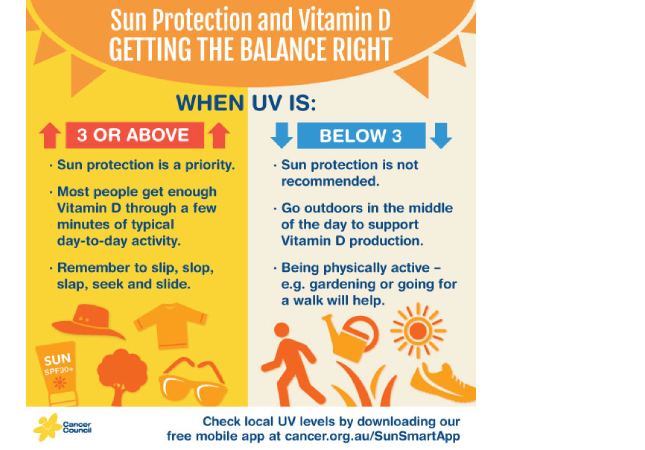
The tension between sun protection and vitamin D synthesis is best understood as a trade-off managed by UVB intensity. When UVB is stronger, both vitamin D potential and skin risk increase. When UVB is weaker, the vitamin D potential may drop faster than people expect. The chart below illustrates the balancing logic—how UVB level influences both outcomes.
What to Do With the Myth Once You Spot It
Spotting the myth is the first step. The next step is replacing it with a more reliable mental model: UVB Index, skin type, exposure amount, and time. This model does not require guesswork. It doesn’t ask you to trust a tradition. It asks you to observe the actual ultraviolet environment.
If your aim is vitamin D support, consider consulting a healthcare professional for personalized guidance, especially if you have risk factors for deficiency or you live in regions with limited UVB during much of the year. In some cases, dietary sources or supplements may be more consistent than “catching” sun at the right time.
The most empowering conclusion is simple: you don’t need to chase morning sunlight like a talisman. You need to understand the UVB reality of the day—and then make a choice that respects both your biology and your skin.
A Closing Thought: Dawn Is a Feeling, UVB Is the Fact
Morning sun will always be enchanting. It photographs well. It feels kind. It begins the day with optimism. But vitamin D does not arise from narrative; it arises from UVB photons and the skin’s chemistry. The UVB Index is the bridge between what we feel and what our bodies actually receive.
So the next time someone recommends “morning” as the magic hour, you can politely shift the conversation: the clock is secondary. UVB intensity is the key. And once you adopt that perspective, sunlight becomes less of a myth and more of a measurable resource.