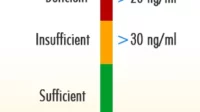
If your recent lab work shows a vitamin D level around 20 ng/mL, you’re standing at the threshold of a bigger physiological story—one that’s been quietly written in sunlight exposure, dietary patterns, and biological timing. The jump to 50 ng/mL is not merely a number; it’s a shift in how your body may marshal calcium handling, immune signaling, and cellular regulation. Consider this protocol a careful, curiosity-driven roadmap—designed to guide you toward a more luminous baseline.
1) First, Reframe What “Low Vitamin D” Really Means
Vitamin D isn’t just a nutrient you “run out of.” It behaves more like a hormone-like regulator that interfaces with multiple systems. When levels hover near 20 ng/mL, many people assume the situation is “fine enough.” Yet your body may still be operating with a slightly dimmed thermostat for immune modulation, muscle function, and bone remodeling.
There’s a useful mental pivot here: rather than chasing vitamin D as a trophy, approach it as a signal. Think of your vitamin D number as a snapshot of your skin’s capacity to manufacture vitamin D, your gut’s absorption efficiency, and how quickly it’s metabolized and cleared. That perspective changes the strategy—from hoping to targeting.

2) Confirm the Starting Point and Understand Lab Variability
Before you intensify anything, verify the test type. Most clinical results refer to 25-hydroxyvitamin D (25(OH)D), the standard marker. If your value is truly around 20 ng/mL, you’re starting in a moderate range—close enough that an organized protocol can plausibly carry you upward.
Also remember: lab variability exists. Hydration status, timing of the draw, seasonal effects, and even differences between assays can nudge results. You don’t need paranoia—you need precision. A sensible plan includes rechecking after a defined interval to see whether your body is responding as expected.
3) Safety First: Use a “Ceiling-Aware” Strategy
Increasing vitamin D should never become a blind acceleration. While the goal is 50 ng/mL, the body has a tolerance curve. Excessive vitamin D can elevate calcium, leading to unwanted effects. That’s why a quality protocol is both ambitious and disciplined.
Consider baseline bloodwork before escalating: calcium, and sometimes phosphorus and parathyroid hormone (PTH). If you have a history of kidney stones, granulomatous disease (such as sarcoidosis), hyperparathyroidism, or significant kidney impairment, you’ll want clinician oversight. A protocol that feels “natural” can still be pharmacologically potent.
4) Choose the Right Form: D3 as the Default Lever
For most people, vitamin D3 (cholecalciferol) is the most commonly used form for supplementation. It tends to be effective at raising serum 25(OH)D because it aligns with the pathway your skin naturally initiates through UV exposure.
Look for consistency: reliable sourcing, a stated dose, and a formulation that fits your digestion. If you’re taking it alongside a meal containing fat, absorption is often more efficient. Small details matter more than people expect.

5) Timing and Dose: The Protocol to Move from 20 to 50
To increase from 20 to 50 ng/mL, the strategy is typically staged. Think of it as ramping up, then stabilizing. A common approach is to select a daily dose that can raise levels over several weeks rather than attempting an abrupt leap.
Stage A (Initial Raise): Consider a regimen that provides a moderate-to-higher daily intake for a limited duration, usually around 8–12 weeks, while monitoring for response. Your exact dose should reflect body weight, baseline status, sun exposure, and absorption. Some people respond quickly; others require steadier time.
Stage B (Consolidation): Once you approach the target range, the dose is often reduced to maintain. The goal becomes equilibrium: enough to hold steady near 50 without drifting upward into unnecessary excess.
Important: Because dosing varies, the “protocol” here is a framework. A clinician can refine the dose using your weight, lab trend, and risk profile. But structurally, ramping for 2–3 months and then retitrating is how most intelligent plans behave.
6) Pair It With Absorption Allies (and Remove Hidden Saboteurs)
Vitamin D’s journey is partly chemical, partly logistical. Absorption depends on dietary fat and the integrity of your gastrointestinal system. If you take vitamin D on an empty stomach, you may be turning a high-performance fuel into a sluggish engine.
Consider “allies” and “saboteurs.” Allies include taking it with a meal that includes healthy fat—olive oil, eggs, avocado, nuts, or fatty fish. Saboteurs include certain malabsorption conditions, chronic inflammatory bowel issues, and medications that alter vitamin D metabolism. If you use glucocorticoids, certain anticonvulsants, or weight-loss surgeries, your dose needs may change dramatically.
There’s also a quiet metabolic actor: magnesium. Magnesium participates in vitamin D activation pathways. Many people are low. If your magnesium intake is inconsistent, your progress may feel strangely muted.
7) Sunlight: The Slow, Spectacular Variable
Sun exposure can contribute significantly, but it’s highly variable—latitude, season, skin tone, cloud cover, sunscreen behavior, and time of day all influence vitamin D synthesis. The goal isn’t to chase a burn; it’s to use sunlight intelligently.
Think in terms of “consistent, moderate exposure” rather than sporadic extremes. In many climates, a few times per week during appropriate hours can help. Still, supplementation is usually the more controllable lever when aiming for a specific lab target like 50 ng/mL.

8) Recheck and Read the Trend Like a Story
A protocol without follow-up is just hope wearing a lab coat. Recheck 25(OH)D after your initial stage—often around 8–12 weeks—so you can see whether your number is tracking upward as expected. Interpretation is trend-based. If you rise from 20 to 35, that tells you your body is responding, but the dose may need adjustment. If the increase is minimal, absorption or adherence may be the missing variable.
When you reach the vicinity of 50 ng/mL, shift into maintenance. Some people hold steady with a lower daily dose; others benefit from periodic higher dosing under professional guidance. Your data should decide the next move.
9) Watch the “Signal Lights”: Symptoms, Calcium, and Muscle Clarity
Many people report improved energy, better muscle function, or mood stabilization as vitamin D rises—but symptoms are not a substitute for lab results. If vitamin D is too high, complications are uncommon yet meaningful. That’s why safety labs can matter, especially when escalating.
If calcium-related symptoms appear—such as excessive thirst, frequent urination, constipation, confusion, or kidney stone symptoms—pause and reassess. Your body’s “signal lights” deserve respect.
10) Maintain Beyond the Target: Turn a Protocol into a Lifestyle
The final phase is the long game. Vitamin D levels can drift down when seasons change or when supplements are reduced too aggressively. Maintenance is about continuity. Think of it as a rhythm rather than an event.
Build a system: consistent supplementation, periodic lab monitoring (perhaps seasonally), and sunlight exposure when feasible. Revisit your diet, too. Fatty fish, fortified dairy or plant milks, and certain egg preparations can help support baseline intake. Food alone may not propel you from 20 to 50 quickly, but it can strengthen maintenance.
11) A Curiosity Checklist Before You Begin
Before initiating the ramp, answer these quietly: Are you consistent with meals when taking supplements? Do you have any conditions affecting absorption? Are you taking medications that alter vitamin D metabolism? Do you know whether your lab measure is truly 25(OH)D? Do you have a plan for re-testing?
This isn’t about control for its own sake. It’s about precision stewardship. When you align dosage, absorption, timing, and monitoring, the jump from 20 to 50 ng/mL becomes less like a gamble and more like a deliberate ascent.
Your vitamin D journey can feel like a single number on a report—but it’s actually a narrative about physiology responding to thoughtful intervention. With a ceiling-aware protocol, absorption allies, and trend-based retesting, you’re not just aiming higher. You’re refining the conditions under which your body can thrive.