Vitamin D is often framed as a guardian of bone strength and immune resilience, a quiet nutrient that “just helps.” But when doses climb beyond physiological needs, that reassurance can curdle. High-dose vitamin D can transform from a helpful supplement into a biochemical hazard—one that may culminate in kidney stones, calcification, and, in extreme situations, toxicity. The most unsettling part is how plausible the danger can seem. After all, vitamin D is essential; the trouble is not the vitamin itself, but the volume, the timing, and the body’s limited capacity to buffer excess calcium-related signaling.
The Popular Assumption: “More Vitamin D Must Be Better”
A common observation is that people equate adequacy with abundance: if a little vitamin D supports health, surely more will strengthen it further. This belief is not entirely foolish—vitamin D deficiency can be harmful, and correction matters. Yet “more” is where the arithmetic breaks.
Vitamin D acts like a hormone precursor, nudging the intestines to absorb more calcium and phosphate. Under normal circumstances, the body uses feedback loops to maintain balance. At high doses, those loops can become overwhelmed. Instead of a controlled rise in serum calcium, the system may overshoot, creating a hypercalcemic environment that encourages mineral precipitation in susceptible tissues.
It’s worth noting the psychological pull behind the fascination. People gravitate toward substances that promise visible outcomes—energy, immunity, winter “mood.” Vitamin D marketing often feels like a straightforward upgrade. But the body is not a dashboard with a single slider. It is an ecosystem with thresholds, buffering mechanisms, and downstream consequences that are easy to ignore until symptoms appear.
Why Vitamin D Excess Becomes a Calcium Problem
Vitamin D’s central pathway is deceptively simple: it increases intestinal absorption of calcium. When vitamin D levels become excessively high, calcium absorption can surge even if dietary intake or hormonal balance would otherwise limit it.
Elevated calcium in the bloodstream is not merely an internal “high.” It can lead to a chain reaction: kidneys must work harder to excrete the surplus, urine can become supersaturated with calcium salts, and urinary chemistry begins to favor stone formation. In parallel, high calcium can disrupt neuromuscular function—manifesting as fatigue, muscle weakness, constipation, or confusion—because calcium is also an electrical signaling molecule in the body.
Some people interpret these symptoms as unrelated illness, delaying corrective action. Others mistake the early, nonspecific signs—like thirst, frequent urination, or nausea—for routine dehydration or “detox.” Those misreads can be costly, because the process is progressive, not dramatic. The body’s slow drift toward toxicity can be mistaken for ordinary discomfort.
Kidney Stones: How High-Dose Vitamin D Sets the Stage
Kidney stones are often blamed on “calcium” in general, but the deeper issue is urine supersaturation. For a stone to form, minerals must concentrate beyond solubility limits. High-dose vitamin D increases calcium availability, which can raise urinary calcium concentration, a key ingredient in many stone types—especially calcium oxalate stones.
Imagine the kidney as a high-precision filter. Excess mineral load behaves like abrasive grit. It doesn’t always cause immediate blockage, but it can seed crystal formation. Over time, crystals accumulate, aggregate, and grow—transforming a subtle chemical imbalance into physical obstruction.
Risk is amplified when other factors are present: high dietary oxalate (from certain foods), insufficient hydration, genetic predispositions, chronic kidney vulnerability, or concurrent supplementation with calcium. Vitamin D can be the spark, but the stone requires additional tinder. That is why some individuals develop complications at lower doses than others.
Beyond Stones: Hypercalcemia, Nephrocalcinosis, and Tissue Calcification
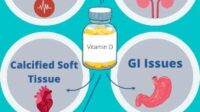
Kidney stones are the headline, but vitamin D toxicity can extend further. Persistent hypercalcemia can contribute to nephrocalcinosis, a condition where calcium deposits build up in the kidney tissue. This is different from a discrete stone; it is a more diffuse injury that can undermine kidney function over time.
There is also the concern of ectopic calcification—mineral deposits in places they do not belong. While the body naturally places calcium in bone, it does not “intend” calcium to accumulate in soft tissues. Excess mineral activity can disturb vascular and organ systems, especially if treatment is delayed.
Symptoms can be misleadingly varied. People may experience excessive thirst, frequent urination, abdominal discomfort, or cognitive changes. In severe cases, cardiac rhythm irregularities can occur. The danger is not only the stone but the environment that encourages mineral imbalance across multiple systems.
“Natural” Doesn’t Mean Harmless: Dose, Duration, and Individual Variation
Vitamin D is produced in the skin through sunlight, but supplementation is different from sun exposure. Sunlight typically triggers regulated synthesis, while supplements—especially high-dose regimens—can push levels higher than intended. The body’s feedback can’t always correct an oversupply quickly enough.
Individual variation is central. Genetic differences in vitamin D metabolism, baseline vitamin D status, body mass, kidney function, and sensitivity to calcium shifts can all alter risk. Two people might take the same dose, yet one remains fine while the other drifts toward toxicity.
There is also a common pattern: prolonged self-directed dosing. Many people start with “just for a few weeks,” then extend it because levels feel slow to stabilize. Unfortunately, vitamin D is fat-soluble and can accumulate. The delay between dosing and toxic effect can create false confidence—symptoms arrive after the excess has already been stored.
Who Is Most at Risk?
Not every body responds identically. People with a history of kidney stones, chronic kidney disease, or disorders affecting calcium regulation are generally higher risk. Those with conditions like hyperparathyroidism or certain granulomatous diseases may be particularly vulnerable, because their calcium pathways can already be dysregulated.
Medication interactions also matter. Some drugs can alter calcium handling, renal excretion, or vitamin D metabolism. Even without obvious interactions, the presence of high calcium intake through diet or supplements can increase the likelihood of a calcium overload scenario.
Age and hydration status add another layer. Older adults may have different renal clearance efficiency, and dehydration—whether from hot weather, illness, or busy routines—reduces the urine volume that normally dilutes stone-forming substances.
Symptoms That Should Trigger Immediate Caution
Vitamin D toxicity and hypercalcemia can be subtle at first. Watchfulness matters when common complaints appear together—thirst plus frequent urination, constipation with fatigue, or nausea paired with weakness and confusion.
These are not “diagnoses.” They are signals. If high-dose supplementation is involved, the symptom pattern should prompt prompt medical evaluation. Kidney stones also have their own warning set: sharp flank pain, blood in urine, and pain that radiates toward the groin.
The most dangerous scenario is delayed recognition—continuing the supplement because symptoms “might pass.” In toxicity, waiting often means the biochemical imbalance continues to strengthen.
How to Reduce Risk: Testing, Reasonable Dosing, and Smart Hydration
Prevention begins with respect for measurement. Blood tests can clarify baseline vitamin D status and help determine whether supplementation is truly needed. Target ranges vary by guideline and clinical context, but the principle remains: use the minimum dose that achieves adequacy.
Reasonable dosing also depends on duration. A short correction plan is not the same as indefinite high-dose use. If supplements are taken, monitoring should occur when appropriate, especially for individuals with higher risk profiles.
Hydration is a practical ally. Adequate fluid intake helps reduce urinary concentration of stone-forming minerals. This doesn’t “cancel out” excessive vitamin D, but it can mitigate one part of the stone-forming cascade—especially urine supersaturation.
Addressing the Fascination: Why People Keep Reaching for High Doses
The allure of high-dose vitamin D often stems from an elegant narrative: fix deficiency, feel better, and protect long-term health. That storyline can be comforting, even seductive, because it reduces complexity. Still, the body’s complexity doesn’t disappear. It just waits.
There is also a deeper phenomenon: selective memory. People may remember the periods when supplementation coincided with improved mood, stronger workouts, or seasonal resilience. They may not recall that those improvements can be influenced by sunlight exposure, diet changes, or placebo effects. Meanwhile, the risk accumulates quietly.
When the danger eventually surfaces—stones, nephrocalcinosis, or toxicity—the timeline can feel unfair. But risk doesn’t usually announce itself with drama. It accumulates with the same persistence that makes vitamin D useful in deficiency.
A Practical Closing Perspective
Vitamin D is not a villain. It is a powerful regulator. The danger lies in treating it like a harmless vitamin candy rather than a hormone-influencing compound with downstream effects on calcium chemistry and renal workload. If supplementation is considered, it should be individualized, measured, and time-aware.
If you or someone you know is taking high-dose vitamin D, the safest posture is measured caution: ask for appropriate blood testing, review total calcium intake, and discuss risk factors—especially a history of kidney stones or kidney disease. The goal is not maximal vitamin D. The goal is stable balance.