Can you take too much D3 and K2—and still feel “fine”? It’s a playful question, almost cheeky, because these supplements are often marketed as helpful, bone-friendly guardians. But the human body is not a blank spreadsheet. It’s a tightly regulated biochemistry lab with multiple feedback loops. Push the dosage past what your system can comfortably process, and the “benefit” script can flip into a toxicity plot twist. Let’s unpack the real risks, what toxicity can look like, and how to use D3 and K2 more intelligently.
First, what are D3 and K2 actually doing?
Vitamin D3 (cholecalciferol) is best known for supporting calcium absorption in the gut. Think of it as turning up the volume on the body’s calcium-harvesting capabilities. Without sufficient vitamin D activity, calcium can’t be efficiently absorbed, even if your diet contains it.
Vitamin K2 (menaquinone) plays a different—yet complementary—role. It helps regulate calcium by activating proteins that direct calcium toward bones and away from soft tissues. In simplified terms, D3 improves calcium intake, while K2 influences where that calcium “goes.”
Here’s the challenge: when one piece of the system is overfed, the other piece may not keep up. That’s not always dangerous in the short term, but it can become a problem if supplementation is excessive or prolonged.
Too much vitamin D3: the main toxicity pathway
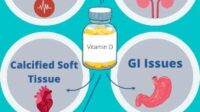
The toxicity risk with D3 is well-characterized because vitamin D is fat-soluble. Unlike water-soluble vitamins that are excreted more readily, fat-soluble vitamins can accumulate. Over time, excessive vitamin D can raise blood calcium levels—a condition often referred to as hypercalcemia.
When calcium rises beyond normal, the body may respond with a cluster of symptoms that can be surprisingly non-specific. This is where things get tricky. A person may feel “off” rather than clearly “poisoned,” and the connection to supplements can be missed.
Potential risk factors include high-dose supplementation without lab monitoring, taking multiple products that both contain vitamin D, and conditions that increase sensitivity to vitamin D (such as certain granulomatous diseases). Age can also matter, since medication use and kidney function may change the margin of safety.
What hypervitaminosis D can feel like
Vitamin D toxicity often manifests through hypercalcemia-related symptoms. These can include nausea, constipation, loss of appetite, excessive thirst, frequent urination, fatigue, weakness, and confusion. Some people may experience muscle aches or irregular heart rhythms in severe cases.
Longer-term, persistently elevated calcium can contribute to kidney stress. The kidneys are the body’s filtration engineers, and they don’t appreciate an overly calcium-rich environment. Calcium deposits can form, raising the risk of kidney stones or even more serious kidney impairment.
It’s important to note: symptom severity varies. Some individuals notice issues quickly; others drift into a slow, uncomfortable deterioration. Either way, the underlying mechanism is the same—an imbalance between calcium absorption and regulation.
What does vitamin K2 toxicity look like (and is it less likely)?
Vitamin K2 is also fat-soluble, but toxicity is generally considered less common than with vitamin D. One reason is that K2 is involved in activating specific proteins, and the body can often modulate use through enzymatic regulation.
However, “less likely” doesn’t mean “risk-free.” The most critical K2-related concern is interaction with anticoagulant medications—especially warfarin. Warfarin reduces the activity of vitamin K-dependent clotting factors. Adding K2 can counteract warfarin’s effect, potentially increasing the risk of unwanted blood clotting.
So while K2 toxicity in the classic sense may be rare, K2 can still create meaningful harm through medication interference. That’s not a theoretical nuance—it’s a practical safety boundary.
How D3 and K2 can become a mismatch
Imagine two orchestra sections: D3 sets the stage for higher calcium absorption, while K2 helps conduct calcium distribution. If D3 is supplied aggressively but K2 is insufficient (or absent), calcium may not be routed as effectively toward bones.
This mismatch concept is sometimes framed as a “calcium misplacement” risk. The long-term concern is calcium deposition in soft tissues—often discussed in contexts like vascular calcification. The scientific landscape is nuanced, and individual risk depends on baseline health, diet, genetics, and lab values.
Still, the logic is persuasive. Calcium homeostasis is not a simple on/off switch. It’s a choreography. Too much D3 without adequate regulatory support could encourage an imbalance, particularly if supplementation is high-dose and persistent.
Common real-world dosing mistakes
Many people inadvertently take excessive D3 through “stacking.” For example: a multivitamin already contains D3; an additional bone supplement adds more; then a separate immunity product includes yet another dose. The total can quietly rise above what was intended.
Another mistake is assuming that “natural” equals “limitless.” Vitamin D3 may be derived from humane processes, but the body still has a finite handling capacity. Selenium, zinc, vitamin A—these all teach the same lesson. Even beneficial nutrients have dosing ceilings.
Then there’s the failure to recheck labs. Vitamin D status and calcium levels are best confirmed with appropriate blood tests when high doses are used. Without monitoring, someone may overshoot slowly, like a thermostat stuck on hot.
Lab markers that help catch trouble early
If supplementing with D3 and K2—particularly at moderate-to-high doses—lab monitoring can be a safety net. Clinicians often look at 25-hydroxyvitamin D to assess vitamin D status. Calcium levels (sometimes ionized calcium) help identify hypercalcemia. In certain cases, kidney function markers may be reviewed as well.
Depending on the situation, additional labs may include parathyroid hormone (PTH), which can reflect the body’s attempt to correct imbalances. A key point: your body may show early biochemical stress before symptoms become obvious.
Short version: symptoms are late evidence. Blood tests are earlier intelligence.
Who should be especially cautious?
Caution is wise for anyone with kidney disease, a history of kidney stones, disorders affecting calcium metabolism, or granulomatous conditions. People on anticoagulant therapy should be particularly careful with K2 due to drug interactions.
Pregnancy and breastfeeding also warrant extra attention. Not because normal supplementation is automatically dangerous, but because dosing should be individualized and guided by clinicians who consider existing nutrient intake from diet and prenatal formulations.
Older adults may also be at greater risk of complications due to changes in absorption, metabolism, and renal clearance. In other words: the same dose can behave differently across life stages.
How to lower risk: smart supplementation habits
Start with totals. Check labels. Add up vitamin D from every source. If D3 is already included in a multivitamin, you may not need an additional high-dose product.
Consider timing and form. Some people prefer smaller, consistent doses rather than occasional high boluses. This can reduce peaks that may increase risk of imbalance.
Pairing D3 with K2 can be reasonable, but it should be approached as a targeted plan rather than a blind assumption. Dietary vitamin K from leafy greens and fermented foods may also contribute, reducing the need for aggressive K2 dosing in some individuals.
Most importantly: if using higher doses, lab monitoring isn’t paranoia. It’s practical risk management.
When to stop and seek medical advice
If someone experiences symptoms consistent with high calcium—persistent nausea, constipation, confusion, extreme thirst, or frequent urination—stop supplementing and seek medical guidance promptly. In severe cases, urgent care may be necessary.
Also seek advice if taking warfarin or other anticoagulants and starting or changing K2 dosing. Medication interactions can evolve quickly and require careful adjustment.
Treat supplementation like a conversation with physiology. When the body starts “answering” with warning signs, it’s time to listen.
The bottom line: a “yes,” with boundaries
Yes, you can take too much D3. The toxicity risk is primarily driven by vitamin D’s ability to elevate calcium levels and burden the kidneys. K2 toxicity is less commonly seen as classic nutrient overdose, but K2 can be risky through interactions—especially with anticoagulants.
D3 and K2 can work well together, like complementary tools. But when doses become excessive, the system can lose its harmony. The playful question turns serious: supplements aren’t magic, and more isn’t always better.
Build a safety-first routine—check totals, consider labs, and align dosing with personal health needs. That’s the mature, high-precision way to keep calcium biology on the right track.