High-dose vitamin D3 has a certain gravitational pull. People feel it may be a straightforward lever for bone strength, immunity, and mood. Yet the same spotlight that illuminates D3 can also reveal a hidden risk: calcium mismanagement. This is where vitamin K2 enters the story—not as a rival nutrient, but as a meticulous traffic director. When K2 and D3 travel together, the body gains a more elegant choreography for directing calcium to where it belongs and keeping it from pooling in places it shouldn’t.
The “Good Intentions” Problem: Why High-Dose D3 Can Become Risky
Vitamin D3 is converted in the body into its active form, which enhances calcium absorption in the gut. That sounds uniformly beneficial. But higher absorption without a parallel “calcium routing” system can create an imbalance. The bloodstream may become calcium-frequent, while tissues that are not meant to mineralize begin to receive signals that do not serve them.
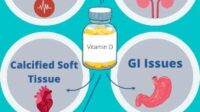
The danger is not that D3 is inherently harmful. It’s that the body has multiple calcium pathways, and high-dose supplementation can shift the balance toward less ideal destinations. Short-term gains can be followed by a longer-term concern: vascular calcification, soft tissue mineralization, and a loss of metabolic finesse.
This is the paradox many encounter: D3 feels like the solution, until it starts acting like a volume knob without a mute button.
Enter Vitamin K2: The Calcium “Master Switch” for Targeted Mineralization
Vitamin K2 is often described as a facilitator of proper mineralization. More precisely, it helps activate specific proteins that determine where calcium should be deposited. Think of it as a molecular notary stamp—verifying instructions so calcium finds its proper legal address.
One of the central actors is matrix Gla protein, which helps restrain calcification in soft tissues and the vasculature. Another is osteocalcin, a bone-associated protein that supports mineral integration within skeletal architecture. In practical terms: where vitamin D3 increases the supply, vitamin K2 improves the destination strategy.
This pairing is why K2 is frequently considered a “counterbalance.” Not a substitute, not an afterthought—an essential organizer that helps high calcium signals behave responsibly.
Addressing a Common Observation: “If D3 Helps Absorb Calcium, Why Would K2 Matter?”
A common observation goes like this: “If vitamin D3 is designed to raise calcium absorption, the body must need more calcium.” The idea feels sensible. Calcium is, after all, a structural mineral. Yet the body is not a single-compartment system. It is a bustling city with multiple zones, each requiring different rules.
Vitamin D3 increases calcium availability. Vitamin K2 helps assign calcium to the correct zoning plan. Without K2, the body may still absorb calcium efficiently, but the downstream activation of calcium-regulating proteins can lag. The result can be a scenario where mineralization processes become misdirected. Calcium can land in locations associated with stiffness and impaired function.
Even when lab values appear acceptable, mineral behavior inside tissues may tell a subtler, more consequential tale. K2 matters because it governs the “handling” of calcium after it arrives—not merely the amount that enters the circulation.
The Deeper Reason People Become Fascinated: The Body’s “Feedback” Systems Are Not One-Dimensional
Human physiology is rarely linear. Many enthusiasts begin with D3 for bone health and then discover an unexpected web: calcium absorption, parathyroid hormone modulation, vitamin K-dependent protein activation, and the interplay between inflammation and mineral deposition. Fascination grows because the story is not confined to a single nutrient pathway.
Vitamin K2 adds a layer of enzymatic specificity. It influences how calcium is “packaged” at the protein level. This is why K2 feels like a missing piece rather than a generic supplement. The body’s feedback loops can compensate for many shortfalls—but they cannot always compensate for the absence of proper molecular instructions.
In other words, K2 isn’t just another vitamin. It’s part of the body’s governance apparatus for mineral timing and location.
Bone Health: How K2 and D3 Can Work Like a Coordinated Construction Crew
Bone remodeling resembles an ongoing renovation. Osteoblasts build; osteoclasts resorb. Vitamin D3 supports the environment needed for bone mineralization by improving calcium availability and supporting related signaling pathways. But bone requires more than raw material. It requires precise molecular groundwork.
Activated osteocalcin—enabled by K2—helps bind calcium within the bone matrix. This supports a more coherent mineral deposition process. When D3 supplies the calcium and K2 directs and validates mineral placement, bones may receive a more disciplined form of nourishment.
That discipline may matter most in people who supplement D3 aggressively or who have risk factors for altered mineral metabolism. The combination can support resilience rather than merely boosting numbers.
Vascular and Soft Tissue Safety: The “Right Calcium, Wrong Place” Concern
The cardiovascular system is not designed to calcify in the way bone does. When calcium deposition occurs in arterial walls or soft tissues, it can contribute to stiffness and impaired elasticity—conditions linked to adverse outcomes.
K2 plays an important role here through matrix Gla protein activation. By supporting protective mechanisms against undesired mineralization, K2 may reduce the likelihood that calcium gravitates toward vascular structures.
This is why K2 is often paired with high-dose D3 logic: it addresses the possibility that extra calcium availability might otherwise be misdirected. The goal becomes balance—bone support paired with vascular restraint.
Choosing the Right Form: MK-7, MK-4, and the Question of Bioavailability
Vitamin K2 comes in different forms, commonly discussed as MK-7 and MK-4. These forms differ in how long they tend to remain active in the body and in how they may influence tissue-specific pathways.
MK-7 is often noted for its longer presence in circulation, while MK-4 is associated with different metabolic handling. The practical implication: people seeking K2 to complement D3 may gravitate toward forms with evidence for sustained biological activity, though individual context matters.
Rather than treating K2 as a single interchangeable entity, it helps to consider the nuance. Supplements differ. Biology differs. And the “best fit” depends on the person’s dosing pattern, diet, and health profile.
Timing and Pairing Strategies: Making the Chemistry Behave
Vitamin D3 and K2 are both fat-soluble. That affects how they should be taken—often alongside meals containing dietary fat to support absorption. Timing can matter because calcium and protein activation occur through sequential processes. A mismatch can create a window where calcium is present but not optimally governed.
Some people choose to take them together to encourage synchronized downstream activity. Others prefer spacing. The deeper point is consistency: the body prefers routine over randomness, and mineral metabolism tends to respond to sustained patterns rather than sporadic bursts.
In daily life, a disciplined pairing can help avoid the “D3 flood” effect without sacrificing the benefits people seek.
Testing and Caution: When Curiosity Should Become Clinical Precision
Enthusiasm is not the enemy, but indiscriminate dosing can be. If vitamin D3 is used in higher amounts, it can be wise to discuss monitoring with a clinician. Blood tests may include vitamin D status and markers relevant to calcium handling. In some cases, clinicians may consider additional indicators to understand whether calcium metabolism is behaving as expected.
Not everyone needs high-dose D3. Age, baseline vitamin D levels, sun exposure, diet, kidney function, and medications can all shift the risk landscape. Vitamin K2 is not a magic shield. It is a functional partner, designed to reduce specific mechanistic hazards.
Particularly important: vitamin K has a complex relationship with certain anticoagulant medications. Anyone using blood thinners should seek medical guidance before making changes, because interference with vitamin K pathways can alter coagulation dynamics.
A Balanced Conclusion: Why the D3–K2 Conversation Feels Like a Discovery
High-dose vitamin D3 can be beneficial, but the body’s calcium management is not a one-lane highway. Vitamin K2 helps close the loop by enabling proteins that support correct mineralization and curb inappropriate calcification. That is the heart of the protective narrative.
People are fascinated because this is not just about “taking more nutrients.” It’s about aligning biological systems—calcium availability, protein activation, tissue targeting, and long-term safety. D3 can increase the supply of calcium; K2 helps ensure that supply is used with architectural intelligence.
When the pairing is considered thoughtfully—alongside diet, timing, monitoring, and medical context—vitamin K2 doesn’t simply prevent dangers. It turns a potentially chaotic mineral environment into something closer to orchestration.