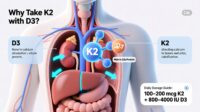
Vitamin D has a knack for feeling both mysterious and essential—like a quiet conductor behind the scenes. And once you begin to care about its levels, a provocative question often follows: if you add K2, will it make D3 absorb better? The promise is tempting. The science, however, is more nuanced. It isn’t a simple “yes” or “no,” but a layered story about transport, timing, receptors, and the choreography of minerals in the body.
Let’s take a step back and explore what K2 might change, what it likely doesn’t, and why perspective matters more than supplements alone.
Vitamin D3 vs. Vitamin K2: Two Different Roles, One Shared Story
D3 (cholecalciferol) is primarily about raising circulating vitamin D status—often measured as 25(OH)D. Once vitamin D is in the right biochemical lane, it can be converted into the hormonally active form (calcitriol), which then supports calcium absorption in the gut and helps regulate phosphate balance. In plain language: D3 is the volume knob for mineral handling.
K2, on the other hand, is less about boosting blood vitamin D levels and more about directing calcium. It activates proteins involved in calcium’s proper “placement” within the body, particularly those that help keep calcium from drifting into tissues where it doesn’t belong. Think of K2 as the careful dispatcher; D3 is the engine.
When people ask whether K2 increases D3 absorption, they’re often unconsciously mixing these roles. A shift in perspective helps: the question may be less about whether K2 improves vitamin D uptake, and more about whether K2 improves vitamin D’s downstream outcomes.
What “Absorption” Actually Means in the Vitamin World
In nutritional science, “absorption” is not one event. It’s a cascade. A nutrient must be released from food, enter the intestinal cells, travel through the bloodstream, undergo metabolic conversion, and finally influence gene expression and mineral transport. Each stage can be influenced by different factors.
D3 is fat-soluble. That means the presence of dietary fat, bile flow, and gut integrity matter. K2 is also fat-soluble, which can lead to the intuitive belief that taking them together naturally improves D3 uptake. Yet intuition is not evidence. Fat-soluble vitamins can share transport pathways, but that does not automatically guarantee improved absorption for one vitamin from the presence of the other.
In other words, K2 might not be increasing D3 absorption at the intestinal gate; it might be changing what happens after D3 has already arrived.
Mechanisms: Could K2 Influence D3 Transport Indirectly?
While K2 is best known for its role in activating vitamin K–dependent proteins, there are theoretical ways it could indirectly influence vitamin D dynamics. For example, both vitamins participate in calcium and mineral homeostasis, and calcium signaling can affect various cellular processes. When calcium metabolism is stabilized, downstream biological behavior may become more “efficient,” which can feel like improved absorption.
Another mechanism to consider is the broader context of fat-soluble vitamin regulation. The body uses lipid transport systems and hepatic handling for both D3 and K2. Co-ingestion can improve the probability that both vitamins travel via similar biochemical routes. Still, “similar routes” does not guarantee “amplified D3 absorption.” It may instead yield a synchronized environment where vitamin D’s effects are expressed more cleanly.
Here’s the curiosity hook: sometimes what looks like “better absorption” is actually “better utilization.” The body can behave differently even when the initial uptake is unchanged.
The Stronger Claim: K2 Supports the Use of Calcium After D3 Raises It
D3 increases the body’s ability to absorb calcium. That’s the central metabolic outcome people usually feel in bone health discussions. But calcium isn’t only about quantity; it’s about distribution. If calcium rises without adequate regulatory proteins, the body may not route it optimally.
K2 activates specific proteins that help govern calcium’s destination. This doesn’t necessarily raise blood D3 levels. Instead, it may reduce the odds of calcium being deposited where it shouldn’t be and support bone mineralization processes where it should.
So if someone’s D3 status improves and they also notice stronger bone-related outcomes after adding K2, the relationship may be functional rather than absorption-based. The vitamins are playing “together,” but not in the way a simple absorption narrative would suggest.
What Research Tends to Show: Outcomes Align, Absorption Enhancement Is Less Clear
When scientists evaluate vitamin interactions, they often measure serum markers rather than the invisible intestinal steps. If K2 truly boosted D3 absorption significantly, you’d expect consistent increases in D-related blood metrics compared with D3 alone. The real-world pattern, however, tends to be more subtle: K2 is more consistently tied to calcium-related endpoints (bone and vascular contexts) than to large, reproducible changes in D3 blood levels.
This doesn’t mean K2 is irrelevant. It means the headline “K2 improves D3 absorption” may be oversimplified. The more defensible phrase is: K2 may improve what D3 accomplishes—especially where mineral routing and protein activation are concerned.
Curiosity grows here: if absorption is not the main lever, what determines the visible effect? Often it’s baseline vitamin K status, calcium intake, magnesium sufficiency, dietary fat, and individual metabolic differences.
Timing and Co-Supplementation: Does Taking Them Together Matter?
Because both vitamins are fat-soluble, taking K2 alongside D3 can be practical. Co-ingestion may increase the chance they’re handled smoothly in the digestive and transport environment. The goal isn’t to force absorption magic; it’s to avoid unnecessary inefficiency.
Yet “together” doesn’t automatically mean “synergistically absorbed.” A better way to think about timing is this: if D3 is being taken, you want the entire mineral governance system to have what it needs. That can include K2, and sometimes cofactors like vitamin A, magnesium, and adequate dietary calcium context.
In short: pairing can make biological sense even if it doesn’t dramatically change D3 intestinal absorption.
Magnesium, Calcium Intake, and the Hidden Supporting Cast
Vitamin D doesn’t operate in isolation. Magnesium is commonly discussed because it can support vitamin D metabolism and activation steps. Without enough magnesium, the conversion pathways may not function optimally. Calcium intake also shapes outcomes: D3 can raise absorption, but if calcium intake is extremely low or imbalanced, the body’s response may differ.
K2 sits downstream in the mineral allocation story. If calcium availability and magnesium support are lacking, K2’s potential advantages may look muted. That’s why some people report dramatic improvements while others see little change.
A curious pattern often appears: people who fix the broader “mineral ecosystem” sometimes interpret the difference as “K2 enhanced D3 absorption,” even though the true story is systems-level optimization.
Safety, Medication Interactions, and Why Precision Matters
K2 interacts importantly with anticoagulant therapy. If someone takes warfarin (or other vitamin K–sensitive medications), vitamin K intake can alter the medication’s effectiveness. This is not a trivial footnote; it changes the ethical and practical conversation about supplementation.
D3 safety also depends on dose and baseline status. Excess vitamin D can raise calcium too high, creating potential complications. K2 may influence calcium routing, but it does not replace the need for careful D3 dosing and monitoring when appropriate.
Precision is the adult move: check labs when feasible, consider baseline diets, and treat supplements as targeted tools rather than universal levers.
The Better Question to Ask: What Outcome Are You Trying to Improve?
If the goal is higher D3 levels on a blood test, the most direct lever is D3 dosing, consistency, dietary fat context, and individual absorption capacity. K2 is less likely to be the primary driver of serum D3. If the goal is bone health quality—mineralization, calcium distribution, protein activation—then K2 becomes more relevant, often more compelling.
So the narrative shift is this: K2 may not be the “absorption booster” for D3 that headlines promise. It may instead be the “execution partner” that helps D3’s effects land where they matter.
That reframing doesn’t diminish K2. It clarifies it. And clarity is what turns curiosity into better decisions.
Practical Takeaway: A Synergy of Functions, Not a Guaranteed Absorption Boost
Does K2 increase D3 absorption? The scientific balance is cautious. K2’s more consistent role is supporting the downstream use of calcium after D3 changes mineral physiology. Co-supplementation may be sensible because both are fat-soluble and may be handled efficiently together, but the strongest “synergy” claims tend to live in outcomes, not in guaranteed intestinal absorption enhancement.
If you’re considering both, focus on the full mineral ecosystem: adequate fat intake with D3, appropriate K2 context, attention to magnesium, reasonable calcium strategy, and safety considerations for medications. The body is not a vending machine. It’s a system. And systems respond to coherence.