For years, the conversation about vitamin D has sounded like a simple duel: D2 versus D3, winner take all. But what if that story is too tidy? What if “inferior” is merely shorthand for “less common in certain contexts,” and not a verdict cast in stone? The more closely you look, the more vitamin D2 reveals a subtler, sometimes even advantageous role—especially when you step outside the default assumptions. This is where curiosity earns its keep.
Reframing the Question: “Better” Depends on the Lens
Most people ask whether D2 can “compete” with D3 as if the human body were a rigid arena with one champion. Yet “better” is often a moving target. It can mean faster improvement in blood levels, better longevity of effect, compatibility with a specific diet, or even practicality for supplementation routines.
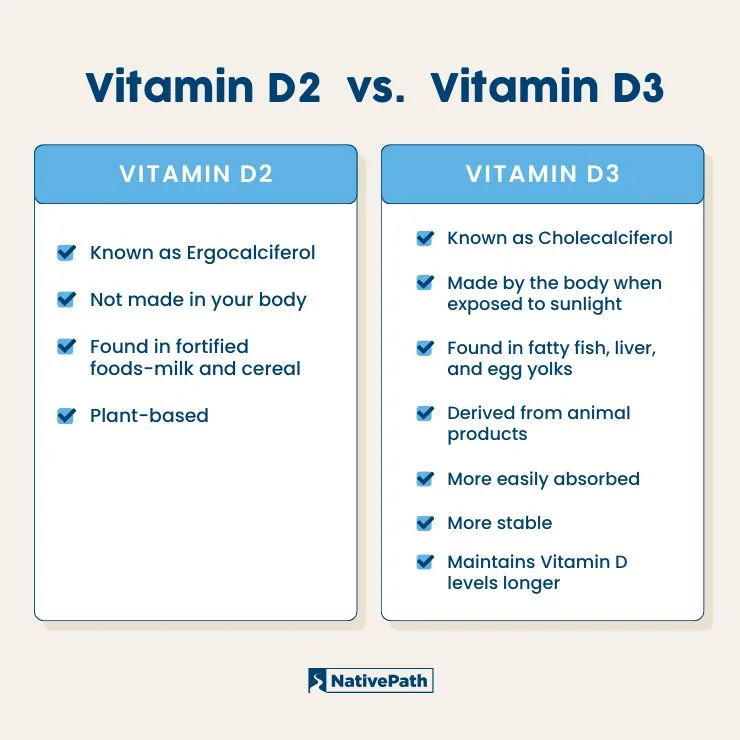
D2 (ergocalciferol) and D3 (cholecalciferol) are both forms of vitamin D, but they begin life differently. D3 is typically associated with sunlight-driven biology and animal-derived sources. D2 is more commonly linked to plant-derived or fungal routes. Those origins may sound like trivia—until a particular person’s life, metabolism, and supplement constraints make those differences matter.
So instead of asking, “Is D2 ever better?” try asking: better under which conditions? That shift in perspective is not just philosophical. It’s a key that changes how the evidence feels.
Bioavailability vs. Efficacy: Two Different Battles
One of the reasons the D2 narrative becomes one-sided is that people tend to blend two separate ideas: bioavailability (how much you absorb and how quickly it shows up in circulation) and efficacy (what that dose accomplishes afterward).
It’s possible for a form to be absorbed in a straightforward way and still behave differently in downstream processes. The body does not merely “receive” vitamin D; it metabolizes it, stores it, and converts it through a chain of events. Think of vitamin D as a relay race, not a single sprint.
Some studies and clinical experience suggest D3 tends to produce a stronger or more sustained increase in serum 25(OH)D in many settings. Yet “tends to” leaves room for “exceptions,” and those exceptions often live where assumptions are least convenient.
In other words: D2 isn’t automatically a flawed tool. It may simply be less consistently aligned with typical supplementation patterns, especially in the long run.
The Metabolic Pathway: Why the Body’s Chemistry Matters
Vitamin D doesn’t function as a simple vitamin in the way vitamin C does. It behaves more like a prohormone, influencing gene expression and immune signaling once converted to active metabolites.
D3 and D2 ultimately travel through similar conversion steps, but they can produce metabolites that behave slightly differently. This is where “better” can get redefined. If someone responds less robustly to D3 due to specific metabolic variables—or if dosing schedules are imperfect—D2 might appear more competitive than expected.
Metabolic context can include liver function, baseline vitamin D status, body composition, and even how often supplementation is taken. Short-term gains and long-term steadiness can tell different stories. A single snapshot can mislead; a trend can clarify.
Special Case #1: When Dietary Constraints Make D2 the Only Real Option
Here’s a perspective many people overlook: sometimes the “better” choice isn’t the one that wins in lab comparisons. It’s the one someone will actually take consistently.
If you follow a fully plant-based lifestyle, choose specific dietary principles, or need a vegan-friendly formulation, D2 may be the practical bridge between intention and implementation. Consistency can outrank theoretical superiority.
Consider the difference between maximal potential and real-world adherence. A “less ideal” supplement that is used faithfully can outperform an “ideal” one that gets skipped.
In this special case, D2 isn’t merely tolerated—it can be strategically superior because it aligns with lifestyle fidelity.
Special Case #2: Baseline Deficiency and “Catch-Up” Strategies
People often forget that the body’s starting point matters. If someone is markedly deficient, the focus shifts toward correction rather than optimization of marginal differences.
In deficiency scenarios, dosing regimens can dominate outcomes. A structured catch-up plan can bring levels up regardless of whether the initial tool is D2 or D3—though the durability of improvement may still vary.
What makes this a special case is timing. If follow-up labs confirm adequate rise and symptom improvement, D2 can be a perfectly functional stepping stone. If levels rebound quickly, D3 might later become the preferred maintenance choice. That evolution is not a failure—it’s calibration.
In short: if the priority is restoring a baseline, the story can become less about “who wins” and more about “how the ramp is built.”
Special Case #3: Dosing Style—Daily, Weekly, or Intermittent
Supplements aren’t always swallowed with daily uniformity. Some people prefer weekly dosing. Others forget, travel, or take irregular schedules because of real life rather than best practices.
Inconsistent dosing can blur the distinction between D2 and D3 because the body’s levels swing in response to dosing patterns. If D2 is administered in a schedule that happens to better fit a person’s routine and absorption rhythm, outcomes may look surprisingly competitive.
This is where “short sentences, long consequences” becomes relevant. A small adjustment—such as choosing a schedule that you can maintain—may produce outsized benefits compared to switching forms midstream.
Special Case #4: Cost, Availability, and the Psychology of Use
Cost is not a footnote. It’s a behavioral variable with biochemical consequences. If one form is substantially more affordable and consistently purchased, it can lead to steadier intake.
Availability also matters. If a particular supplement is easy to find locally and reliably, adherence improves. When adherence improves, the “better” form becomes the one that doesn’t disappear from the routine.
There’s an almost underrated truth here: the body benefits from what happens repeatedly, not what happens once. That is how vitamin D often earns its reputation—through accumulation and sustained maintenance.
D2 and Bone Health: The Role of Long-Term Maintenance
Bone health is not a single-variable story. Vitamin D supports calcium absorption, which is part of a broader calcium-phosphate balance. So if D2 helps keep vitamin D status adequate over time, it can indirectly support skeletal integrity.
The distinction is that D3 may more consistently maintain serum 25(OH)D in many people, making it a frequent “default.” Yet in special cases—where D2 achieves stable levels through proper dosing and monitoring—D2 can still participate meaningfully in bone maintenance.
Think of bone health like a slow-built architecture. The question becomes: does the foundation stay stable year-round? If D2 keeps the foundation stable, it has a legitimate claim to effectiveness.
Safety and Monitoring: The Unsexy Advantage
The healthiest way to navigate D2 versus D3 is to treat it like an experiment with feedback. Measure baseline levels when appropriate. Recheck after a reasonable interval. Adjust dosing based on response rather than belief.
Vitamin D is not “more is always better.” Excess can be harmful, and individual sensitivity varies. This is where medical supervision or at least informed guidance becomes valuable—especially for people with kidney disease, certain granulomatous disorders, or those using medications that alter vitamin D metabolism.
Monitoring turns an argument into a plan. It turns curiosity into certainty. And it helps ensure that whichever form is chosen, it serves the body rather than ideology.
So Can D2 Ever Be Better? A Nuanced Answer That Feels Like Relief
Yes—vitamin D2 can be better, but not in a universal, one-size-fits-all way. D2 becomes a superior choice when it wins the real-world contest: adherence, compatibility with dietary restrictions, effective correction of deficiency under a structured regimen, and stable maintenance that keeps serum levels where they need to be.
Meanwhile, D3 often remains the more straightforward option for many people due to its typical ability to maintain serum 25(OH)D. But “typical” isn’t “inevitable,” and biology rarely respects slogans.
The most empowering takeaway is not to crown a victor. It’s to choose wisely within your constraints and to verify results with monitoring. When you do that, the D2 conversation stops feeling like a verdict—and starts feeling like a toolset.
Closing Curiosity: The Better Question to Ask Next
When the lights dim and the debate fades, the question that stays is simple: What approach reliably gets you to adequate vitamin D status, consistently and safely, in your actual life? If D2 can do that for you, it is not second-best—it is simply the right instrument.