It’s a curious thing: when people talk about vitamin D, they often frame it as a “bone nutrient” or a wintertime comfort. Yet inside the immune system, vitamin D behaves less like a passive nutrient and more like a molecular stage director—coaxing immune cells to take the right stance at the right moment. T cells and macrophages, two players with dramatically different personalities, become unexpectedly synchronized under vitamin D’s influence. The fascination is not merely that vitamin D “helps immunity,” but that it seems to choreograph activation, restraint, and survival with a precision that feels almost deliberate.
Vitamin D as an immune system signal, not just a supplement
Vitamin D’s immune relevance begins with a simple premise: immune cells are not sealed off from environmental cues. They can interpret hormonal signals, translate them into gene expression, and recalibrate their behavior. Once vitamin D is converted into its bioactive forms, it can engage vitamin D receptors present in immune cells. That engagement behaves like turning a key in a lock—opening transcriptional programs that shape how T cells respond to threats and how macrophages manage the debris of battle.
There’s a common observation here: people frequently associate immune activation with louder, faster action. But vitamin D often nudges the system toward functional activation rather than raw urgency. The deeper reason for fascination is that the immune response must be both vigorous and controlled; vitamin D seems to contribute to that balancing act.
How T cells interpret vitamin D: from readiness to purposeful activation
T cells are often described as the immune system’s strategists. They scan, recognize, and decide whether escalation is warranted. Vitamin D appears to influence the early “decision circuitry” of T cells. When activated in the presence of vitamin D signaling, T cells may shift their differentiation trajectory—becoming more adept at responding without tipping into maladaptive overactivation.
One reason this is so compelling is the duality of T cell behavior. Activation is essential for clearing pathogens, yet excessive activation can cultivate inflammatory damage. Vitamin D’s effects often map onto pathways that promote tempered, calibrated responses. The result can look like improved immune coordination: not just more action, but better-timed action.
On a molecular level, vitamin D signaling can support transcriptional regulation tied to survival and immune functionality. It may also modulate cytokine environments that otherwise determine whether T cells become inflammatory amplifiers or controlled responders.
Macrophages under vitamin D: disciplined phagocytosis and balanced inflammation
Macrophages are the immune system’s custodians and interrogators. They engulf pathogens, process antigens, and communicate with other cells through cytokines. Vitamin D’s influence on macrophages is often described as a blend of competence and restraint: encouraging effective phagocytic behavior while promoting an anti-inflammatory sensibility that prevents the battlefield from turning into collateral damage.
When vitamin D signaling is present, macrophages can adopt a phenotype associated with improved microbial handling. This includes supporting mechanisms that help them survive the stressful conditions of inflammation and continue their work long enough to finish the job. In other words, vitamin D helps macrophages avoid premature exhaustion.
There’s also an architectural aspect to this influence. Macrophages operate through complex signaling networks, and vitamin D can affect the expression of genes involved in innate immune responses. The deeper fascination lies in the way one molecule can modulate both “attack mode” and “self-preservation,” which are usually treated as separate goals.
Pro-survival signaling: the quiet advantage behind immune effectiveness
Immune activation is not only about speed; it’s about endurance. T cells and macrophages frequently face harsh microenvironments—oxidative stress, inflammatory pressure, and nutrient scarcity. Vitamin D can strengthen the survival capacity of these cells, effectively extending their operational lifespan.
This is where the common observation becomes subtly misleading. Many people think stronger immunity always means more inflammation. But pro-survival signaling can enhance immune effectiveness without requiring relentless inflammatory output. Cells that last longer can complete phagocytosis, sustain antigen presentation, and maintain coordinated communication.
The “deeper reason” for the fascination, then, is that vitamin D reframes effectiveness. Instead of “more fire,” it can support “better ignition and longer burn,” reducing the tendency toward inflammatory burnout and dysfunctional resolution.
Promoting immune homeostasis: turning down the noise without silencing defense
Homeostasis is the immune system’s preferred aesthetic: calm readiness with rapid escalation when needed. Vitamin D appears to contribute to this equilibrium by influencing cytokine production and the immune milieu surrounding T cells and macrophages. The immune response becomes less like a frantic brawl and more like a structured operation.
In practical terms, this may help explain why vitamin D status can correlate with immune outcomes that are not easily reduced to a single direction like “more infection resistance.” Instead, immune regulation can improve, including the tendency to avoid unnecessary inflammatory amplification.
When vitamin D supports homeostasis, the system may also improve its ability to transition from early response to resolution. That transition is where many immune disorders find their foothold.
Interaction with antigen presentation: bridging innate and adaptive responses
Macrophages do more than engulf. They present antigens and act as a bridge between innate detection and adaptive instruction. Vitamin D’s effects on macrophage function can therefore ripple outward, influencing how T cells perceive and respond to threats.
This connection is easy to overlook because T cells and macrophages are often discussed in separate compartments. Yet their conversation is continuous. Vitamin D can shape that dialogue by affecting macrophage signaling and the inflammatory context in which antigen presentation occurs.
So the immune system becomes more “coherent.” Instead of signals arriving from one direction only, vitamin D helps align innate processing with adaptive decision-making. Coherence is a powerful word here—because immune coherence is often what determines whether a response becomes protective or derails into chronic inflammation.
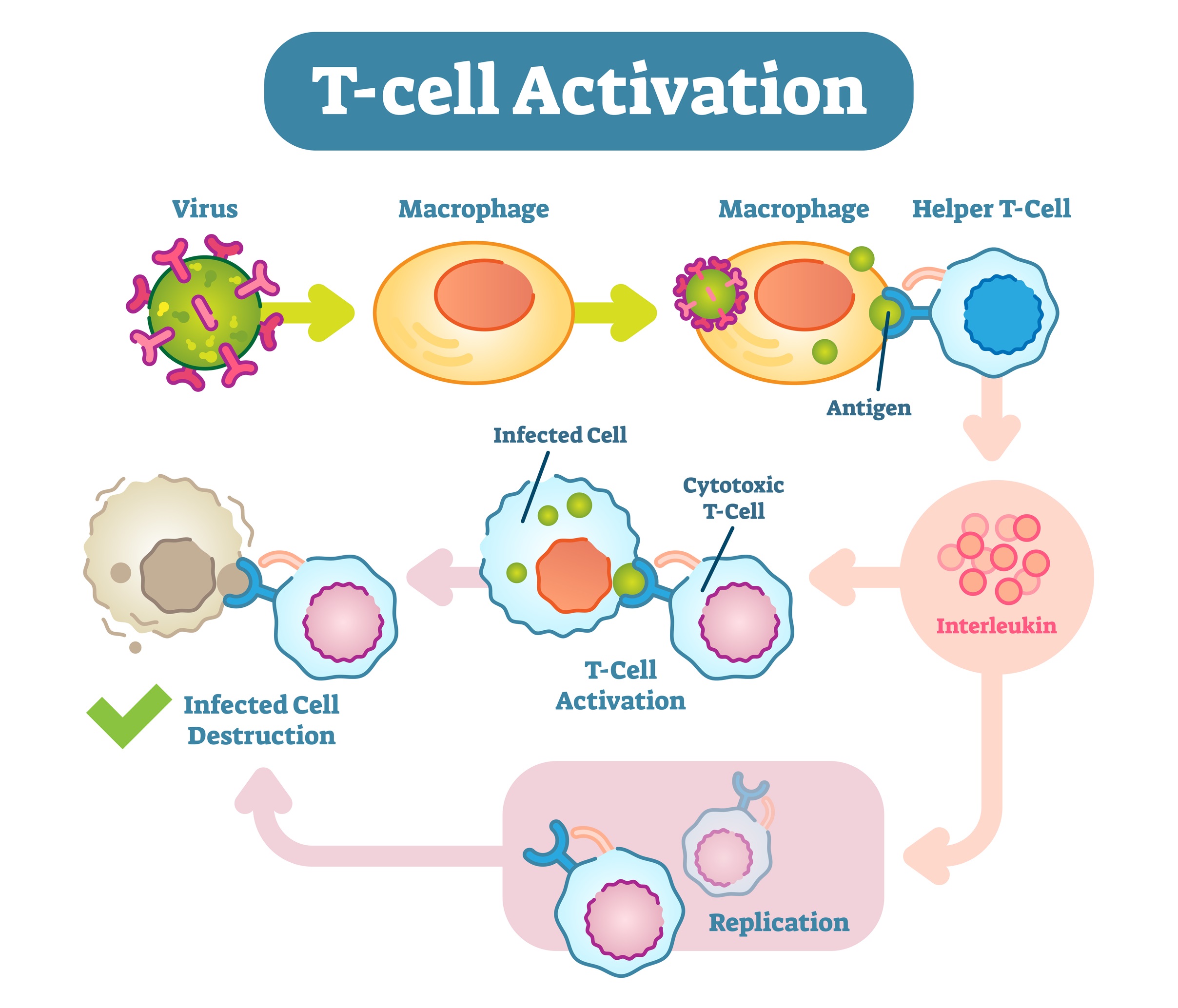
Diagram of immune influence: vitamin D’s signaling reach
To appreciate the breadth of vitamin D’s impact, it can help to visualize how signaling moves between immune pathways. The immune system is not a single line of command; it’s an interactive network.
Why activation matters: the timing of immune choreography
Activation is not a binary switch. It’s a sequence. T cells require context—antigen recognition, co-stimulation, and cytokine guidance—before they commit to proliferation and differentiation. Macrophages require signals that determine whether they should intensify antimicrobial action or pivot toward resolution.
Vitamin D may influence the timing and quality of these steps. The system is, in a sense, learning. With vitamin D signaling, the immune cells may interpret danger cues differently—adopting activation programs that are robust yet restrained.
This temporal nuance helps explain why vitamin D’s role can feel paradoxical: it can support activation while simultaneously discouraging excessive inflammatory turbulence. Both are necessary for a response that clears threats without leaving a chronic scar.
Sources and metabolism: ensuring the signal can actually arrive
Vitamin D’s immune story depends on availability and conversion. Dietary intake and sun exposure affect circulating vitamin D status, while metabolism transforms vitamin D into forms capable of receptor engagement. If the precursor levels are low or conversion is disrupted, immune signaling may become suboptimal.
This is where many people miss the plot. They focus on the immune effects but ignore the upstream logistics: if the signal is faint, receptor-mediated gene regulation may not reach the threshold needed for consistent immune modulation.
When vitamin D status is adequate, immune cells can respond more effectively to the signals that guide activation, survival, and homeostasis. When it is inadequate, the immune system may operate with less interpretive clarity—like a team playing without a shared playbook.
Effects across different immune contexts: infections, inflammation, and risk
Immune demands change across contexts. During infection, the priority is containment and clearance. In chronic inflammatory conditions, the priority becomes recalibration—preventing ongoing tissue harm. Vitamin D’s influence on both T cell behavior and macrophage function suggests it may be relevant across these shifting landscapes.
That doesn’t mean vitamin D acts as a stand-alone cure. Immunology is a multi-variable science. But the possibility that vitamin D improves immune “fitness” is meaningful: it may enhance the likelihood of effective responses while reducing the risk of inflammatory persistence.
People often notice improved general well-being with adequate vitamin D. The immune system is one plausible explanation, especially given the interplay between cell survival, cytokine regulation, and coordinated activation.
Meticulous balance: why too little—or too much—can be a problem
Immune systems dislike extremes. Too little vitamin D may reduce the fidelity of immune signaling, nudging the system toward less controlled inflammation or diminished effective activation. Conversely, excessive vitamin D can introduce physiological imbalances, including metabolic disturbances that can indirectly affect immunity.
This is why the most compelling narrative is not maximal supplementation; it’s optimized status. The immune system thrives on balanced cues that resemble natural physiology.
Closing reflections: fascination in the network, not the singular effect
The role of vitamin D in activating T cells and macrophages is captivating because it refuses to be a single-note story. It influences readiness and survival, shapes cytokine landscapes, and contributes to immune homeostasis. T cells and macrophages—two categories of immune workers with distinct tasks—can become harmonized under vitamin D signaling.
Perhaps the deeper reason for fascination is that vitamin D behaves like a translator between environments and immune intent. It helps the body interpret threat with both vigor and restraint. In the immune theater, vitamin D is less the villain, less the hero, and more the invisible stage manager—quietly guiding the performance so it ends with resolution rather than chaos.