You can be meticulous with your vegan routine—reading labels, choosing “clean” formulations, even tracking your bloodwork—yet still watch vitamin D levels stubbornly refuse to budge. It’s an unnerving little paradox: you’re taking vitamin D2, but your 25(OH)D seems to stay frozen in time. If that sounds familiar, you’re not alone. Many people notice that vegan Vitamin D2, despite its reputation and steady availability, sometimes under-delivers. The plot twist is that the issue often isn’t your diligence; it’s the molecular choreography behind how D2 is handled in the body—and why switching to vitamin D3 can feel like flipping a switch from hesitation to momentum.
The first clue: “I’m taking D2, so why the plateau?”
A common observation goes like this: “I’m consistent, I’m not missing doses, but my levels haven’t risen much.” The most uncomfortable part is the emotional interpretation. It can feel like your body is ignoring the effort you’re investing. Sometimes it’s not indifference—it’s kinetics. Vitamin D status is a balance of absorption, conversion, storage, and utilization. If any step is sluggish, supplementation may appear to be working “on paper” while the bloodstream tells a different story.
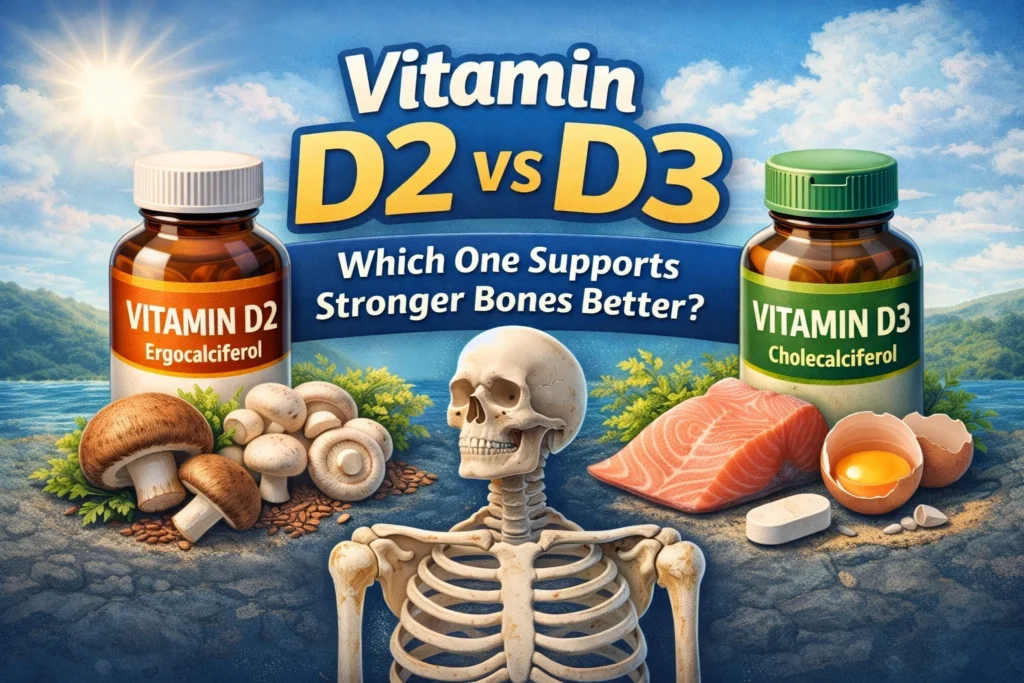
Vitamin D2 (ergocalciferol) and vitamin D3 (cholecalciferol) share a similar headline role—supporting bone health, immune modulation, and cellular signaling. Yet they don’t behave identically once they enter your system. Think of them as cousins who speak the same language but negotiate differently at the cellular level.
D2 vs D3: The body’s preference isn’t a rumor
When vitamin D enters the body, it must be transported, metabolized, and converted into a form your system can use efficiently. This is where D3 often demonstrates an advantage. Many people experience that D3 leads to a more robust rise in serum 25-hydroxyvitamin D, the marker typically used to gauge long-term vitamin D status.
While both forms can increase levels, vitamin D3 tends to have a stronger ability to raise and maintain circulating concentrations. The deeper fascination here is that the body doesn’t treat both forms like equivalent currencies. It may store, process, and recycle them with different efficiencies, which can create a visible divergence in test results over time.
In practice, this can look like months of D2 with marginal movement, followed by a noticeable improvement after switching to D3. That “light-bulb moment” is often less about willpower and more about biochemical compatibility.
Bioavailability and absorption: the quiet gatekeepers
Even the best vitamin D choice can be undermined by absorption variables. Vitamin D is fat-soluble, so its journey depends on dietary context—especially fat intake and overall digestive efficiency. If your D2 supplement is taken with a low-fat meal, or if absorption is compromised by gut conditions, the molecule may not reach the bloodstream in an optimal amount.
But bioavailability isn’t only about what you swallow. It’s also about the delivery method. Some formulations are more “digestible” in real life due to the matrix they come in. Think of it like trying to deliver cargo through different types of shipping containers. The port is the same. The route differs.
Switching to a vegan D3 can still work even if you’re careful with how you take it—because the difference isn’t solely absorption. It’s also what happens after absorption.
Conversion dynamics: from “ingested” to “activated”
Your body doesn’t simply store vitamin D and call it done. It performs a series of conversions—turning vitamin D into metabolites that can be measured and utilized. This conversion process involves liver and kidney activity, and it can vary due to genetics, baseline vitamin D status, body composition, and overall metabolic health.
Vitamin D3 often aligns more smoothly with these pathways. As a result, it can be associated with a higher and steadier rise in serum levels. The deeper reason this matters is psychological: when you don’t see changes, you might interpret it as a personal failure. In reality, you’re observing a systems-level difference between the forms.
So the plateau may not be stubbornness. It could be that D2 is arriving but not transforming at the pace you expect.
Starting point matters: low levels need a different strategy
If your baseline vitamin D is very low, the body typically requires time and consistent dosing to rebuild stores. With D2, some people need a more aggressive or longer-term approach to reach and sustain optimal levels. Without that, you may see minimal change—even if the supplement is technically “working.”
This is where patience should be paired with precision. Monitoring after a reasonable interval can reveal whether your regimen is sufficient. Some people benefit from adjusting dose or timing, rather than simply continuing indefinitely.
Switching to D3 often makes the regimen feel more efficient. The same discipline produces more measurable outcomes, which is why the switch is so frequently discussed among people who live by results.
Consistency, timing, and the fat-soluble rhythm
Short sentences, long impact: take vitamin D with food, especially meals containing fat. Timing can influence how smoothly the vitamin passes through digestion and enters circulation. Even the difference between taking it on an empty stomach versus with a substantial meal can create noticeable shifts over weeks.
If you’re switching from D2 to D3, treat it like a reset button. Choose a steady daily routine or a structured weekly cadence, and keep it consistent. Your body loves patterns. It also loves predictability in absorption.
In the vegan context, where some individuals take multiple supplements, it’s worth considering how other compounds might affect digestion and tolerability. Sometimes it’s not the vitamin; it’s the supplement “ecosystem” around it.
Why many people report feeling better on D3
Bloodwork is the official scoreboard, but people often describe an accompanying shift in how they feel—energy steadiness, musculoskeletal comfort, mood stability, and immune confidence. While individual experiences vary, the common thread is that D3 may restore sufficiency more reliably.
Vitamin D participates in gene expression and immune signaling. It’s not merely a bone-supporting vitamin; it’s a regulator. When levels move upward, the downstream effects can become less theoretical and more tangible.
That’s why the fascination is so persistent. It’s not just “which pill works.” It’s the story of someone watching their body respond in a way that feels coherent: supplement → metabolite rise → improved status.
Vegan D3: the “how” matters, not only the “what”
Many assume vitamin D3 must be animal-derived. Yet modern vegan-friendly options exist, including D3 sourced through non-animal methods. When you switch, the goal is to choose a D3 product designed for consistent dosing and compatibility with vegan lifestyles.
Quality can influence outcomes. Look for transparent labeling, appropriate dosing, and a formulation that supports absorption. A well-designed vegan D3 isn’t a shortcut; it’s a refinement.
How to switch thoughtfully: a practical transition plan
If you’ve been on vegan D2 and haven’t seen the rise you expected, switching to D3 can be logical. However, a thoughtful plan matters. You can track your progress with follow-up bloodwork, typically after a period that allows the body to rebuild stores. Many people also re-check whether the dose aligns with their baseline and lifestyle.
Keep your routine stable during the transition. Don’t change multiple variables at once—food timing, dose frequency, and supplement brands—unless you enjoy mystery narratives. One change at a time helps you learn what actually moves the needle.
If you have medical conditions, kidney or liver concerns, or you take medications that interact with vitamin D metabolism, consult a healthcare professional for personalized guidance. This isn’t fear. It’s calibration.
The deeper takeaway: your body isn’t ignoring you—it’s responding differently
When vegan D2 doesn’t raise your levels, it can feel like a riddle with missing pieces. But the pattern often points to real, biochemical differences—conversion dynamics, storage behavior, and the body’s preference for how vitamin D3 fits into its regulatory pathways. In other words, the plateau isn’t proof that vitamin D is futile. It’s evidence that your chosen form may be mismatched to your goals.
Switching to vegan D3 isn’t merely a trend. For many people, it’s the moment their supplementation stops feeling like a hopeful gesture and starts behaving like a measurable intervention. The fascination comes from coherence: the science lines up with the results, and the story ends not with guesswork, but with clarity.