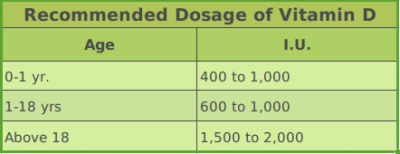
Vitamin D is a fat-soluble nutrient with an outsized influence on the body—more like a molecular key than a casual supplement. Many people understand the basics: it supports bones, immunity, and muscle function. Yet the conversation usually stops at “take vitamin D,” even though the real decision is dose-specific. How do 600 IU, 1000 IU, 2000 IU, and 5000 IU compare? What does each amount plausibly do, and who should think about it? This guide walks through the dosage landscape with practical clarity, so readers can anticipate what different vitamin D regimens feel like, look like, and require.
Start with the “why”: what vitamin D actually does in the body
Vitamin D helps regulate calcium and phosphate absorption in the gut, which is essential for bone mineralization. When vitamin D levels are insufficient, the body compensates in subtle ways—leading to less resilient bones over time and, in some cases, muscular aches or fatigue. Beyond skeletal maintenance, vitamin D is also involved in immune modulation, meaning it can influence how the body calibrates inflammatory responses. These are not dramatic overnight changes. Instead, the benefits often unfold gradually, as if your physiology is slowly adjusting the thermostat.
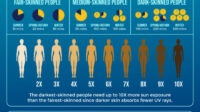
It’s also important to remember that vitamin D status is not uniform. Sun exposure, skin pigmentation, latitude, seasonality, body fat distribution, dietary intake, and even certain medications can shift blood levels. The same dose can yield different results across individuals, which is why dosing conversations ideally connect to blood testing.
Understand the units: what “IU” means and why it matters
IU, or International Units, is a measurement scale used for biological activity. Vitamin D supplements are typically formulated as either vitamin D3 (cholecalciferol) or vitamin D2 (ergocalciferol). D3 is commonly favored in supplementation strategies because it tends to raise circulating 25-hydroxyvitamin D more effectively in many people. Still, individual response varies.
A key nuance: vitamin D dosing is not a linear “more equals better” scenario. Higher doses may correct deficiency more rapidly, but they can also overshoot in people who are already sufficient. That’s why many dosing guides revolve around goals—maintain, replete, or stabilize.
The cornerstone marker: 25-hydroxyvitamin D (what you’d ideally measure)
When clinicians talk about vitamin D levels, they usually refer to 25-hydroxyvitamin D, often abbreviated as 25(OH)D. This marker reflects your body’s vitamin D stores. A dosage plan becomes far more legible when it’s anchored to a baseline level and a follow-up test schedule.
Readers often wonder how frequently testing is necessary. In many practical routines, retesting is considered after a period long enough for levels to equilibrate—commonly around 8 to 12 weeks after a dose change—though personalized guidance matters.
600 IU: a “maintenance-minded” starting point
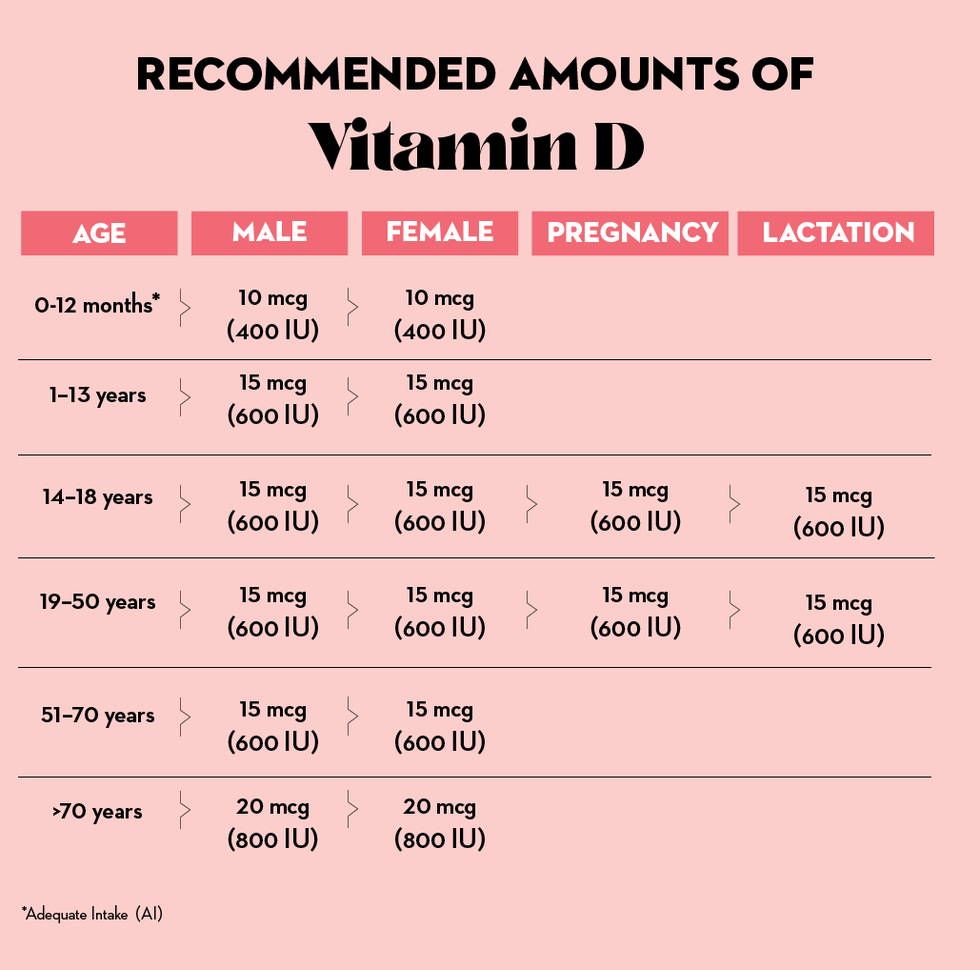
600 IU is frequently positioned as a baseline maintenance dose. For some people—especially those with modest sun exposure and adequate dietary intake—it may help preserve low-to-moderate vitamin D levels. Think of 600 IU as the nutritional equivalent of keeping a pilot light on: steady, not aggressive.
Where might 600 IU fit?
- General maintenance for individuals at low risk of deficiency.
- Seasonal supplementation during months when sunlight is limited.
- Light support when combined with vitamin D–containing foods and reasonable sun exposure.
Short-term experiences may be subtle. People might not “feel” improvement immediately, but over time the goal is to prevent a slow slide into insufficiency. If someone already has documented deficiency, 600 IU may be too conservative to correct the deficit.
1000 IU: the dose many people choose for steadier support
1000 IU is a common middle ground—often used for maintenance with a bit more insurance. It tends to be more effective for individuals who have limited sun exposure, darker skin tones, or lifestyles that keep them indoors. This dose can also be a pragmatic bridge for those transitioning seasons.
What readers can expect with 1000 IU:
- Gradual repletion when levels are low but not profoundly deficient.
- Improved consistency compared with 600 IU for many adults.
- A better match for those who want a structured regimen without stepping into high-dose territory.
As with any dose, absorption and compliance play major roles. Taking vitamin D with a meal that includes fat can improve uptake because it’s fat-soluble. Small behavioral choices—like timing and consistency—can amplify results without increasing dose.
2000 IU: a more assertive option for insufficiency or winter recovery
2000 IU is often considered an “intervention-adjacent” dose—frequently used when deficiency risk is higher or when bloodwork indicates insufficiency. It’s commonly chosen during winter months in temperate climates, when UVB radiation is limited.
In real-world scenarios, 2000 IU may be associated with:
- More noticeable level changes over 8–12 weeks (ideally tracked via 25(OH)D).
- Support for people with higher risk profiles, such as reduced sun exposure or certain dietary patterns.
- Practical dosing that often avoids extreme “pulse dosing” while still acting decisively.
Still, this is not a universal “safe for everyone” number. People with baseline sufficiency may not need this dose, and medical conditions affecting calcium metabolism may demand tailored supervision. Vitamin D is powerful precisely because the body treats it like a hormone-like regulator.

5000 IU: high-dose territory—use with precision, not optimism
5000 IU is generally considered a high-dose regimen. It can be appropriate in specific contexts—often for documented deficiency—either for a limited “correction phase” or under clinician direction. The central idea is not merely to raise levels, but to raise them to a target without overshooting into excessive vitamin D status.
Readers should approach 5000 IU with careful intent. This dose is commonly discussed when:
- There is confirmed deficiency based on 25(OH)D testing.
- A structured repletion plan is in place, sometimes followed by a lower maintenance dose.
- There are risk factors for poor vitamin D status that require stronger supplementation.
Potential downsides are the reason caution matters. Excessive intake over time can contribute to hypercalcemia risk in vulnerable individuals. Symptoms of too much calcium can include nausea, constipation, confusion, and increased urination or thirst—none of which should be treated as “normal adjustment.” Any high-dose plan benefits from a monitoring strategy.
Choosing between 600, 1000, 2000, and 5000 IU: a reader-friendly decision framework
Rather than treating dose as a popularity contest, consider it a matching process. Start with your context:
- Baseline levels: bloodwork provides the most reliable compass.
- Sun exposure: limited UVB reduces natural synthesis.
- Diet and supplement consistency: irregular use often blunts results.
- Body factors: higher body fat can influence storage and availability.
- Medical considerations: conditions affecting kidneys or calcium metabolism warrant caution.
If you lack testing, many people choose a conservative-to-moderate step-up (for example, 600 → 1000 → 2000) while monitoring how their regimen aligns with seasonal changes. Going straight to 5000 IU without data is like accelerating before checking the road.
Common signs of deficiency and how dosage connects to symptoms
Vitamin D deficiency can present with non-specific symptoms that overlap with other conditions: persistent fatigue, bone or back pain, muscle weakness, and frequent aches. These signs are not exclusive, but they can justify evaluation—especially when risk factors are present.
A helpful perspective: correcting deficiency can improve symptoms, but the timeline varies. Some people notice changes within weeks; others experience gradual improvement over months. If symptoms worsen, persist, or come with concerning features, the next step should be medical evaluation—not dose escalation.
How to take vitamin D for best results: timing, food, and consistency
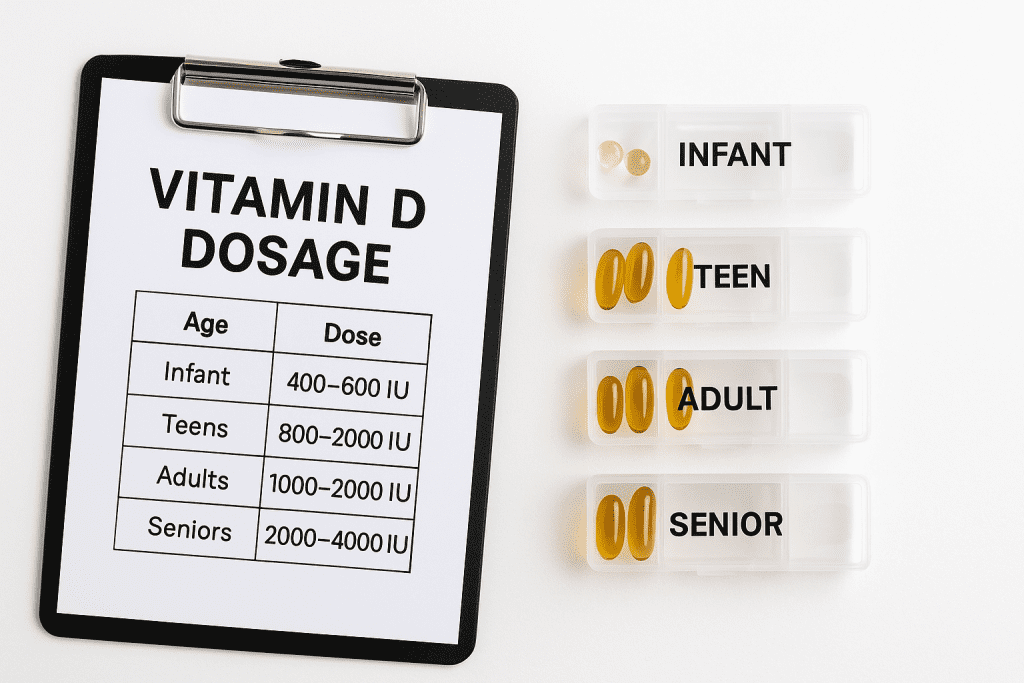
Because vitamin D is fat-soluble, pairing it with a meal containing dietary fat can improve absorption. Many people prefer taking it with breakfast or lunch for routine anchoring. Consistency matters more than perfection; taking the dose most days tends to outperform sporadic “catch-up” use.
Some individuals split doses to reduce gastrointestinal discomfort—though the main driver is likely ensuring adequate absorption and maintaining steady blood levels. When using higher doses, a clinician may recommend a structured schedule rather than indefinite daily high intake.
Safety considerations and when to involve a professional
Safety is not a footnote. People with kidney disease, a history of kidney stones, disorders of calcium regulation, or those taking medications that influence calcium or vitamin D metabolism should seek guidance before high-dose supplementation. Also, if you take other supplements that contain vitamin D, your total intake may be higher than you realize.
If using 5000 IU, monitoring becomes especially relevant. A plan that includes baseline testing and follow-up can transform high-dose use from guesswork into targeted therapy. Even lower doses can be inappropriate for certain individuals, particularly if their vitamin D status is already adequate.
Putting it all together: the “right dose” is the dose that meets your goal
600 IU often suits maintenance and cautious support. 1000 IU is a steady upgrade for many people with limited sun exposure. 2000 IU frequently aligns with insufficiency risk or winter recovery strategies, ideally with awareness of testing and follow-up. 5000 IU belongs to a more careful category—typically reserved for confirmed deficiency or structured medical guidance.
In the end, the most effective vitamin D dosage is not the highest number you can take—it’s the dose that restores or maintains healthy status safely, consistently, and with measurable progress where it matters most.