Winter has a way of turning familiar physiology into a quiet mystery. Days shorten. Streets grow dimmer. Ultraviolet (UV) light thins into a pale echo. And with that seasonal dimming comes what many people describe—sometimes too casually—as a “vitamin D collapse.” But the real story is more elegant, more mechanical, and far more interesting than a simple shortage. It’s a shift in geometry: the angle of the sun, the choreography of photons through the atmosphere, and the skin’s ability to translate light into chemistry. When you view winter vitamin D through the lens of UVB angles, the season stops feeling like an enemy and starts resembling an intricate set of constraints—and opportunities.
What “Collapse” Really Means: Not Vanishing, Just Misfiring
The word “collapse” implies abrupt failure, like a system shutting down. In reality, winter often triggers a gradual miscalibration. Your skin may still be capable of synthesizing vitamin D, but the inputs are wrong. UVB photons—specifically the band of ultraviolet light that drives the conversion of 7-dehydrocholesterol into previtamin D—arrive with reduced effectiveness.
Think of it as a tuning fork. The instrument (your skin) remains intact. The sound (UVB intensity and quality) changes. As a result, vitamin D production drifts downward. Shorter daylight isn’t the only culprit; the angle at which UVB enters the atmosphere dictates how much gets absorbed or scattered before it reaches you.
UVB Angles: The Sun’s Pitch, the Atmosphere’s Filter
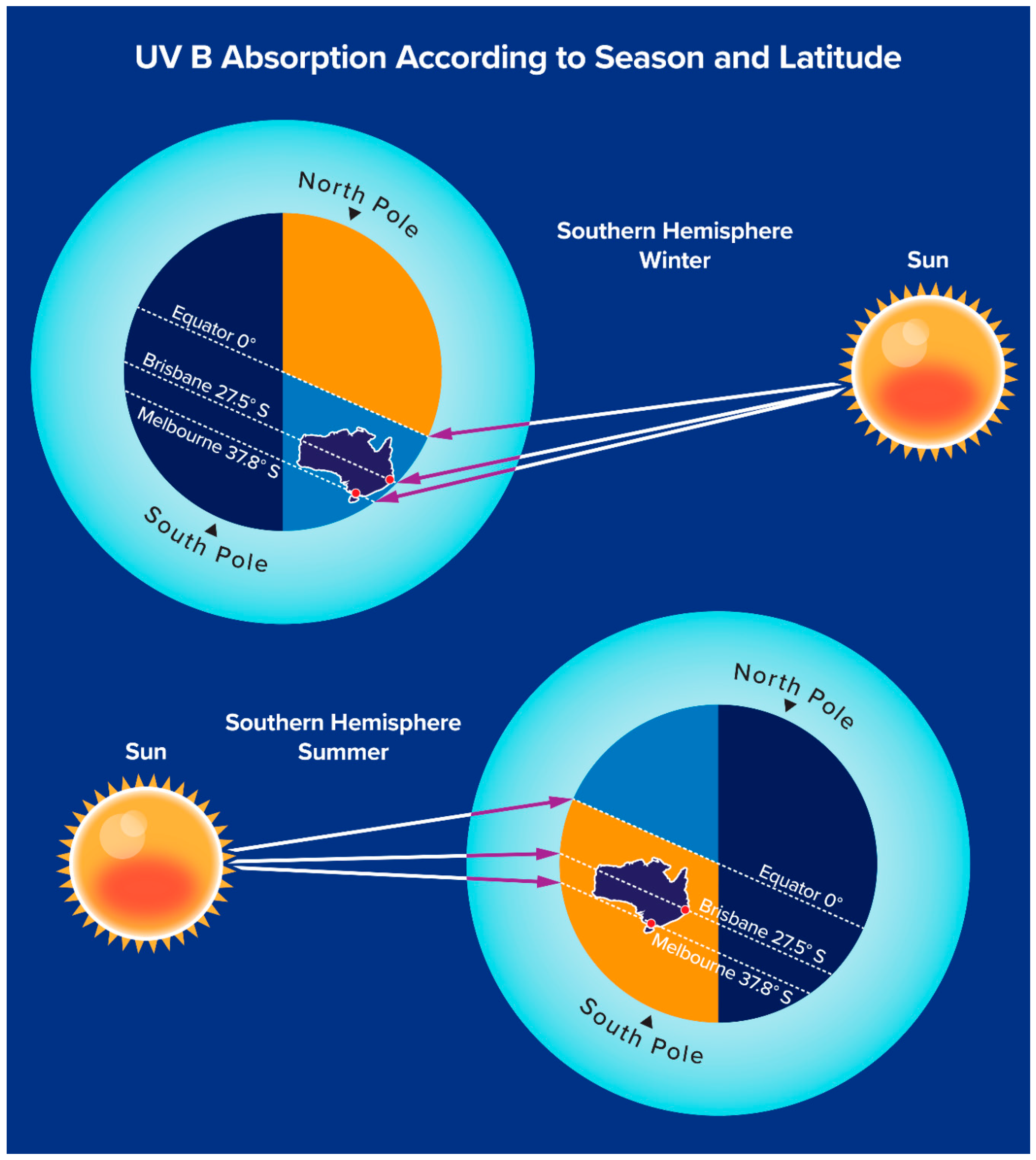
Angle is destiny here. When the sun sits low in the sky, sunlight travels a longer path through the atmosphere. That extra distance encourages scattering and absorption, especially for UVB wavelengths. In plain terms: winter sunlight is like a signal passing through a thicker curtain.
UVB angles also influence the “usefulness” of the remaining light. Even when UV levels are not zero, the proportion that falls into the UVB range can be insufficient for robust vitamin D synthesis. The result can feel paradoxical: bright winter daylight might look sunlit, yet it produces little biochemical output.
This is why some people can spend time near windows or outdoors and still experience low vitamin D status. The atmosphere has already done the pruning before the light ever reaches the skin.
Atmospheric Geometry: Scattering, Absorption, and the Long Walk of Photons
The atmosphere is not a neutral medium—it’s an engineered adversary for certain wavelengths. Molecules scatter light in ways that reshape what arrives at ground level. Meanwhile, ozone and other atmospheric constituents absorb portions of the UV spectrum. When the sun’s elevation drops, UVB photons endure a harsher journey.
Clouds add another layer of variability. A cloudy day can be more complex than “less sun.” UVB levels can fluctuate with cloud thickness and type, producing inconsistent exposure. And snow, with its reflective surface, can brighten surroundings—yet reflection doesn’t fully compensate for the angle and atmospheric filtering that limits UVB penetration.
In winter, the problem is often not simply “how much light,” but “how photons behave” on their route. Curiosity helps here: ask not only when you’re outside, but what the sky is doing with the spectrum.
Skin as a Converter: Chemistry That Depends on Specific Light
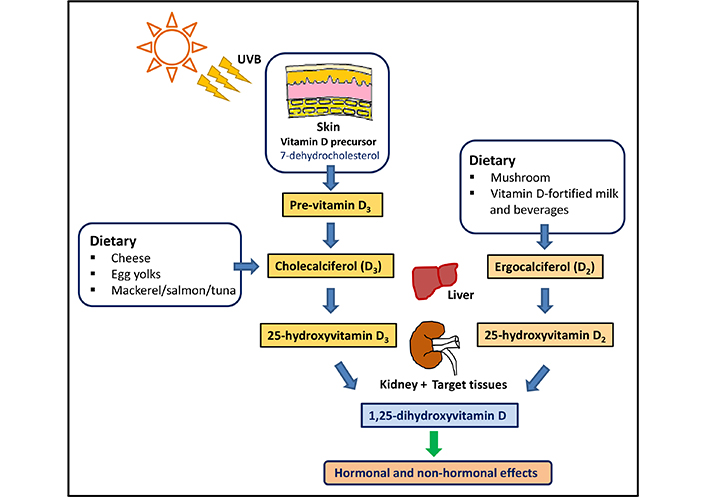
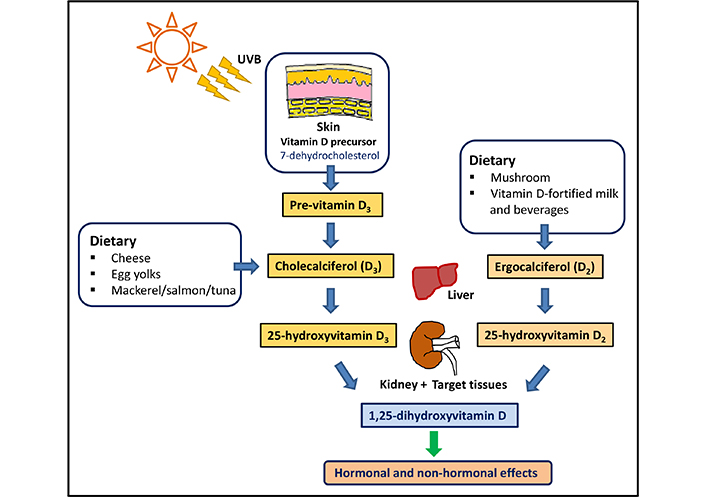
Human skin is a photochemical workshop. Beneath its surface, 7-dehydrocholesterol waits for UVB to trigger conversion into previtamin D, which then becomes vitamin D3. This pathway is remarkably responsive—until the right photons are scarce.
Not all skin behaves the same under winter conditions. Factors such as melanin concentration, epidermal thickness, and surface properties can alter how efficiently UVB triggers the pathway. Darker skin typically requires more UVB exposure to produce comparable vitamin D levels, and in winter—when UVB angles are unfavorable—that threshold may become difficult to reach.
Also, the duration of exposure is not the whole story. The same time outside can yield different biochemical results depending on season, latitude, and cloud cover. The body doesn’t count “sunlight hours” so much as it counts the usable chemistry-completing photons.
Latitude and Season: Why Winter Feels Personal
Winter vitamin D collapse is not uniform across the globe. The farther from the equator you live, the more dramatic the sun-angle shift. UVB angles become persistently shallow, compressing the window of effective UVB exposure. That’s why winter can feel like a cliff in northern latitudes and a gentler slope elsewhere.
Even within the same region, differences matter. Urban canyons, air pollution, and seasonal haze can further reduce UVB reaching the skin. Your environment becomes part of the equation.
Here’s a shift in perspective: consider winter not as a single event, but as a geometric regime. The sun’s relationship to your location changes the spectrum you receive—day after day, week after week.
Clothing and Distance: When “Outside” Still Isn’t UVB-Accessible
Another misconception is assuming that being outdoors automatically equals meaningful vitamin D synthesis. Most winter clothing acts as a UVB gatekeeper. Even if UVB levels are present, fabric coverage can prevent photons from reaching the skin where the conversion happens.
Body regions matter. Exposed forearms and hands can contribute more than fully covered areas, yet winter habits often maximize coverage for warmth. The body’s priorities—thermal comfort and protection—collide with photobiology.
Then there’s the matter of proximity to glass. Many windows filter UVB. So “sunlight indoors” may be bright and enjoyable while remaining chemically underpowered for vitamin D production.
Indoor Alternatives: Light Quality Versus Light Drama
If winter UVB access is constrained by angle and atmospheric filtering, what happens when people try to substitute with indoor light?
Not all “light therapy” is created equal. The spectrum and bandwidth determine whether the exposure can drive vitamin D synthesis. Visible brightness is not a reliable indicator of UVB content. Some indoor lighting feels intense but does not provide the wavelength specificity needed for the skin’s vitamin D pathway.
This is where curiosity becomes practical. Ask a better question: not “Is it sunny?” but “Does it deliver UVB wavelengths in a controlled, physiologically meaningful dose?” The distinction matters because indiscriminate UV exposure can pose risks, whereas targeted strategies focus on benefits.
Health Ripples: Vitamin D Status as a Systemic Conversation
Vitamin D is often described in single terms—bone health, immunity, mood. But it functions as a hormone-like regulator influencing multiple biological pathways. In winter, when levels tend to drop, several systems may feel the downstream effect.
Some shifts are subtle: changes in musculoskeletal comfort, fatigue, or vulnerability to seasonal respiratory illnesses. Others are more pronounced in individuals already at risk due to limited sun exposure, dietary insufficiency, darker skin pigmentation, older age, obesity, or certain medical conditions.
Winter vitamin D collapse is therefore not merely a number on a lab report. It’s an upstream change that can reframe how the body manages calcium handling, inflammatory signaling, and cellular regulation.
Promises and Pitfalls: The Allure of Fixes
The internet is full of promises: “Just get more sun,” “supplements solve everything,” “UVB is either miracle or menace.” Reality is more nuanced.
Sun exposure is constrained in winter not only by time indoors and outdoor habits, but by UVB angles and atmospheric absorption. Supplements can help, yet they are not one-size-fits-all. Dose selection ideally considers baseline vitamin D status, diet, body composition, and individual risk factors.
A powerful perspective shift is this: instead of chasing a mythic “perfect winter sun,” consider a coordinated strategy—dietary intake, safe supplementation when appropriate, and realistic exposure within seasonal constraints. The goal isn’t spectacle. It’s physiological continuity.
How to Think Like a Photobiologist: Practical Curiosity for Winter
Imagine you’re planning a science experiment with your own body as the test site. Winter doesn’t offer unlimited control, but it does offer variables you can manage: clothing choices (even small changes in exposed skin area), timing (midday tends to maximize sun angle when possible), and lifestyle patterns (brief outdoor exposure versus prolonged indoor routines).
Also, monitoring can sharpen decisions. When appropriate, checking vitamin D levels—paired with guidance—can convert uncertainty into clarity. The aim is not obsession. It’s calibration.
And perhaps the most useful curiosity is this: treat winter as a predictable optical problem. The UVB angles change. You can respond with informed adjustments rather than vague hope.
A New Winter Narrative: From Deficit to Design
Winter vitamin D collapse doesn’t have to be a story of deprivation. It can be a story of design—understanding how photons move, how skin converts, and why geometry matters. UVB angles become a compass: not a warning label, but a map of why certain seasons require different strategies.
When you adopt that viewpoint, winter shifts from an unavoidable enemy to a solvable puzzle. You start asking sharper questions. You stop relying on intuition alone. And you gain something valuable: agency grounded in the science of light.
The season remains cold. The atmosphere still filters. But your understanding warms up, piece by piece, until the “collapse” feels less like fate and more like physics—with a path forward.